

▶ Explore this week’s Tape — live, sortable, drill-down →
The AI Buildout Just Became a Credit Trade
Broadcom put up the best AI guidance in the semiconductor industry and lost five percent for it. Nobody who read the release thinks that was a demand problem. The buildout has passed the point where equity markets fund it, and what prices the chip names from here is whether somebody else’s lender says yes.
Start with the number that did the damage. Bank of America’s Tom Curcuruto put the financing requirement sitting behind the chip buildout at three-hundred-seventy billion dollars, and downgraded on XPU credit risk¹². Not on units. Not on the guide. Fifty-six billion of 2026 AI revenue, up a hundred and eighty percent³, was never in dispute. The bank asked who writes the checks and did not like the answer.
Three-hundred-seventy billion dollars.
That is the analytical move worth taking seriously, because it re-prices the whole complex. An order book is a claim on somebody else’s balance sheet. When the buyer is Alphabet, the claim is money good and the conversation stays boring. Alphabet’s own filings show AI purchase commitments going from three-hundred-thirty-two billion at the end of the first quarter to eight-hundred-eleven billion by the end of the second⁴, with capex guided to one-ninety-five to two-oh-five billion and free cash flow explicitly taken negative to fund it⁵. Alphabet can carry that. The question was never Alphabet. The question is the tier underneath: the neoclouds, the sovereign projects, the model labs whose GPU orders are contracted against capital they have not raised yet.
The last time the equipment cycle outran its customers’ ability to pay, the vendors solved it themselves. Lucent and Nortel financed the competitive carriers buying their gear, booked the revenue, and carried the receivable. When the carriers could not refinance in 2001, the write-downs landed on the vendors’ own income statements. Ugly, and useful, because you could see it coming in the filings. The receivable line moved first.
This cycle solved the same problem in a way that removes exactly that tell. The credit is not on the vendor’s books. It is syndicated out to private capital, which is what Nvidia’s five-hundred-billion-dollar third-party financing platform with Apollo, BlackRock, Blackstone, Brookfield, Goldman Sachs and KKR is actually for⁶. Hunt, Jason and Mike took that apart on Wednesday’s show from the supply side. Read it from the credit side and it is the more interesting object: the vendor arranging the loan without holding the loan. Revenue converts to cash on delivery, and the duration risk sits with somebody whose marks nobody publishes quarterly. There is no receivable line to watch, because there is no receivable.
Which is why Intel is the honest data point of the week. A company that needed twenty billion dollars to fund AI capacity went and sold common stock at ninety-five a share to get it⁷, upsized from fifteen. That is what it looks like when the credit window is not the cheapest window available to you. The cashflow read is in Marcus’s column below, short version, the memo has the whole complex priced as though the funding is settled. Page one of the Cash Flow Memo has Alphabet at roughly fifty-six billion of trailing free cash flow against a hundred and thirty-two billion of trailing capex⁸⁹. The buildout is already being paid for out of somebody’s balance sheet. The only live question is whose, and at what spread.
What changes the read. The disclosure that matters on Broadcom’s next print is customer concentration, not the AI revenue guide. If the ten-K names the XPU customers and they are all investment grade, the BofA cut ages badly. If the concentration line stays vague, the three-hundred-seventy billion is not a modeling assumption, it is a gap. Nvidia reports Wednesday the twenty-sixth¹⁰, and the tell there is the same one: financed demand versus funded demand, and whether management will separate them out loud. Watch private credit spreads on data-center paper alongside the print. Those two things now move the semis together, and the thesis breaks the first quarter they diverge.
Wall Street’s consensus on the AI financing question: the demand is real, so the money will be there. The demand was real in 1999 too. It was the money that stopped.
The Tape — W2633
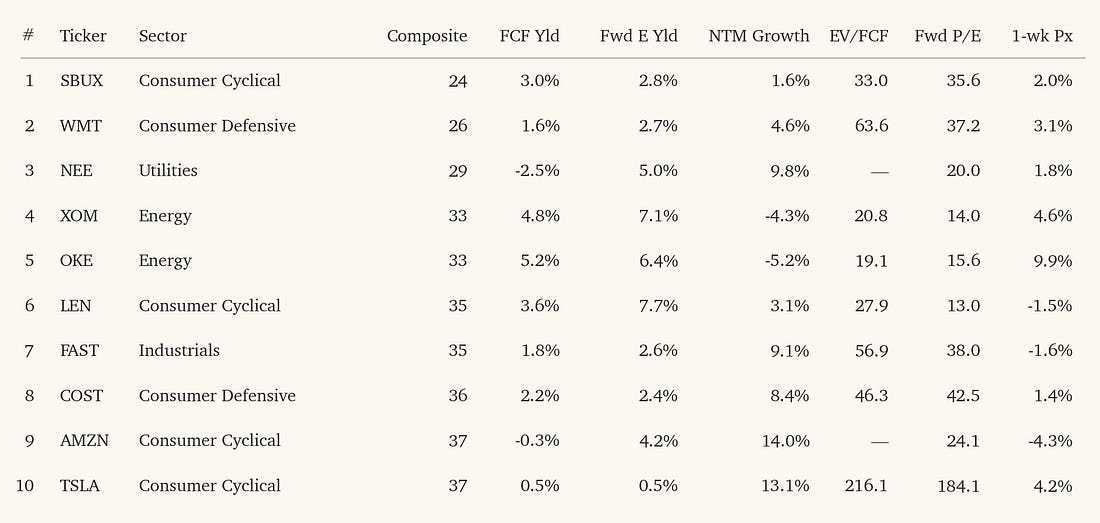
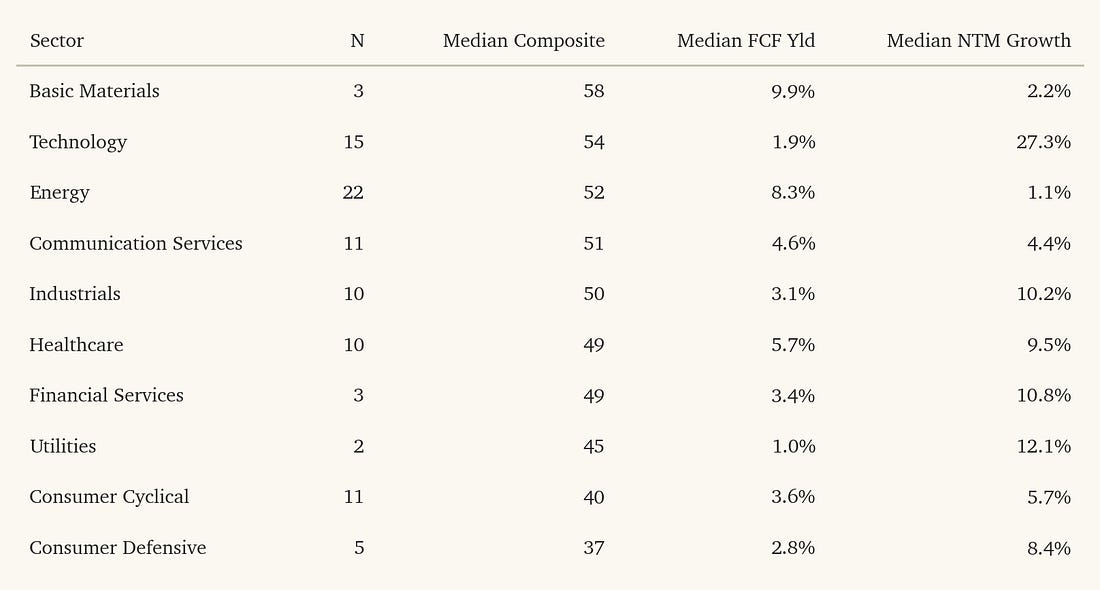
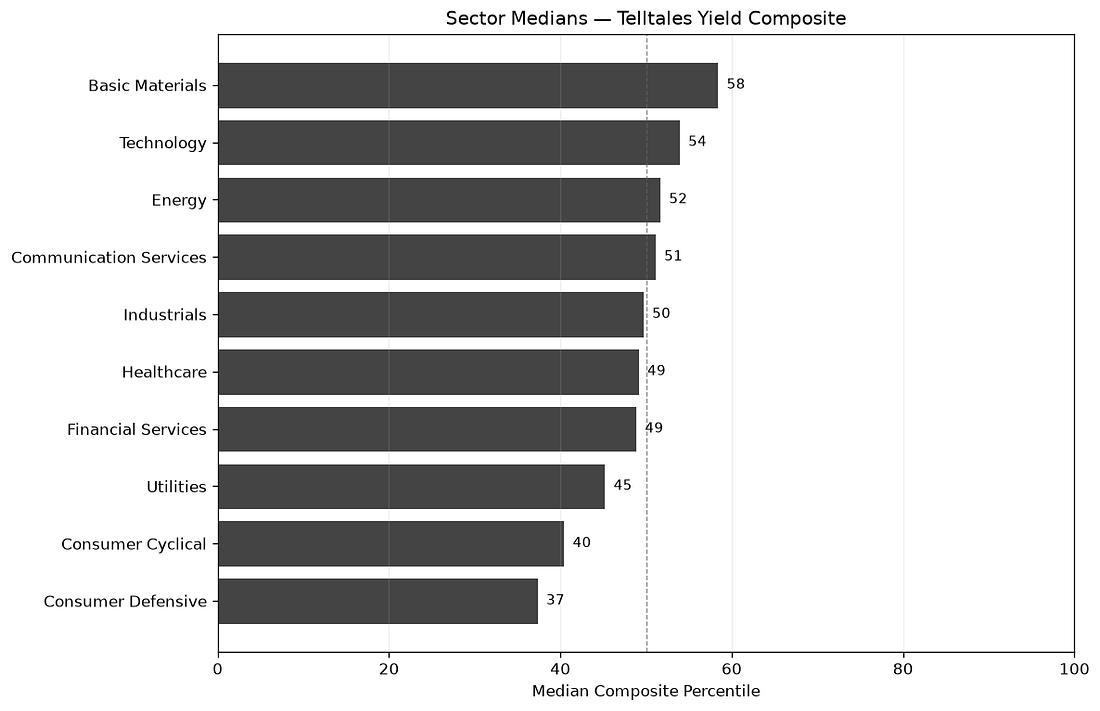
Universe of 94 cashflow-memo names, snap dates 2026-08-07 → 2026-08-14. Composite is rank-sum percentile of FCF Yield + NTM Revenue Growth (higher = better balance). Banks and finance-book names shown separately.
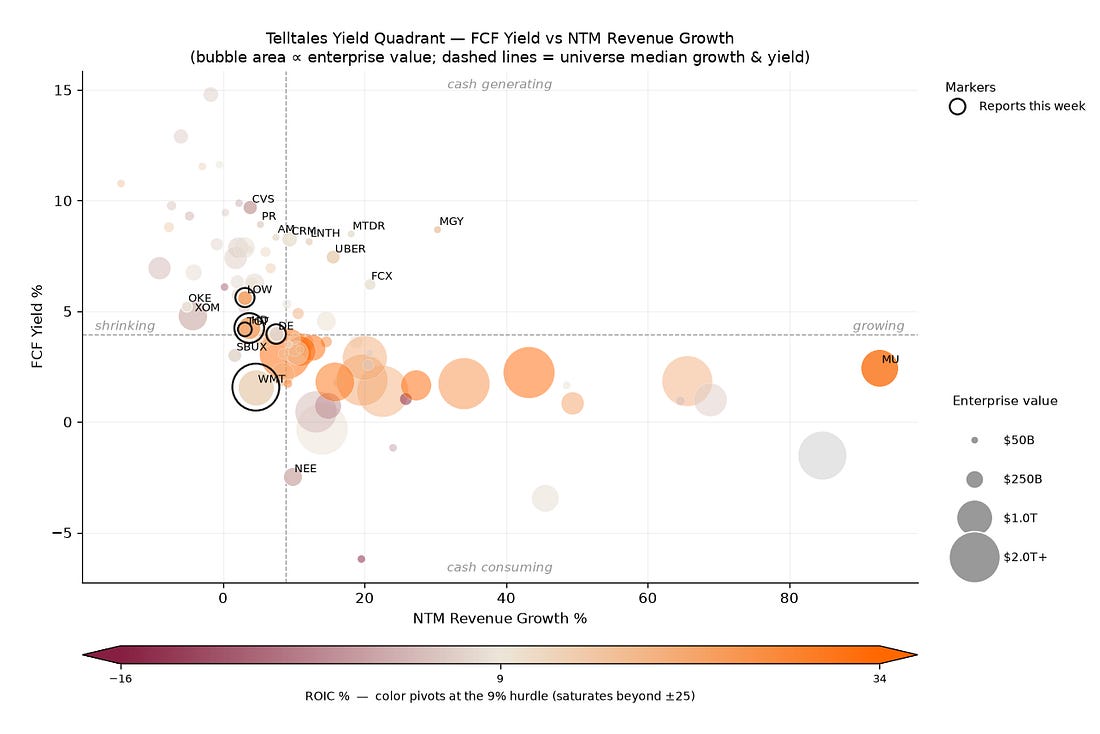
Telltales Yield — Top 10
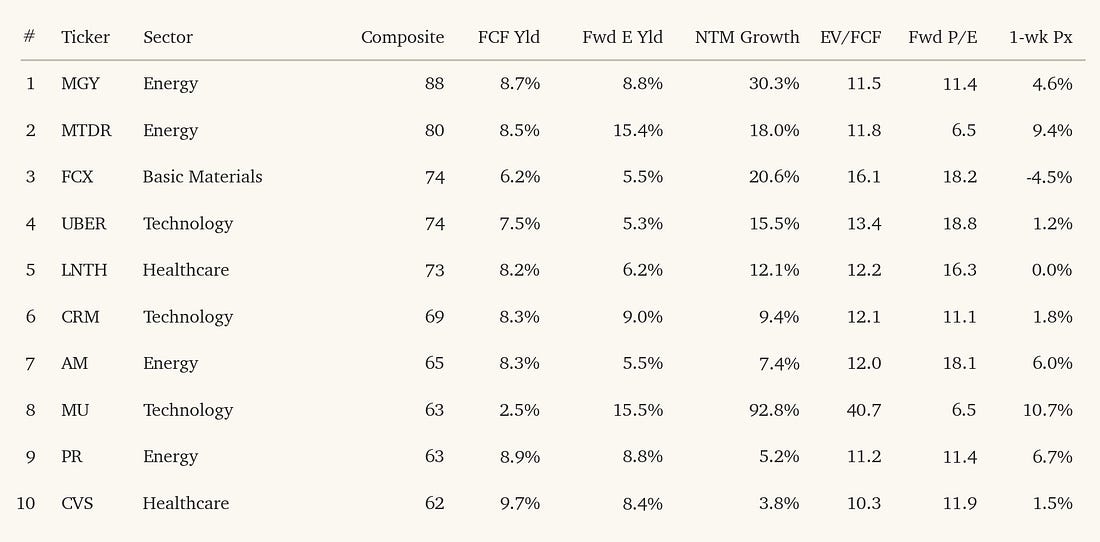
From the Cashflow Desk — Marcus Graham
Micron is the one line on this table where two multiples describe two different companies. Forward P/E of 6.5 says the market has already called the top of the memory cycle. EV/FCF of 40.7 says the cash from this cycle has not arrived yet. Both can be true for another quarter or two, and NTM revenue growth of 92.8% is the only thing reconciling them. Consensus reads the 6.5 as cheap. It is not cheap, it is a peak-earnings multiple behaving the way peak-earnings multiples behave, and the composite here is carried by the growth leg, not the cash leg. The test on the next print is whether free cash flow converges toward earnings or the gap holds open on capex. I read it as roughly 60/40 that it closes.
Telltales Yield — Bottom 10
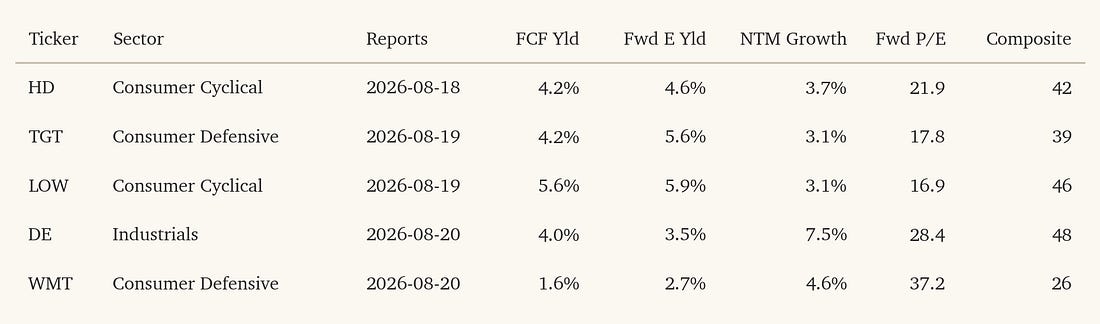
This Week’s Reporters
Sector Medians
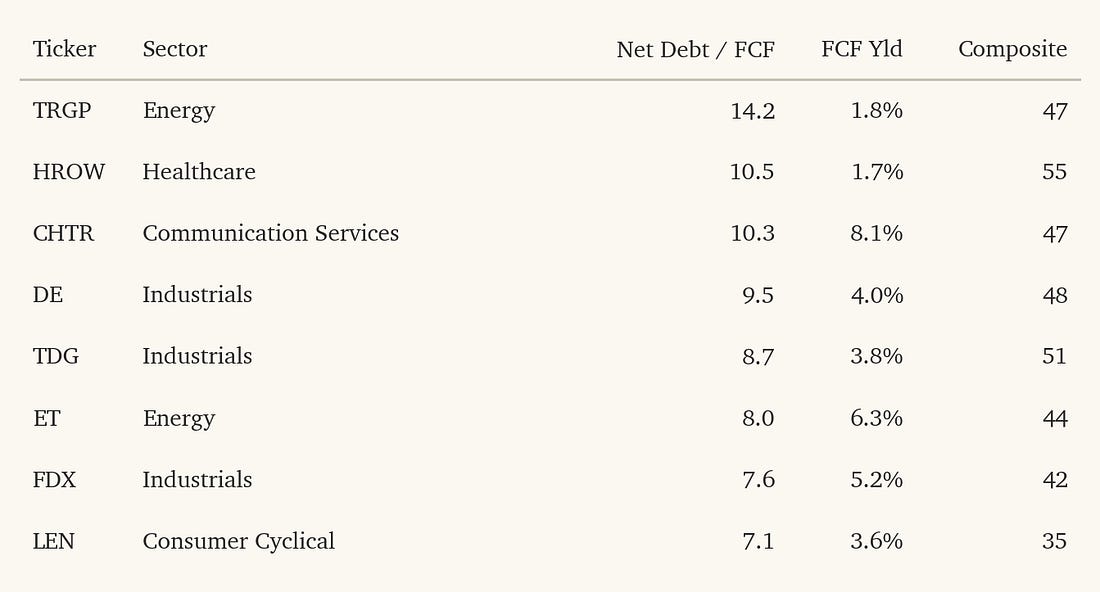
Debt / FCF Watch (highest leverage on TTM FCF)
Weekly Price Movement
Top 5 (week-over-week price) 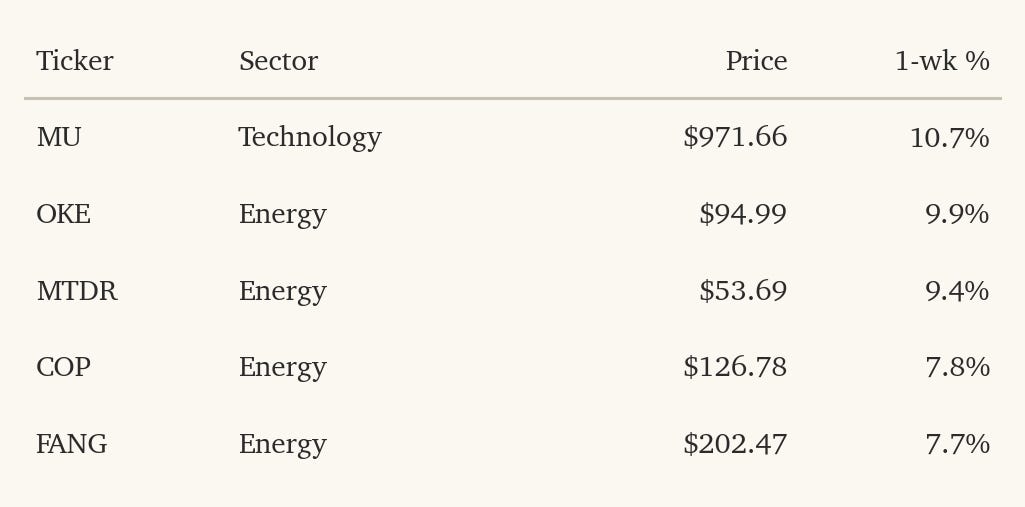
Bottom 5 (week-over-week price) 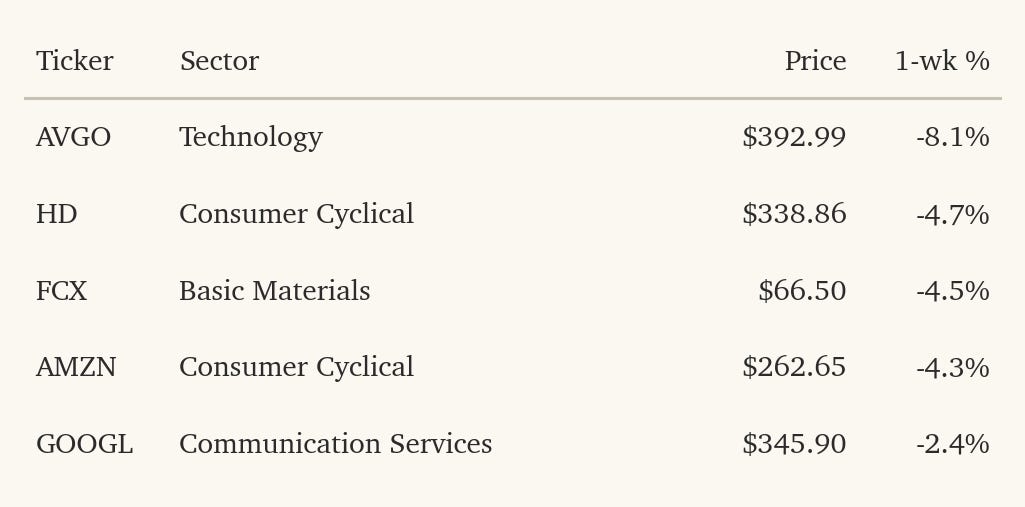
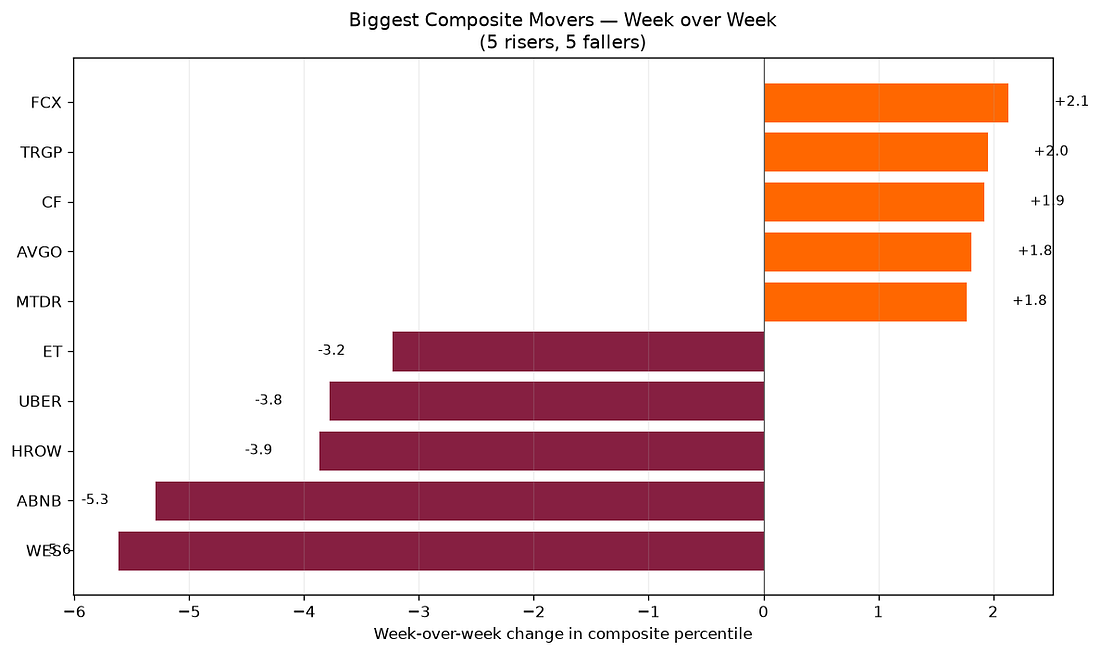
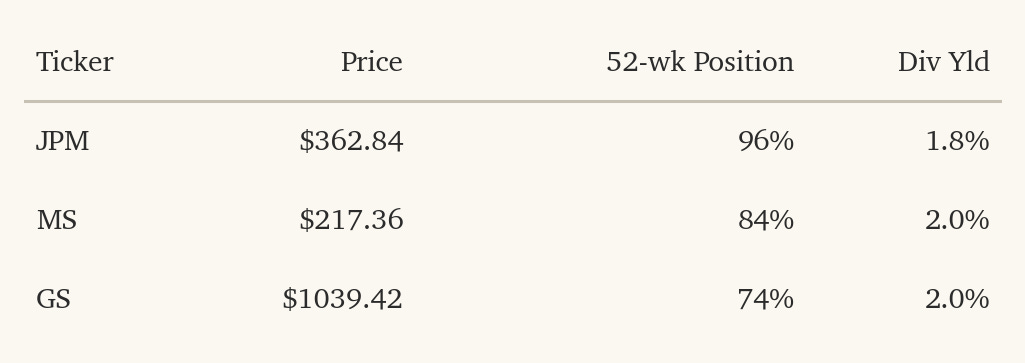
Banks (shown separately — FCF metric not meaningful)
Finance-book — FCF not comparable
Customer-float / captive-finance / reserve businesses (IBKR broker float, KMX CarMax Auto Finance, PYPL customer funds, CRCL stablecoin reserves). The memo’s operating-FCF method overstates their FCF, so they are held off the ranked leaderboard pending the P&L-waterfall rebuild. 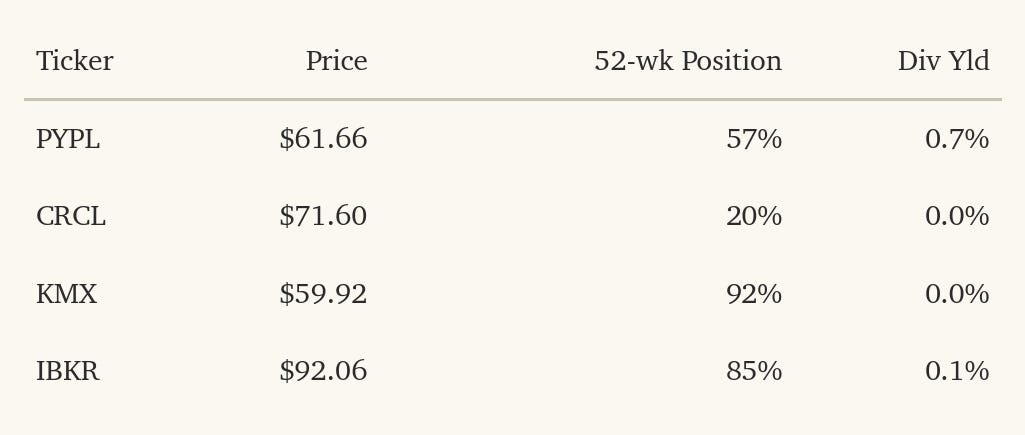
Data Gaps
90 of 92 ranked-eligible names ranked. 2 dropped for missing FCF yield or NTM revenue growth; 7 shown separately (banks + finance-book, FCF not comparable).
Source: cashflow-memo master_2026-08-14.csv. NTM growth from analyst-estimates consensus. Composite is a percentile rank, not a recommendation.
The Issue — This Week's Brief

The Cashflow Memo
Who’s Paying For It
The AI buildout outgrew its own cash flow, and this week the invoices got itemized.
The Telltales Weekend Update. Ava Cabot and analyst Marcus Graham walk through what happened this week — and what’s coming next — across the 86 companies in the Cash Flow Memo. About 14 minutes. No filler.
Download the memo at telltales.us. Hunt, Jason, and Mike are back Wednesday on episode E2634.
Chapter markers
Time | Segment
0:00 | Cold open — the buildout outran the cash flow
0:45 | Theme — who’s paying for it: Alphabet, Broadcom, Intel
4:45 | Deep dive — Apple: Cook hands over the margin
8:45 | Rapid fire — PayPal, Eli Lilly, Snowflake, Microsoft
11:45 | Close — Consensus Watch and the forward week
12:40 | Closing disclaimer
Full transcript
Cold open
Ava: The AI buildout has officially outrun free cash flow. This week three companies showed you how they intend to cover the gap. Alphabet is covering it with commitments. Broadcom is covering it with somebody else’s credit. Intel covered it by printing $20 billion of new stock in a single week. And the largest company in the memo, which is not building any of it, is paying for it anyway, out of gross margin, in the same week it changed CEOs. Somebody always pays. This week the invoices got itemized.
Ava: Telltales Weekend Update. I’m Ava Cabot, with Marcus Graham at the cashflow desk.
Theme — who’s paying for it
Ava: Alphabet on page 1, Broadcom on page 2, Intel on page 3. Three pages of the Cash Flow Memo, one problem. Start with Alphabet, because Alphabet stopped being a cash-generative company this quarter and told you so in writing. AI purchase commitments went from $332.4 billion at the end of the first quarter to $811 billion by the end of the second[^news-googl-commitments-20260814]. In one quarter. Capital expenditure guidance for the full year moved to $195-205 billion, and Alphabet said plainly that this takes free cash flow negative[^news-googl-capex-20260814]. And in the same week the world found out that Berkshire Hathaway spent the quarter buying it, lifting its stake 83% to nearly 106 million shares, about $37.8 billion, now a top-three Berkshire holding[^news-googl-berkshire-20260814][^news-googl-berkshire-stake-20260814]. Marcus, what does Buffett see that the free cash flow line doesn’t?
Marcus: Alphabet stopped being a cash machine on purpose, and that’s a defensible thing to do once. The memo has capex running about $132 billion trailing twelve months[^memo-googl-capex-20260814] against roughly $56 billion of trailing free cash flow[^memo-googl-fcf-20260814]. Then they guided capex to $195-205 billion for the year[^news-googl-capex-20260814]. When you spend at that rate free cash flow goes negative, and that’s the cost of the build, not a flag. Which means the multiple isn’t the right frame on this name right now. What actually prices Alphabet is whether that commitment book converts into revenue that clears the depreciation it just bought. I’d hold that read until the December quarter shows an operating margin with the new asset base in it.
Ava: There is one more line in Alphabet’s filings worth sitting with. More than 70% of net income last quarter came from investments in other companies, largely Elon Musk’s SpaceX[^news-googl-spacex-income-20260814]. Alphabet disclosed a 7.2% stake in SpaceX Class A stock — 551.2 million shares across Alphabet, XXVI Holdings and Google[^news-googl-spacex-stake-20260814]. The search company’s earnings quality this quarter is a rocket company. Now Broadcom, which had the opposite kind of week: the numbers were excellent and the stock fell anyway. AI revenue guidance for 2026 of $56 billion, up 180%. Quarterly revenue of $22.2 billion, up 48%. EPS of $2.44 against $2.40 consensus[^news-avgo-ai-guidance-20260814]. AI semiconductor revenue alone hit $10.8 billion in the quarter, up 143%[^news-avgo-ai-guidance-20260814]. The stock finished down nearly 5%[^news-avgo-drop-20260814].
Marcus: Broadcom’s problem isn’t demand. It’s who funds the customer. Bank of America didn’t cut the revenue line, it cut the credit — analyst Tom Curcuruto put the financing requirement behind that chip buildout at $370 billion[^news-avgo-financing-20260814], and downgraded on XPU credit risk[^news-avgo-bofa-cut-20260814]. The memo has Broadcom at about 54x trailing free cash flow[^memo-avgo-evfcf-20260814] on $36 billion of trailing FCF[^memo-avgo-fcf-20260814]. That is a price that assumes every one of those customers can pay for what they ordered. The disclosure I’d watch next print is customer concentration, not the revenue guide.
Ava: The order book is only as good as the balance sheet on the other end of it. Which brings us to Intel, which did not wait for anybody else’s balance sheet. Intel announced a $15 billion common stock offering and then upsized it to $20 billion, at $95 a share, to fund AI capacity[^news-intc-offering-20260811]. Marcus — what does that raise tell you about Intel’s own cash flow?
Marcus: That management doesn’t think it has any. $20 billion of equity[^news-intc-offering-20260811] against about $4 billion of trailing free cash flow[^memo-intc-fcf-20260814] and $12 billion of trailing capex[^memo-intc-capex-20260814]. Everything this company generates in a year, raised in a week and sold to strangers, and it still doesn’t cover the spend. At that free cash flow level the multiple is noise, so don’t use it. What decides this is whether the foundry customers behind the raise are contracted or hoped for, and Intel hasn’t told you which.
Deep dive — Apple
Ava: Apple is the other name on page 1, and Apple is the one company in this conversation that could write the check for all of it and has decided not to. Tim Cook steps down as chief executive on September 1. John Ternus takes the job. Cook becomes Executive Chairman[^news-aapl-ceo-transition-20260814]. Twenty-five years, and the handoff lands in the middle of a quarter that split cleanly down the middle: revenue of $109.4 billion, up 16%, EPS up 29% — and the stock down 5%[^news-aapl-q3-earnings-20260814].
Marcus: Apple is funding the AI era by declining to participate in it, and the cash flow statement has never looked better for it. The memo has Apple at about 32x trailing free cash flow[^memo-aapl-evfcf-20260814], a 3.1% free cash flow yield[^memo-aapl-fcfyield-20260814], on $137 billion of trailing free cash flow[^memo-aapl-fcf-20260814]. That is a business getting better at turning revenue into cash while the story around it gets worse. The quarter is fine. The guide is where the argument is.
Ava: And the guide is where it went wrong. Apple told the Street to expect 9% to 11% revenue growth in the September quarter, against consensus above 12%[^news-aapl-q4-guidance-20260814]. Gross margin is guided to slip to 47%-48%, from roughly 50% in June[^news-aapl-margin-guidance-20260814]. Jefferies had already cut the stock to a sell-equivalent rating four days earlier, taking its target to $263.66 from $285.56, on supply-chain checks indicating the all-glass iPhone has been cancelled[^news-aapl-jefferies-target-20260810][^news-aapl-jefferies-downgrade-20260810].
Marcus: Here is the comparison the headlines missed. Apple spent about $10 billion on capital expenditure over the last twelve months[^memo-aapl-capex-20260814] and $82 billion buying back its own stock[^memo-aapl-buyback-20260814]. Alphabet, same page of the memo, same end market, spent $132 billion on capex over the same window[^memo-googl-capex-20260814]. One of them is buying capacity. The other is buying scarcity in its own shares. Both are coherent strategies and we find out which one was right somewhere around the end of the decade.
Ava: Two philosophies, one page. Marcus, on the margin guide specifically — cost or mix?
Marcus: I’d weight it as cost. 47%-48% against roughly 50% in June[^news-aapl-margin-guidance-20260814] is a guided step down, not a modeled one. Call it 70/30 that this is component cost and it persists into next year, rather than a one-product build expense that washes out. The December print is the test.
Ava: So the new chief executive’s first job is finding the margin his predecessor just gave away.
Marcus: And that’s the real succession risk, which is timing rather than strategy. Ternus is a hardware engineer inheriting a company whose next four quarters get decided by component prices and a single launch, with the market already paying about 33x forward earnings for the handoff[^memo-aapl-fwdpe-20260814]. Apple’s trailing revenue is $467 billion[^memo-aapl-revenue-20260814], so the margin step they just guided is somewhere around $9 billion a year of gross profit that has to come from somewhere else. I’d wait for the December print for real evidence, not the keynote.
Ava: Which is September 9, when Apple is expected to show the iPhone 18 Pro, the Pro Max, and an all-new foldable[^news-aapl-september-event-20260814]. Eight days after Ternus takes the chair. Cook spent his final weeks as CEO opening a manufacturing plant in Houston alongside Commerce Secretary Howard Lutnick[^news-aapl-houston-plant-20260814]. A supply-chain executive closing out a supply-chain career, handing the company to another supply-chain executive, at the exact moment the binding constraint stopped being supply and started being what supply costs.
Rapid fire
Ava: Rapid fire. Somebody finally put a price on PayPal. Stripe and the private-equity firm Advent International are in talks to buy it at $60.50 a share[^news-pypl-acquisition-talks-20260814]. The stock closed 1.9% above the bid[^news-pypl-bid-premium-20260814], which is the market’s way of saying the first number is not the last number. Going in, the memo had PayPal at 7.5x trailing free cash flow[^memo-pypl-evfcf-20260814] at a 13.4% free cash flow yield[^memo-pypl-fcfyield-20260814], on nearly $7 billion of trailing free cash flow[^memo-pypl-fcf-20260814]. And in the same week PayPal said it will cut roughly 20% of its workforce, about 4,800 people, over the next few years[^news-pypl-layoffs-20260814], while raising full-year adjusted EPS guidance to about $5.38[^news-pypl-guidance-raise-20260814]. A 13% yield and a 20% headcount cut is what a company looks like once it has quietly agreed the growth story is over and the cash is the story.
Ava: Eli Lilly put up a quarter that makes the rest of large-cap healthcare look sedentary. Second-quarter revenue of $22.97 billion, up 47.7%, beating consensus by 11.4%, with adjusted EPS of $8.38 against $6.58 expected[^news-lly-earnings-20260814]. Full-year EPS guidance went up nearly $3 at the midpoint, to $35.50-36.50[^news-lly-eps-guidance-20260813]. The oral GLP-1, Foundayo, took its first European approval in the UK[^news-lly-foundayo-approval-20260812], with weekly prescriptions at a new high of 29,388[^news-lly-foundayo-prescriptions-20260814]. And Lilly sued six companies over black-market sales of retatrutide, the obesity drug it has not launched yet[^news-lly-retatrutide-suits-20260812]. Suing counterfeiters of a product you cannot buy is its own kind of demand data. Lilly also agreed to acquire three vaccine biotechs — Curevo, LimmaTech and Vaccine Company — for up to $3.8 billion[^news-lly-vaccine-acquisition-20260814]. That is a company spending obesity money on vaccines, which is what you do when you have more cash than pipeline. The memo has Lilly at 55x trailing free cash flow[^memo-lly-evfcf-20260814] on $21 billion of trailing FCF[^memo-lly-fcf-20260814].
Ava: And Snowflake is being priced as though the AI-agent story is already settled. Oppenheimer took its target to $400 from $295, citing consumption trends and adoption of the company’s coding agent[^news-snow-oppenheimer-20260813]. Snowflake raised full-year guidance to about $7.65 billion[^news-snow-fy-guidance-20260813], on quarterly revenue of $1.39 billion, up 33%[^news-snow-q1-earnings-20260814]. The memo has Snowflake at 95x trailing free cash flow[^memo-snow-evfcf-20260814] on about $1.2 billion of trailing FCF[^memo-snow-fcf-20260814]. 95x. At that multiple the guidance is not a data point, it is the whole investment case.
Ava: And Microsoft told you what the buildout costs in a single line item. Net losses on its OpenAI investment reduced Microsoft’s net income by $3.1 billion and diluted EPS by $0.41 — that is Microsoft’s own investor-relations disclosure, not somebody’s estimate[^news-msft-openai-loss-20260810]. JPMorgan raised its price target to $625 from $550 in the same week, on 24x projected fiscal 2028 EPS[^news-msft-jpm-target-20260814]. The memo has Microsoft at 53x trailing free cash flow[^memo-msft-evfcf-20260814], on $70 billion of trailing FCF[^memo-msft-fcf-20260814] against $116 billion of trailing capital expenditure[^memo-msft-capex-20260814]. Microsoft is the only name in the memo paying for this buildout twice: once through its own capex, and once through its partner’s income statement.
Ava: Forward calendar. Home Depot Tuesday[^earn-hd]. Lowe’s and Target Wednesday[^earn-low][^earn-tgt]. Walmart and Deere Thursday[^earn-wmt][^earn-de]. The entire American consumer inside three days. And then the print that settles the argument in this whole show — NVDA, Wednesday the 26th[^earn-nvda]. We will take that one the weekend before it lands.
Close
Ava: That’s the show. Wall Street’s consensus on the AI trade this week: the demand is real, so the financing will sort itself out. Broadcom lost 5% finding out those are two separate questions.
Ava: The buildout has outrun free cash flow, and every name we covered this week is a different answer to who pays. Alphabet pays out of its own cash flow until there isn’t any. Broadcom is asking its customers’ lenders. Intel asked the equity market and got $20 billion. Microsoft is paying twice and disclosing both. And Apple, which isn’t building any of it, is still handing its new CEO two points of gross margin.
Ava: On Wednesday’s episode 2633, Hunt, Jason, and Mike took apart Nvidia’s $500 billion third-party financing platform[^ep-e2633] — the supply side of the exact question this show just spent 13 minutes on. Hunt, Jason, and Mike are back Wednesday on episode 2634.
Ava: Download the memo at telltales.us. 20 pages, every week. And send us feedback through the Substack. Every note gets seen.
Ava: The show is produced entirely with AI tools, and both voices you’re hearing are AI-generated.
Closing disclaimer
Ava: The following conversation is intended for informational purposes only. You should always do your own work to determine if an investment is suitable for you. The views expressed on this podcast are the host alone and do not constitute an offer to sell or a recommendation to purchase, or a solicitation of an offer to buy any security, nor a recommendation for any investment product or service. While certain information contained herein has been obtained from sources believed to be reliable, neither the host nor any of their employers or their affiliates have independently verified this information, and its accuracy and completeness cannot be guaranteed. Accordingly, no representation or warranty, express or implied, is made as to, and no reliance should be placed on, the fairness, accuracy, timeliness, or completeness of this information. The host and all employers and their affiliated persons assume no liability for this information and no obligation to update the information or analysis contained herein in the future, and may or may not hold positions in the securities mentioned.
Sources
Apple Inc. (2026, August 14). Apple CEO Tim Cook confirms John Ternus as new CEO on September 1. MacRumors. https://www.macrumors.com/2026/08/14/apple-ceo-tim-cook-reflects-on-legacy-apple/
Barchart. (2026, August 14). Oppenheimer just gave Snowflake stock a big vote of confidence. Barchart. https://www.barchart.com/story/news/3857783/oppenheimer-just-gave-snowflake-stock-a-big-vote-of-confidence
BigGo Finance. (2026, August 14). Hyperscaler purchase commitments surge past $1.5 trillion, led by Alphabet. BigGo Finance. https://finance.biggo.com/news/e321e44d-121e-4d0e-8c2d-47ad70fcff25
BigGo Finance. (2026, August 14). JPMorgan lifts Microsoft price target to $625 on AI infrastructure and Copilot profit potential. BigGo Finance. https://finance.biggo.com/news/f76980e4-671d-45a0-8b53-aa2d96cc789e
Breaking The News. (2026, August 14). Broadcom down nearly 5% amid BofA cut, exploit reports. Breaking The News. https://breakingthenews.net/Article/Broadcom-down-nearly-5-amid-BofA-cut-exploit-reports/66924839
CNBC. (2026, August 10). Apple is a sell, glass iPhone debut may be canceled, Jefferies says. CNBC. https://www.cnbc.com/2026/08/10/apple-is-a-sell-glass-iphone-debut-may-be-canceled-jefferies-says-.html
CNBC. (2026, August 10). Don’t let a Wall Street analyst’s downgrade of Apple scare you out of the stock. CNBC. https://www.cnbc.com/2026/08/10/dont-let-a-wall-street-analysts-downgrade-of-apple-scare-you-out-of-the-stock.html
CNBC. (2026, August 11). Intel upsizes stock offering to $20 billion at $95 per share as AI demand accelerates. CNBC. https://www.cnbc.com/2026/08/10/intel-intc-stock-offering-ai.html
CNBC. (2026, August 12). Eli Lilly’s weight loss pill Foundayo gets UK approval. CNBC. https://www.cnbc.com/2026/08/11/eli-lilly-weight-loss-pill-foundayo-gets-uk-approval-plus-oil-holds-back-stocks.html
CNBC. (2026, August 12). Lilly sues six companies over alleged illegal sales of experimental obesity drug retatrutide. CNBC. https://www.cnbc.com/2026/08/12/lilly-lawsuits-obesity-drug-retatrutide.html
CNBC. (2026, August 14). Apple’s Tim Cook joined by Howard Lutnick in opening Houston manufacturing plant. CNBC. https://www.cnbc.com/2026/08/13/apples-tim-cook-and-howard-lutnick-open-houston-manufacturing-plant.html
CNBC. (2026, August 14). Berkshire Hathaway boosts Alphabet to a top three holding, ups Delta and housing bets. CNBC. https://www.cnbc.com/2026/08/14/berkshire-hathaway-boosts-alphabet-to-a-top-three-holding-ups-delta-and-housing-bets.html
eciks.org. (2026, August 14). Broadcom guides $56B AI revenue for 2026, up 180% from prior year. eciks.org. https://eciks.org/21181-broadcom-avgo-ai-revenue-guidance-2026
Fierce Pharma. (2026, August 14). The oral GLP-1 tracker: Novo’s Wegovy pill vs Lilly’s Foundayo. Fierce Pharma. https://www.fiercepharma.com/pharma/oral-glp-1-tracker-launch-trajectories-lilly-foundayo-novo-wegovy-pill
Forbes. (2026, August 14). iPhone 18 Pro event tipped as Apple shifts key release schedule date. Forbes. https://www.forbes.com/sites/davidphelan/2026/08/14/iphone-18-pro-event-tipped-as-apple-shifts-key-release-schedule-date/
MarketScreener/Reuters. (2026, August 14). Alphabet becomes Berkshire Hathaway’s third-largest investment. MarketScreener. https://www.marketscreener.com/news/alphabet-becomes-berkshire-hathaway-s-third-largest-investment-ce7859dfdb8ef224
Microsoft Corporation. (2026, August 10). FY26 Q1 — Performance [Investor relations disclosure]. Microsoft Investor Relations. https://www.microsoft.com/en-us/investor/earnings/fy-2026-q1/performance
MM&M Online. (2026, August 14). Rx Rundown: KKR, Eli Lilly, Procter & Gamble and more. MM&M Online. https://www.mmm-online.com/news/rx-rundown-kkr-eli-lilly-procter-gamble-and-more/
Panda Forecast. (2026, August 14). GOOG Stocktwits, news and mentions. Panda Forecast. https://pandaforecast.com/company-news/?ticker=goog
Space Exploration Technologies Corp. (2026, August 14). Schedule 13G — passive investment disclosure (Alphabet, XXVI Holdings, Google; 7.2% of SpaceX Class A) [SEC filing]. Stock Titan. https://www.stocktitan.net/sec-filings/SPCX/schedule-13g-space-exploration-technologies-corp-passive-investment-d-8e184da44355.html
TechCrunch. (2026, August 14). Talks to sell PayPal to Stripe and Advent are heating up. TechCrunch. https://techcrunch.com/2026/08/14/talks-to-sell-paypal-to-stripe-and-advent-are-heating-up/
The New York Times. (2026, August 14). Amazon and Alphabet’s profits reveal circular nature of A.I. boom. The New York Times. https://www.nytimes.com/2026/08/14/business/ai-tech-profits.html
Ts2.tech. (2026, August 14). PayPal stock closes 1.9% above $60.50 bid as talks continue. Ts2.tech. https://ts2.tech/en/paypal-stock-closes-1-9-above-60-50-bid-as-talks-continue/
Watcher Guru. (2026, August 14). Should you buy Apple stock after its 5% post-earnings drop? Watcher Guru. https://watcher.guru/news/should-you-buy-apple-stock-after-its-5-post-earnings-drop
Yahoo Finance. (2026, August 13). Eli Lilly (LLY) Q2 2026 earnings call transcript. Yahoo Finance. https://finance.yahoo.com/healthcare/articles/eli-lilly-lly-q2-2026-032008362.html
Yahoo Finance. (2026, August 13). Oppenheimer revamps Snowflake stock target for 2026. Yahoo Finance. https://ca.finance.yahoo.com/news/oppenheimer-revamps-snowflake-stock-target-200242396.html
Yahoo Finance. (2026, August 14). 5 revealing analyst questions from Eli Lilly’s Q2 earnings call. Yahoo Finance. https://finance.yahoo.com/markets/stocks/articles/5-revealing-analyst-questions-eli-054900384.html
Yahoo Finance. (2026, August 14). Apple dropped by 5% after earnings. Yahoo Finance. https://finance.yahoo.com/markets/stocks/articles/apple-dropped-5-earnings-history-105000023.html
Yahoo Finance. (2026, August 14). Broadcom plunges 5% as its AI boom faces a $370 billion financing question. Yahoo Finance. https://finance.yahoo.com/technology/ai/articles/broadcom-plunges-5-ai-boom-170842189.html
Yahoo Finance. (2026, August 14). Tech layoffs 2026: Tracking all of the job losses across TikTok, Microsoft, Meta, Oracle, Samsung, Zillow and others. Yahoo Finance. https://tech.yahoo.com/general/article/tech-layoffs-2026-tracking-all-of-the-job-losses-across-tiktok-microsoft-meta-oracle-samsung-zillow-and-others-144545528.html
ZoomInfo. (2026, August 13). Snowflake — Overview, news & similar companies. ZoomInfo. https://www.zoominfo.com/c/snowflake-computing/367752085
Internal data
Internal data is provided on a best efforts basis.
Earnings slate
Forward earnings dates are sourced from the W2633 earnings slate, pulled 2026-08-14. See 04. Publishing/shows/weekend-update/W2633/dryrun/earnings_slate.md.
HD — Home Depot, 2026-08-18 (Tuesday). Consensus EPS $4.73, consensus revenue $47.3B.
LOW — Lowe’s, 2026-08-19 (Wednesday). Consensus EPS $4.23, consensus revenue $26.2B.
TGT — Target, 2026-08-19 (Wednesday). Consensus EPS $2.25, consensus revenue $26.1B.
WMT — Walmart, 2026-08-20 (Thursday). Consensus EPS $0.74, consensus revenue $186.7B.
DE — Deere & Company, 2026-08-20 (Thursday). Consensus EPS $4.71, consensus revenue $10.8B.
NVDA — Nvidia, 2026-08-26 (Wednesday). Consensus EPS $2.08, consensus revenue $91.9B.


