

▶ Explore this week’s Tape — live, sortable, drill-down →
Microsoft Bought Twenty Years of Power. The Market Graded the Buyer.
The AI build spent this week being graded on the buyer’s income statement. The most consequential thing that happened to it was signed by a seller. Chevron agreed to supply Microsoft with two-point-six-seven gigawatts of behind-the-meter power at a West Texas data center, for twenty years, disclosed inside Chevron’s own second-quarter release.¹ Twenty years. In a week the market spent deciding whether Microsoft’s spending was disciplined and Meta’s was reckless, one of them committed to a two-decade fixed obligation that lands on neither company’s capex line.
Start with what a behind-the-meter contract actually is, because the phrase is doing real work. The power never touches the public grid. It is generated on site and delivered straight into the data center, which means Microsoft is not waiting in an interconnection queue and is not buying at a utility tariff that moves. It is buying a fixed claim on generation through 2046. That is not capital expenditure. It does not show up in the capex line the entire market spent the week staring at, it does not depress free cash flow in the quarter it is signed, and it does not appear on any screen sorting hyperscalers by how fast the revenue is catching the build.
Which is the same maneuver, in a different costume, as the fourteen-billion-dollar data center venture Meta struck with BlackRock three days earlier.² Both companies are moving the build off their own cash flow statement. One did it with a joint venture and one did it with an offtake contract, and both were signed by companies whose stocks the market was busy re-rating on precisely the cash flow statements the deals are designed to bypass. The show asked who got paid this week. The answer neither company put in a headline is that the counterparties did.
Now look at where those counterparties sit on this week’s Tape. Energy carries the lowest expected forward revenue growth of the ten sectors on the board, barely above zero, and the second-worst median composite score in the universe. The screens price the sector as structurally ex-growth. The screens are reading a strip. The strip does not know that the marginal buyer of new American electricity is now a company with a compute deadline and a balance sheet that makes twenty-year commitments look cheap.
Be precise about the size, because the size is not the argument. Chevron earned twelve-point-one billion dollars in the quarter, six dollars and eleven cents a share, up nearly four hundred percent year over year.³ Against that, one power contract is a rounding error, and it will be one for years. What is not a rounding error is the precedent: a supermajor just booked two decades of investment-grade contracted demand for a product the market values at spot. The rest of Chevron stays exactly what it was, priced off the same cyclical molecules, and CEO Eimear Bonner told Bloomberg she expects fuel-making margins to stay high for as long as energy markets remain, quote, under stress.⁴ Under stress. That is a CEO describing the best margin environment she has, in the vocabulary of a hostage.
The cashflow read is in Marcus’s column below; short version, the highest-ranked name on this week’s board is an oil and gas producer, and the Cash Flow Memo ranked it before the deal that changes it.
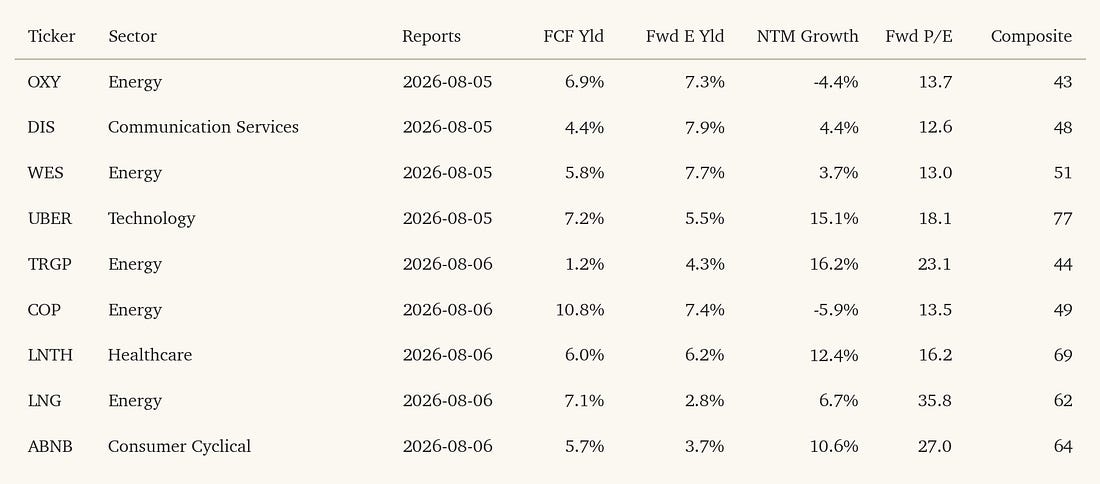
What changes the read is whether this contract is a species or a specimen. The forward calendar tests it immediately. Occidental reports Wednesday, ConocoPhillips and Cheniere on Thursday.⁵ Cheniere is the cleanest tell, because long-dated contracted offtake against a spot-priced sector is the entire LNG business model and the market has never paid it for the duration. The test on those calls is whether any management team names a data center or hyperscaler counterparty, or whether power demand stays in the abstract-tailwind register it has occupied for two years. Thesis breaks if the Chevron deal stays a one-off through the fourth quarter. One contract is an anecdote. Four is a repricing.
Wall Street’s consensus on energy: a terminal-decline sector, correctly priced for no growth. The largest incremental buyer of American electricity just signed up through 2046.
The Tape — W2631
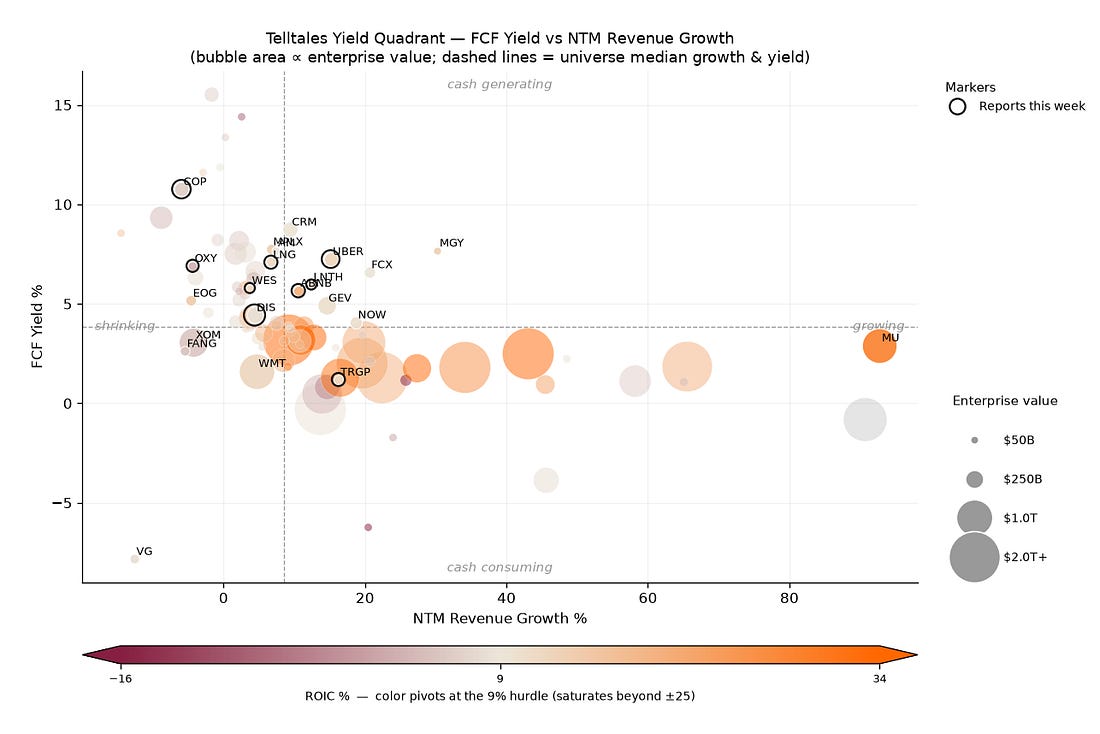
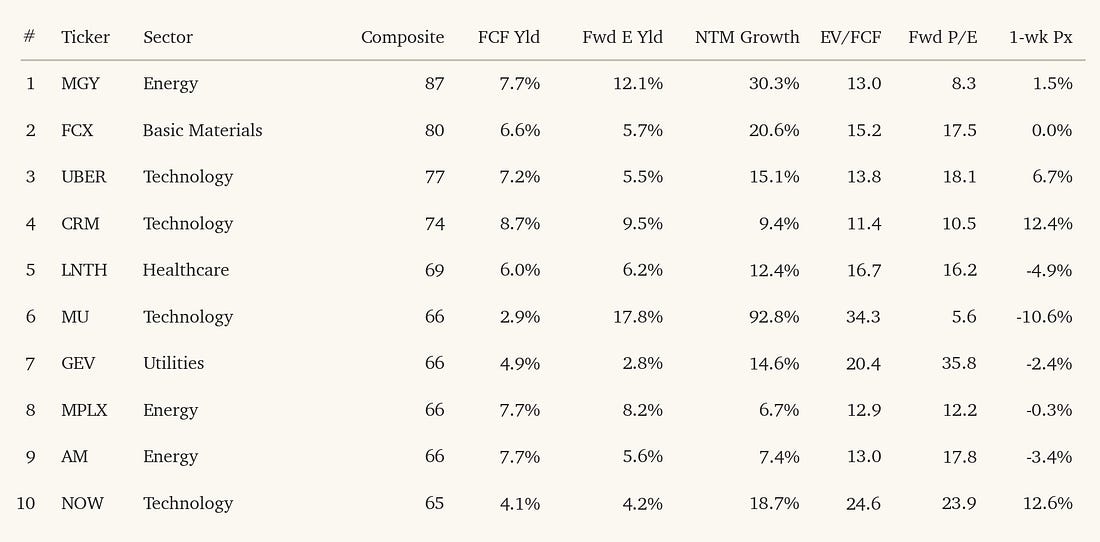
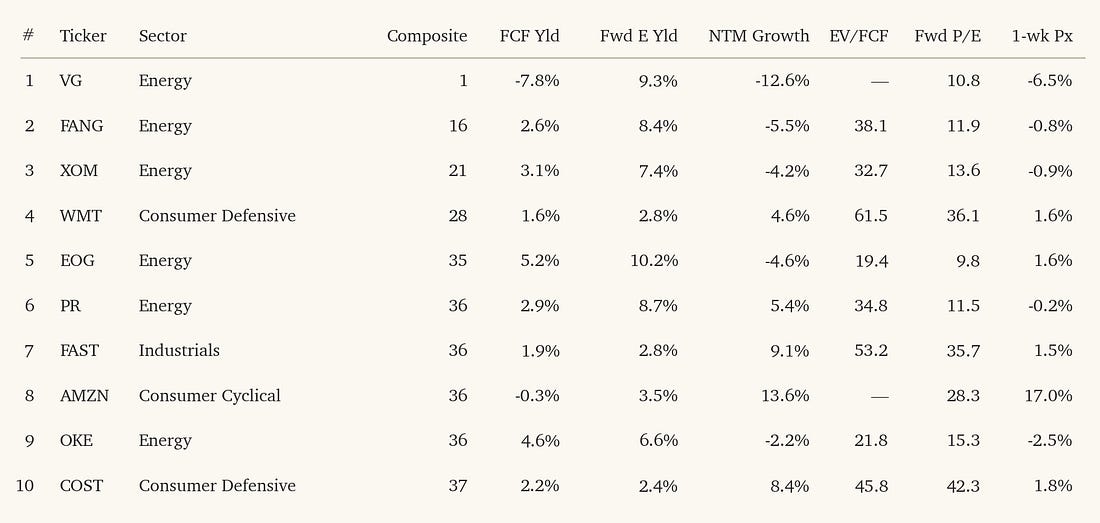
Universe of 94 cashflow-memo names, snap dates 2026-07-26 → 2026-07-31. Composite is rank-sum percentile of FCF Yield + NTM Revenue Growth (higher = better balance). Banks and finance-book names shown separately.
Telltales Yield — Top 10
From the Cashflow Desk — Marcus Graham
The top of this week’s board is ranking a balance sheet that no longer applies. Magnolia takes the number one composite at 13.0x EV/FCF and a 7.7% FCF yield, both computed off the Q1 10-Q, before the company agreed to buy WildFire Energy for $4.06B and priced a stock offering to help fund it. So the row is accurate and it is stale — a producer that pays for an acquisition partly in equity moves its share count, its debt, and its per-share cash flow in the same week the screen ranked it. Consensus is treating the offering as the news; the offering is the financing. The test is the August 5 print: whether management sizes the combined capex program for 2027, or defers it to the close.
Telltales Yield — Bottom 10
This Week’s Reporters
Sector Medians
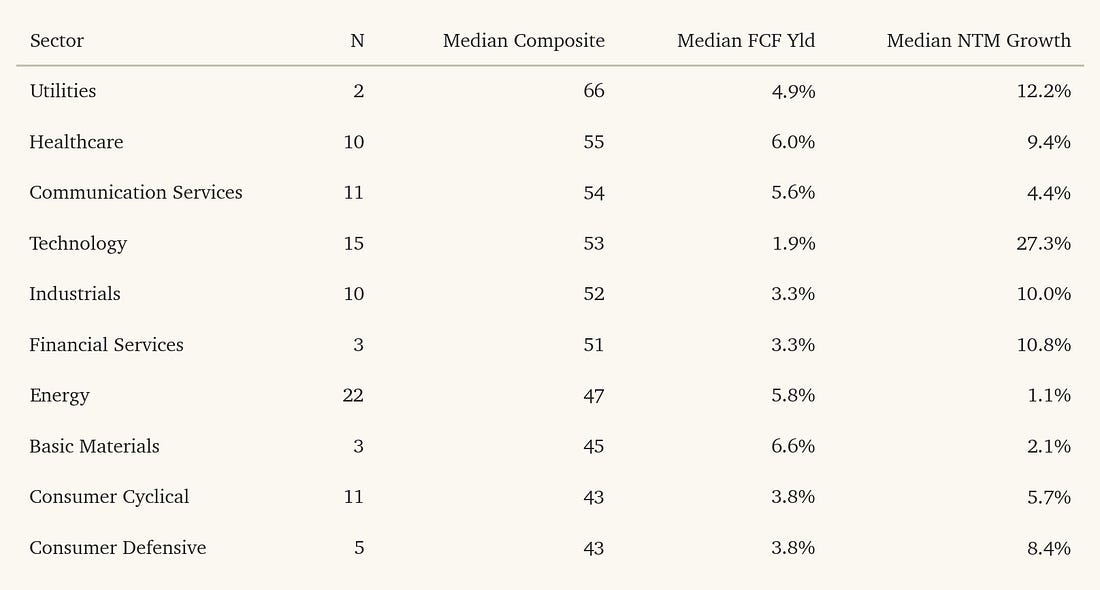
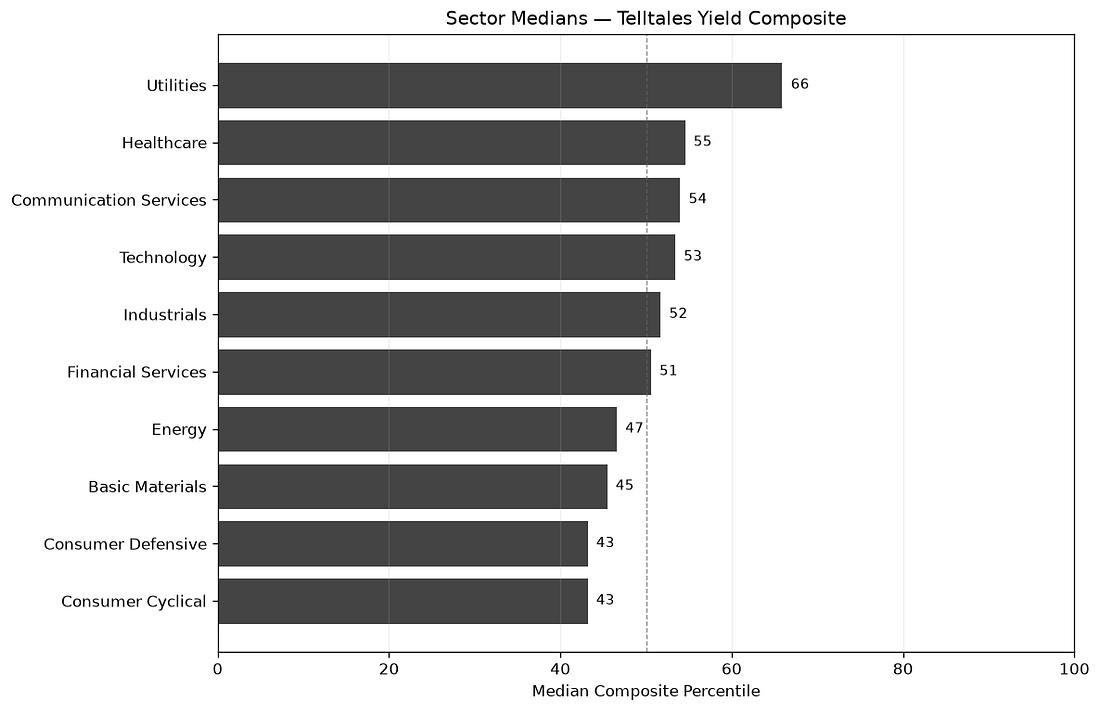
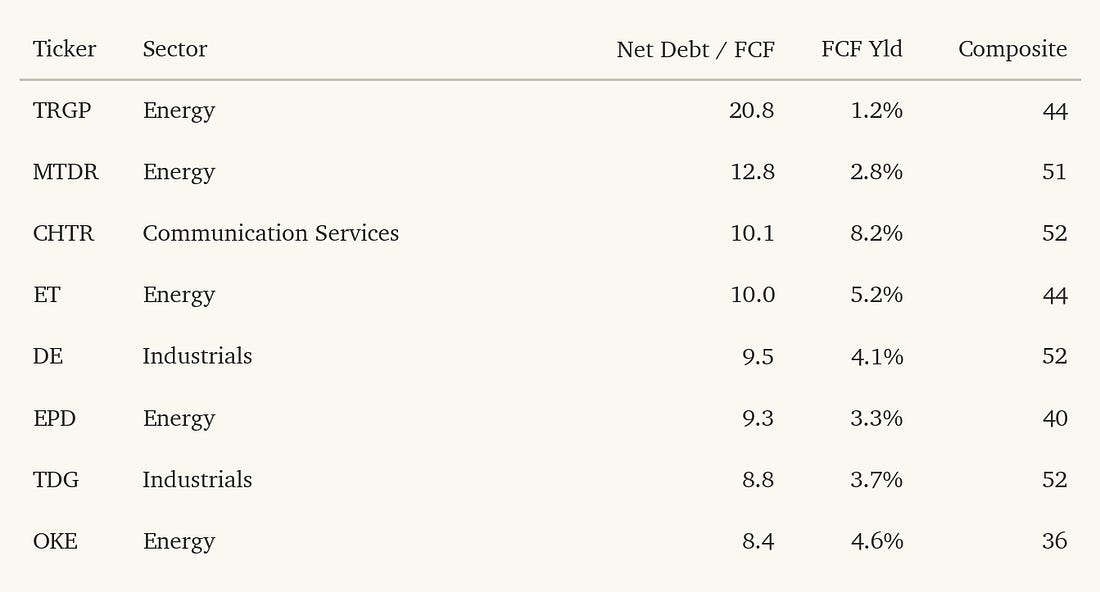
Debt / FCF Watch (highest leverage on TTM FCF)
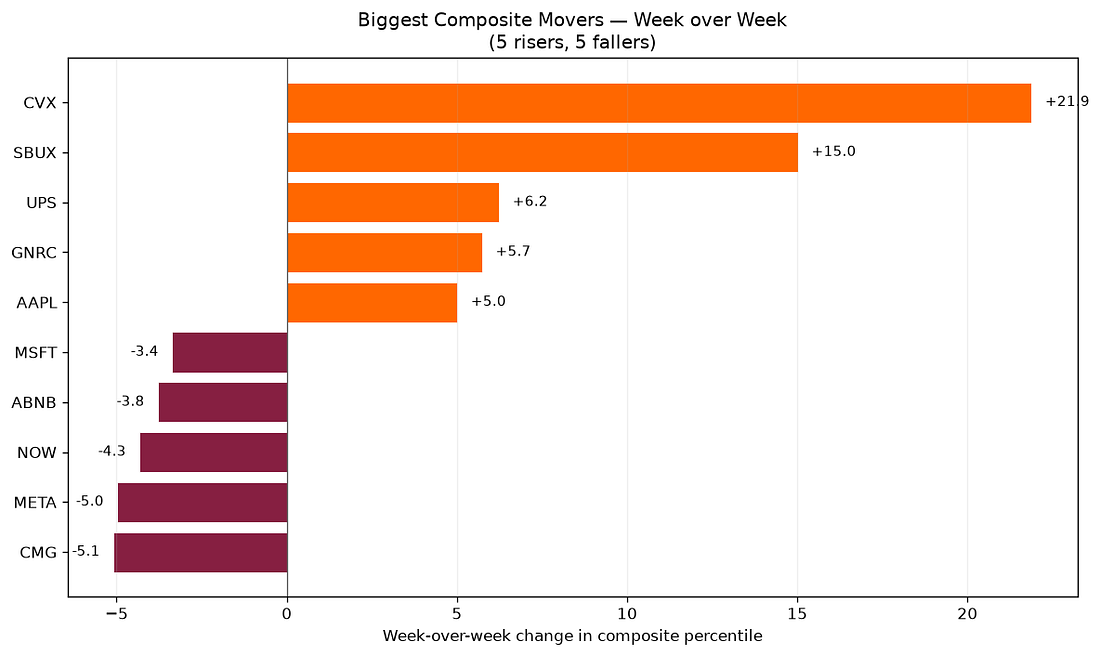
Weekly Price Movement
Top 5 (week-over-week price) 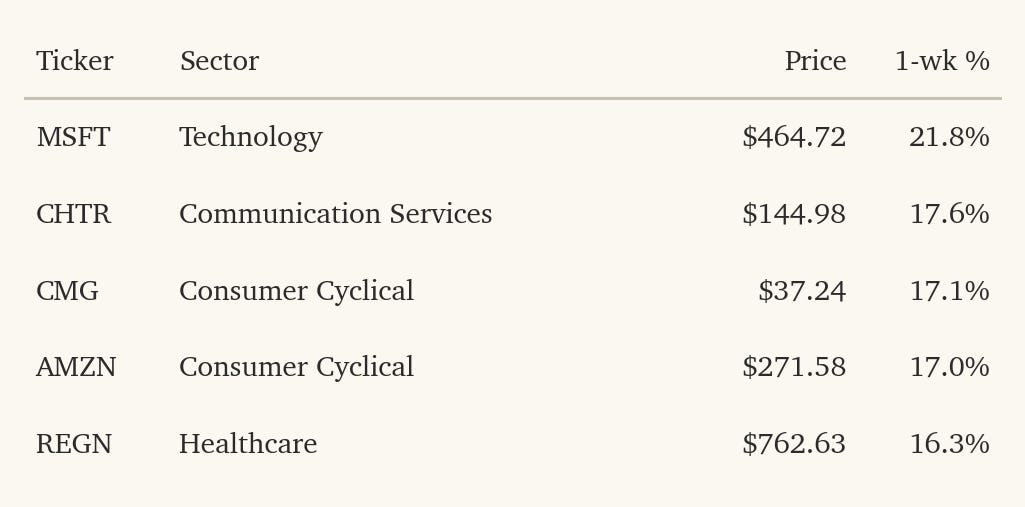
Bottom 5 (week-over-week price) 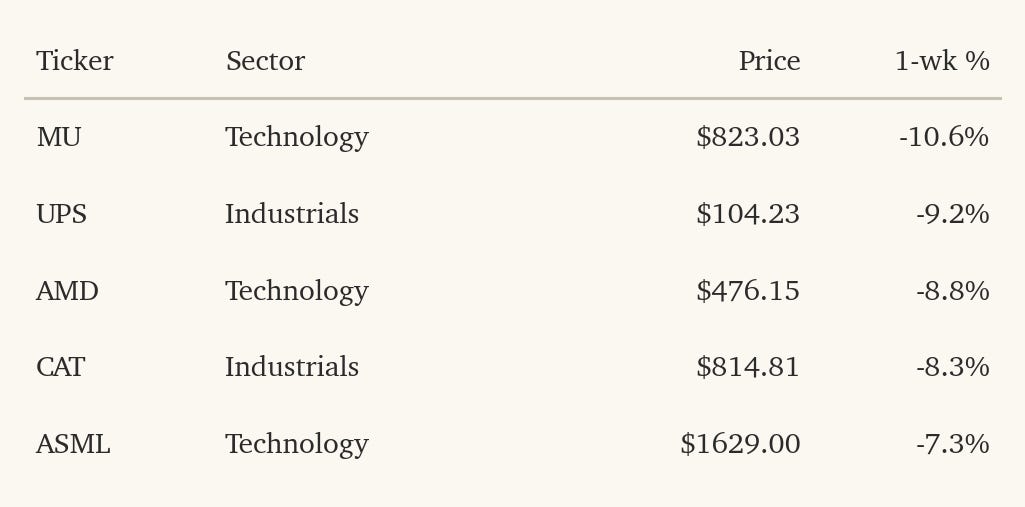
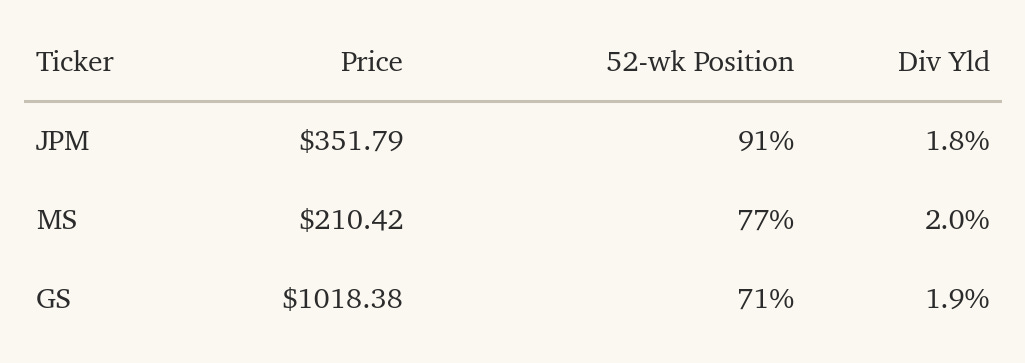
Banks (shown separately — FCF metric not meaningful)
Finance-book — FCF not comparable
Customer-float / captive-finance / reserve businesses (IBKR broker float, KMX CarMax Auto Finance, PYPL customer funds, CRCL stablecoin reserves). The memo’s operating-FCF method overstates their FCF, so they are held off the ranked leaderboard pending the P&L-waterfall rebuild. 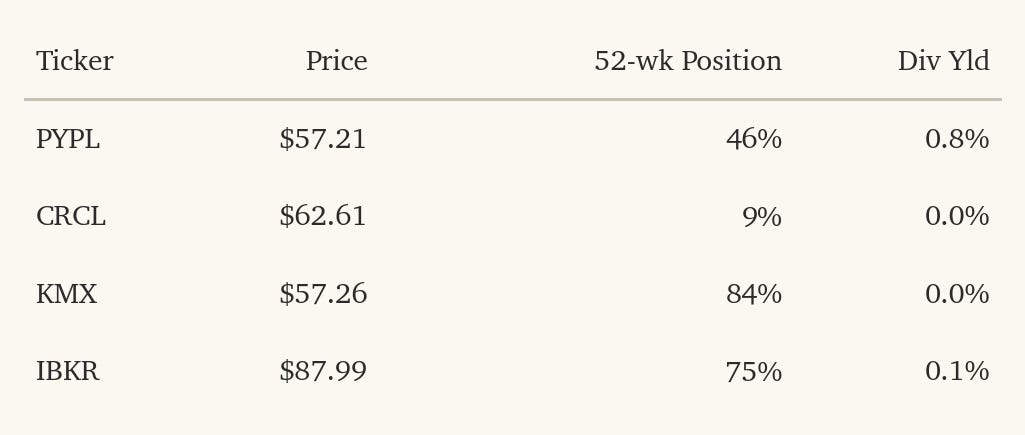
Data Gaps
89 of 92 ranked-eligible names ranked. 3 dropped for missing FCF yield or NTM revenue growth; 7 shown separately (banks + finance-book, FCF not comparable).
Source: cashflow-memo master_2026-07-31.csv. NTM growth from analyst-estimates consensus. Composite is a percentile rank, not a recommendation.
The Issue — This Week's Brief

The Cashflow Memo
Who’s Getting Paid
Microsoft got paid for spending. Meta got billed for it. Same week, same build.
The Telltales Weekend Update. Ava Cabot and analyst Marcus Graham walk through what happened this week — and what’s coming next — across the 86 companies in the Cash Flow Memo. About 14 minutes. No filler.
Download the memo at telltales.us. Mike, Jason, and Hunt are back Wednesday on episode E2632.
Chapter markers
Time | Segment
0:00 | Opening disclaimer
0:15 | Cold open — cash flow did the grading
0:45 | Theme — who’s getting paid: Microsoft, Meta, Apple
4:45 | Deep dive — page fifteen: Vertex and Lantheus
8:45 | Rapid fire — ASML, Intel, Chevron, and the forward week
11:45 | Close — Consensus Watch
12:45 | Closing disclaimer
Full transcript
Opening disclaimer
Ava: The following conversation is intended for informational purposes only. You should always do your own work to determine if an investment is suitable for you.
Cold open
Ava: You’re listening to the Telltales Weekend Update. I’m Ava Cabot.
Marcus: And I’m Marcus Graham — the cashflow desk.
Ava: Quick note before we start: the show is produced entirely with AI tools, and both voices you’re hearing are AI-generated. Send feedback through the Substack.
Ava: This was the week the AI build stopped being a guide and started being a cash flow statement. Three of the largest companies on earth reported inside 72 hours, and the market handed out three completely different grades for what looks, from the outside, like the same behavior. On Wednesday’s show, episode 2631, Hunt, Jason, and Mike spent their time on open weights versus closed labs, and where the value goes once model economics commoditize[^ep-e2631]. This week the market answered a much narrower version of that question, with money. Cash flow did the grading.
Theme — Who’s getting paid
Ava: Microsoft just got a standing ovation for spending money. Azure crossed $100 billion of revenue in a single fiscal year for the first time[^news-msft-azure-20260730]. Fourth-quarter earnings, $4.74 adjusted, up 23%[^news-msft-q4eps-20260729]. The stock jumped 15% on it[^news-msft-stock-20260730]. And buried underneath the applause: Microsoft Cloud gross margin fell to 68%, and the company’s own explanation was the cost of scaling AI infrastructure and the growing usage of AI features[^news-msft-cloud-margin-20260724]. So the build is already in the margin line. On page 1 of the memo, Apple and Microsoft printed inside two days of each other, and only one of them got that reception. Marcus — who actually got paid this week?
Marcus: Microsoft got paid on the income statement and billed on the cash flow statement, and the market only graded the first one. Going into this print the memo had them at about 38x trailing free cash flow[^memo-msft-evfcf-20260331], on roughly $76 billion of trailing free cash flow that was down about 21% year over year[^memo-msft-fcf-20260331]. That’s Q3 10-Q confirmed; we re-anchor when the 10-K files. Azure crossing that line is real money. So is the cash disappearing into the build. What I’d watch on the next print is whether the revenue line starts catching the capex line, or whether we’re still calling this a growth story two years from now.
Ava: Meta spent the same kind of money and got the opposite grade. Revenue over $60 billion, up 28%[^news-meta-rev-20260730]. Second-quarter free cash flow down 91%[^news-meta-fcf-20260731]. The stock fell 8%, extending a record losing streak[^news-meta-stock-20260731]. And on the call, Mark Zuckerberg said Meta is, quote, getting a lot of offers for compute at a significant premium over what the company paid[^news-meta-compute-20260731]. Free cash flow down 91%, and the pitch is that people would like to rent his GPUs. There was also a $2.4 billion charge for legal proceedings[^news-meta-legal-20260730], and a $14 billion data center venture with BlackRock[^news-meta-blackrock-20260728]. Marcus, what did that $14 billion buy?
Marcus: It bought the ability to keep building without the whole bill landing on Meta’s own cash flow statement. That is what a joint venture is for. Going into this print the memo had Meta at about 30x trailing free cash flow[^memo-meta-evfcf-20260331], on about $50 billion of trailing free cash flow that was still growing 22%[^memo-meta-fcf-20260331]. Q1 10-Q confirmed; we re-anchor when the Q2 10-Q files. So the trailing picture going in was fine. The quarter is what broke. And the move in the stock says the market has decided the quarter is the new trend rather than the exception. I’d weight that as more likely right than wrong, but it is one quarter, and I’d hold that view loosely until the next one confirms it.
Ava: Which brings us to the control group. Apple didn’t build anything, and got marked down anyway. The June-quarter print beat, with net sales around $109 billion and iPhone sales up 22% year over year[^news-aapl-q3-20260731]. It was Tim Cook’s last earnings call as CEO, with the stock at a record[^news-aapl-cookcall-20260729]. He hands the job to John Ternus on September 1 and becomes executive chairman[^news-aapl-ceo-20260729]. And then Apple guided the September quarter to 9–11% revenue growth, below where the Street was, and blamed supply constraints[^news-aapl-guide-20260731]. Goldman Sachs cut its price target to $360 on the guide[^news-aapl-ptcut-20260731]. Morgan Stanley also moved to $360, working off calendar 2027 earnings of $10.30 a share[^news-aapl-mspt-20260731]. Two houses, two different models, the same number. Marcus, this one’s for you.
Marcus: Apple is the counterexample that makes the rest of the week legible. Going into this print the memo had Apple at about 37x trailing free cash flow[^memo-aapl-evfcf-20260328], on trailing capex of roughly $11 billion[^memo-aapl-capex-20260328], which is a fraction of hyperscaler scale, with free cash flow growing 28%[^memo-aapl-fcf-20260328]. FQ2 10-Q confirmed; we re-anchor when the FQ3 10-Q files. So here is the week in one line. The market paid for the build where the revenue already showed up, billed it where it hasn’t, and then marked Apple down for something else entirely. Parts it can’t get. That’s a supply problem, not a valuation problem, and supply problems resolve on a different clock.
Ava: Three companies, one build, three verdicts.
Deep dive — Page fifteen
Ava: Two pharmaceutical deals landed this week, both on page 15 of the memo, and they are the same argument as the hyperscalers — just at a deal table instead of an earnings call. One company had the cash flow to write the biggest check in its history. The other one has cash flow good enough that somebody wants to buy it, and not enough scale to make that go away.
Ava: Vertex agreed to acquire Crinetics Pharmaceuticals for $10 billion in cash, $85 a share — the largest acquisition Vertex has ever made[^news-vrtx-crinetics-20260728]. It also signed a collaboration with AbCellera on next-generation T-cell engagers, $28 million up front[^news-vrtx-abcellera-20260729]. And Vertex reports Monday[^earn-vrtx]. Meanwhile, Curium is in advanced talks to acquire Lantheus for about $7 billion, a deal that could be announced within days[^news-lnth-curium-20260727]. And two days after that report landed, B. Riley raised its price target on Lantheus, to $129 from $97[^news-lnth-briley-20260729]. Marcus — which side of that table would you rather be on?
Marcus: Lantheus is the more interesting one, because the sell side responded to a takeover report by marking the company up. That does not usually happen when the bid is generous. The memo has Lantheus at about 17x trailing free cash flow[^memo-lnth-evfcf-20260331], at roughly a 6% free cash flow yield[^memo-lnth-fcfyield-20260331], with effectively no net debt[^memo-lnth-debt-20260331]. Q1 10-Q confirmed. A debt-free radiopharmaceutical business throwing off that kind of yield is not a distressed seller. What I’d watch over the next two weeks is whether the board treats that number as a floor or a ceiling, and whether a second name shows up before anything gets signed.
Ava: An offer the analysts think is too low. Imagine that.
Marcus: Vertex is on the other side of that trade because its cash flow bought it the option to be. The memo has Vertex at about 30x trailing free cash flow[^memo-vrtx-evfcf-20260331], on about $3.7 billion of trailing free cash flow, up roughly 66% year over year[^memo-vrtx-fcf-20260331]. Q1 10-Q confirmed. That is what lets you write an all-cash check of that size without asking anyone’s permission. The honest caveat is that writing the check is the easy part. This is the largest deal Vertex has ever done[^news-vrtx-crinetics-20260728], which means the integration is unproven, and in the meantime the existing franchise is funding all of it. Monday’s print won’t tell you anything about the acquisition. It’ll tell you whether the base business is still carrying the load.
Ava: And look at what Vertex is assembling on top of the acquisition. That AbCellera collaboration is aimed at multispecific T-cell engagers for autoimmune disease and other conditions[^news-vrtx-abcellera-20260729]. So inside one week: a $10 billion company purchase and a $28 million science partnership. Very different price tags, same instinct. Lantheus, on the other side of the table, is a radiopharmaceutical business[^news-lnth-curium-20260727] — targeted drugs, narrow patient populations, and specialty sales forces that are expensive to build and hard to replace once you have one.
Marcus: Which is why the buy-versus-build math has gone so lopsided. Building a specialty commercial organization takes years you do not get back, so a company with real free cash flow buys one instead, and the price of that shortcut gets set by whoever else has cash that week. Vertex had it. Curium apparently has it. Lantheus is the one being priced. Same mechanism we just watched in the hyperscalers. The currency is a sales force instead of a data center.
Marcus: Same page, same week, and what decided which side of the table each one sat on was how much cash each business throws off. What I’d watch from here is that Lantheus number. If $7 billion moves, it tells you the cash flow was worth more than the bid assumed.
Ava: Two companies, one page of the memo. The cash flow statement wrote the outcome for both.
Rapid fire
Ava: Rapid fire. Three names, then the forward week.
Ava: The most important company in the AI build had one of its worst weeks of the year, and it didn’t report anything. A Shanghai-based, state-backed Chinese company has begun mass producing deep-ultraviolet immersion lithography equipment — the machines ASML has effectively had to itself — reportedly after absorbing staff from a Huawei-backed startup[^news-asml-china-20260729]. The shares slid to their lowest level since early June[^news-asml-stock-20260728]. Bank of America says investors are overreacting to the China threat[^news-asml-bofa-20260728]. Maybe. ASML also posted €5.6 billion of net bookings in mid-2026, on strong demand for its High-NA EUV systems[^news-asml-bookings-20260730]. So the order book is fine and the moat is the open question. Those are different problems, on very different timelines.
Ava: Intel, also on page 3, posted its fastest revenue growth in 15 years and announced 24,000 job cuts inside the same ten days. Second-quarter revenue up 25% to $16.1 billion, the strongest growth since Q3 2011[^news-intc-q2-20260723]. The forward guide topped estimates on data center strength[^news-intc-guide-20260723]. Intel also committed to mass production of its 14A node in 2028[^news-intc-14a-20260724]. And CEO Justin Hotard is cutting 24,000 jobs as part of a restructuring[^news-intc-layoffs-20260728]. Growth and a restructuring in the same breath usually means the growth isn’t coming from where the headcount is.
Ava: And the AI build showed up in an oil major’s earnings. Chevron reported second-quarter earnings of $12.1 billion, $6.11 a share diluted, up 384% from a year ago[^news-cvx-q2-20260731]. Chevron also signed a 20-year power purchase agreement with Microsoft, supplying 2.67 gigawatts of behind-the-meter power to a West Texas data center[^news-cvx-msft-20260731]. Twenty years. Behind the meter. That is a hyperscaler deciding it would rather buy the gas than wait on the grid. And CEO Eimear Bonner said she expects fuel-making margins to stay high for as long as energy markets remain, quote, under stress[^news-cvx-margins-20260731]. Chevron also confirmed the Caspian Pipeline Consortium is flowing again with ships loading this week[^news-cvx-caspian-20260731], and signed preliminary agreements to advance discussions on Iraq’s West Qurna 2 and Nassiriya fields[^news-cvx-iraq-20260731]. A quadrupled quarter, a 20-year utility contract, and two new frontiers, all in one press cycle.
Ava: The forward week is heavy. Palantir and Vertex report Monday[^earn-pltr]. AMD, Caterpillar, Pfizer, Spotify, and TransDigm on Tuesday[^earn-amd]. Wednesday brings Disney, Eli Lilly, Uber, Occidental, and Magnolia[^earn-dis] — which just agreed to buy WildFire Energy for about $4 billion[^news-mgy-wildfire-20260730] and priced a $1.1 billion stock offering the same week[^news-mgy-offering-20260730]. And Thursday: ConocoPhillips, Cheniere, Airbnb, and Lantheus, which may or may not still be an independent company by the time it reports[^earn-lnth].
Close
Ava: That’s the show. Wall Street’s consensus on the AI trade this week: Microsoft’s spending is disciplined and Meta’s is reckless. Same build, same bill. The only real difference is that one of them can already show you the invoice it sent. Cash flow did the grading this week. Microsoft got paid for the spending, Meta got billed for it, Apple got marked down for parts it couldn’t get — and over on page 15, the company with the cash flow wrote the check while the company with less of it got an offer. Next week the forward calendar does the talking. Download the Cash Flow Memo at telltales.us. Hunt, Jason, and Mike are back Wednesday on episode 2632. I’m Ava Cabot. Have a good weekend.
Closing disclaimer
Ava: The views expressed on this podcast are the host alone and do not constitute an offer to sell or a recommendation to purchase, or a solicitation of an offer to buy any security, nor a recommendation for any investment product or service. While certain information contained herein has been obtained from sources believed to be reliable, neither the host nor any of their employers or their affiliates have independently verified this information, and its accuracy and completeness cannot be guaranteed. Accordingly, no representation or warranty, express or implied, is made as to, and no reliance should be placed on, the fairness, accuracy, timeliness, or completeness of this information. The host and all employers and their affiliated persons assume no liability for this information and no obligation to update the information or analysis contained herein in the future, and may or may not hold positions in the securities mentioned.
Sources
AppleInsider. (2026, July 31). Goldman Sachs drops Apple price target, sees growth in 2027. AppleInsider. https://appleinsider.com/articles/26/07/31/unimpressed-goldman-sachs-trims-aapl-target-by-10-after-earnings-call
AppleInsider. (2026, July 31). Services slowdown pushes Apple’s price target down to $360. AppleInsider. https://appleinsider.com/articles/26/07/31/services-slowdown-pushes-morgan-stanleys-aapl-target-down-to-360
AppleMagazine. (2026, July 29). Apple CEO transition gets a public preview. AppleMagazine. https://applemagazine.com/apple-ceo-transition-tim-cook-john-ternus/
Bloomberg. (2026, July 23). Intel earnings: (INTC) forecast tops estimates, fueled by data center growth. Bloomberg. https://www.bloomberg.com/news/articles/2026-07-23/intel-forecast-shatters-estimates-fueled-by-data-center-growth
Bloomberg. (2026, July 27). ASML shares drop after report of China producing DUV chipmaking tools. Bloomberg. https://www.bloomberg.com/news/articles/2026-07-27/asml-slides-after-report-of-china-beginning-duv-tool-production
Bloomberg. (2026, July 27). Curium is said to near about $7 billion acquisition of Lantheus. Bloomberg. https://www.bloomberg.com/news/articles/2026-07-27/curium-is-said-to-near-about-7-billion-acquisition-of-lantheus
Bloomberg. (2026, July 31). Chevron says big fuel margins to persist amid energy stress. Bloomberg. https://www.bloomberg.com/news/articles/2026-07-31/chevron-says-big-fuel-margins-to-persist-amid-energy-stress
BioPharma Dive. (2026, July 29). AbCellera, Vertex partner on next-gen T-cell engagers. BioPharma Dive. https://www.biopharmadive.com/news/abcellera-vertex-partnership-next-gen-t-cell-engagers/826471/
Chevron Corporation. (2026, July 31). Chevron reports second quarter 2026 results [Press release]. https://chevroncorp.gcs-web.com/news-releases/news-release-details/chevron-reports-second-quarter-2026-results
CNBC. (2026, July 24). Intel (INTC) earnings report Q2 2026. CNBC. https://www.cnbc.com/2026/07/23/intel-intc-earnings-report-q2-2026.html
CNBC. (2026, July 28). ASML Holding NV — Stock price, quote and news. CNBC. https://www.cnbc.com/quotes/ASML
CNBC. (2026, July 28). Meta partners with BlackRock: Here’s what you need to know [Video]. CNBC. https://www.cnbc.com/video/2026/07/28/meta-partners-with-blackrock.html
CNBC. (2026, July 29). Tim Cook’s last earnings call comes at momentous time for Apple with stock at record. CNBC. https://www.cnbc.com/2026/07/29/tim-cooks-last-earnings-call-comes-at-momentous-time-for-apple-.html
CNBC. (2026, July 30). Apple (AAPL) Q3 2026 earnings report: Live updates. CNBC. https://www.cnbc.com/2026/07/30/apple-earnings-live-updates.html
CNBC. (2026, July 31). Alphabet, Amazon and Microsoft added nearly $1.5 trillion in combined value this week. CNBC. https://www.cnbc.com/2026/07/31/apple-aapl-amazon-amzn-stock-today.html
CNBC. (2026, July 31). Meta sinks 8%, continuing record losing streak, while Microsoft jumps 15% as AI trade splits. CNBC. https://www.cnbc.com/2026/07/30/microsoft-msft-meta-stock-today-earnings.html
Fortune. (2026, July 31). Meta earnings reveal cash flow drops 91% — while Zuckerberg writes op-eds about superintelligence. Fortune. https://fortune.com/2026/07/30/zuckerberg-superintelligence-meta-cash-flow-drop/
Intellizence. (2026, July 28). Companies that announced major layoffs and hiring freezes. Intellizence. https://intellizence.com/insights/layoff-downsizing/major-companies-that-announced-mass-layoffs/
Investing.com. (2026, July 28). Vertex to acquire Crinetics Pharmaceuticals in $10 billion all-cash merger. Investing.com. https://www.investing.com/news/analyst-ratings/ubs-downgrades-crinetics-stock-rating-on-vertex-acquisition-93CH-4815601
Investing.com. (2026, July 31). Chevron says Caspian Pipeline Consortium is flowing, ships loading. Investing.com. https://www.investing.com/news/stock-market-news/chevron-says-caspian-pipeline-consortium-is-flowing-ships-loading-93CH-4829114
Latham & Watkins. (2026, July 30). Latham advises financing sources in connection with US$4.06 billion acquisition of WildFire Energy by Magnolia Oil & Gas. Latham & Watkins. https://www.lw.com/en/news/2026/07/latham-advises-financing-sources-in-connection-with-acquisition-of-wildfire-energy-by-magnolia
Latham & Watkins. (2026, July 30). Latham advises on US$1.1 billion public offering of common stock by Magnolia Oil & Gas. Latham & Watkins. https://www.lw.com/en/news/2026/07/latham-advises-on-public-offering-of-common-stock-by-magnolia-oil-gas
MarketScreener. (2026, July 29). B. Riley raises price target on Lantheus Holdings to $129 from $97, keeps Buy rating. MarketScreener. https://www.marketscreener.com/news/b-riley-raises-price-target-on-lantheus-holdings-to-129-from-97-keeps-buy-rating-ce7f51d3d98ffe22
Microsoft Corporation. (2026, July 24). FY26 Q1 — Performance. Microsoft Investor Relations. https://www.microsoft.com/en-us/investor/earnings/fy-2026-q1/performance
Microsoft Corporation. (2026, July 29). Microsoft fiscal year 2026 fourth quarter earnings conference call. Microsoft Investor Relations. https://www.microsoft.com/en-us/investor/events/fy-2026/earnings-fy-2026-q4
Seoul Economic Daily. (2026, July 29). ASML shares tumble 7% on report of Chinese DUV lithography development. Seoul Economic Daily. https://en.sedaily.com/international/2026/07/29/impregnable-asml-rocked-as-china-lithography-report-wipes
The New York Times. (2026, July 30). Microsoft increases spending on A.I. as profit jumps 31%. The New York Times. https://www.nytimes.com/2026/07/29/technology/microsoft-quarterly-earnings-report.html
Tom’s Hardware. (2026, July 24). Intel commits to 14A mass production in 2028 as its sales rise 25% year-over-year. Tom’s Hardware. https://www.tomshardware.com/pc-components/cpus/intel-commits-to-14a-mass-production-in-2028-as-its-sales-rise-25-percent-year-over-year
Unbox Future. (2026, July 30). Inside the 2026 semiconductor surge: Why Lam Research, Micron & AMD rallied on AI chip CapEx. Unbox Future. https://www.unboxfuture.com/2026/07/inside-2026-semiconductor-surge-why-lam.html
Upstream. (2026, July 31). Chevron sees significant potential in Iraq after latest agreements. Upstream. https://www.upstreamonline.com/field-development/chevron-sees-significant-potential-in-iraq-after-latest-agreements/2-1-2023717
Variety. (2026, July 30). Meta takes $2.4 billion charge for legal proceedings in Q2, revenue booms 28% to over $60 billion. Variety. https://variety.com/2026/digital/news/meta-q2-2026-earnings-results-legal-proceedings-charge-1236823577/
Internal data
Internal data is provided on a best efforts basis.
Earnings slate
Forward earnings dates and consensus figures are drawn from the episode’s earnings slate, pulled 2026-07-31. See 04. Publishing/shows/weekend-update/W2631/dryrun/earnings_slate.md.
Palantir, Vertex Pharmaceuticals — 2026-08-03 (Monday)
Advanced Micro Devices, Caterpillar, Pfizer, Spotify, TransDigm — 2026-08-04 (Tuesday)
Disney, Eli Lilly, Uber, Occidental Petroleum, Magnolia Oil & Gas — 2026-08-05 (Wednesday)
Airbnb, Cheniere Energy, ConocoPhillips, Lantheus — 2026-08-06 (Thursday)


