

▶ Explore this week’s Tape — live, sortable, drill-down →
GE Vernova Is Already Selling 2031. The Scarcity Was Manufactured Twenty Years Ago.
Every company in this week’s news was selling capacity it still has to build. GE Vernova was selling a place in line. It shipped three gigawatts of turbines in the second quarter and booked twenty gigawatts of orders and slot reservations against them.¹ Six or seven claims on the factory for every machine that walked out of it. That is a queue, and Vernova now sets the price of standing in it.
Start with what a slot reservation actually is, because the phrase does a great deal of work inside that backlog number. It is not an order for a turbine. It is a paid claim on a window of factory time, booked years before the machine gets built, before the plant is permitted, before the interconnection queue clears. The customer buys optionality on Vernova’s throughput; Vernova sells scarcity forward. Reservations are running four to five years out, per Utility Dive’s account of Tuesday’s call. Bookings for 2031 delivery are being taken right now, and Scott Strazik expects to be more than halfway contracted for that year by December.²
Which is why the cash showed up early, and why the way it showed up matters more than the amount. Vernova raised its full-year free cash flow guidance to between eleven and a half and twelve and a half billion dollars, up from six and a half to seven and a half.³ It raised the revenue guide by about a billion. A five-billion-dollar cash raise on a one-billion-dollar revenue raise is not operating leverage, and the company says so plainly: the quarter’s free cash flow rose primarily due to higher positive benefits from working capital.⁴ Translation, in the least mysterious sense: a sold-out factory collects customer money long before it collects revenue. In the Cash Flow Memo, Vernova’s line went from thirty-eight times trailing free cash flow in March to twenty-one in June without the share price doing the work.⁵ The denominator moved.
Now the part that decides whether this is a good business or just a good year. Vernova can charge for a place in line because roughly three companies on earth can forge heavy-duty iron at this scale, and the reason there are three is 2002. The 1998-to-2001 merchant power boom pulled forward a decade of gas turbine orders; when gas prices climbed, the orders vanished, the factories emptied, and the downturn consolidated global manufacturing capability into the three suppliers that survived it, per Bloomberg’s reporting on the current bottleneck.⁶ All three remember. Tony Brough, whose firm advises the OEMs, put it flatly last summer: they are expanding, but each of them have been through boom times before so they are taking a measured and careful approach to capacity additions.⁷ That sentence is the investment case. The discipline is not a strategy anyone chose. It is scar tissue, and it converts a cyclical equipment order into a priced option on time.
The other half of the asset is the installed base. Of the hundred seventy-six billion dollars of performance obligations on the June balance sheet, roughly half is services rather than equipment.⁸ That is an annuity on machines already spinning, indifferent to whether the next gigawatt gets financed. The cashflow read is in Marcus’s column below; short version, a free cash flow yield can be manufactured, and this week one of the memo’s cheapest-looking names manufactured its own.
What changes the read is Vernova. Strazik committed on Wednesday to twenty gigawatts of annual output in the third quarter, twenty-four gigawatts in 2028, and actions to produce 30 GW in 2030.⁹ That is a company being paid to dismantle the exact scarcity that prices its own backlog, run by people who lived through the last time the industry tried it. The tell is not the backlog number, which will keep climbing; management guided to at least a hundred twenty-five gigawatts under contract by year end. The tell is 2032. Strazik described healthy discussions with customers about 2032 bookings and then said he needs more time before we can articulate the timing of contracting in ’32.¹⁰ Healthy discussions, no dates. BNP Paribas read that as possible peak momentum in the gas story, and the jury on the thirty-gigawatt expansion as still out.¹¹ Wind is the standing offset: equipment orders fell forty percent year over year, against a four-hundred-million-dollar segment EBITDA loss carried for the year.¹²
Wall Street’s consensus on GE Vernova: a backlog story, and the backlog is the number to track. The backlog is sold out either way. What prices this company is how quickly it decides to stop being scarce.
The Tape — W2630
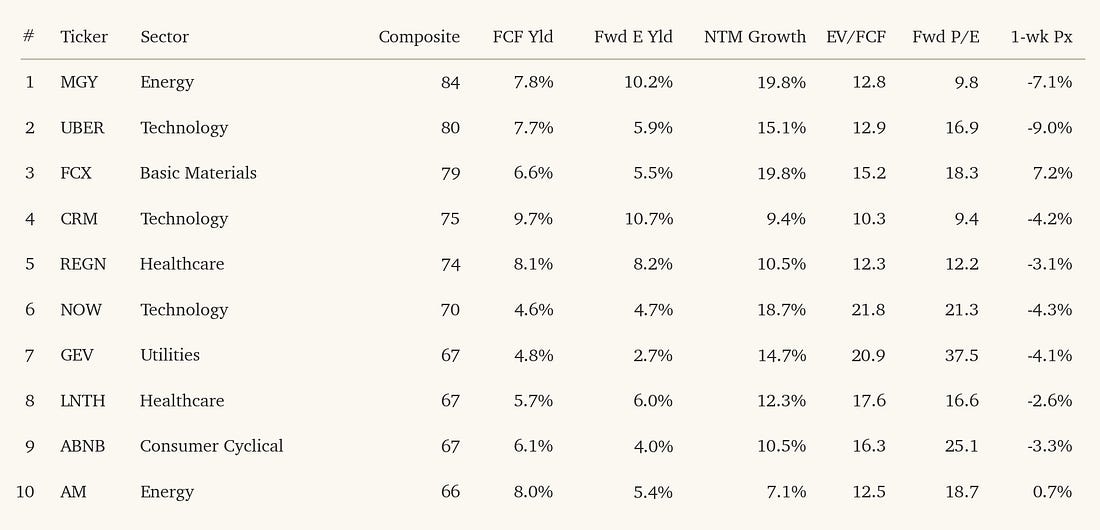
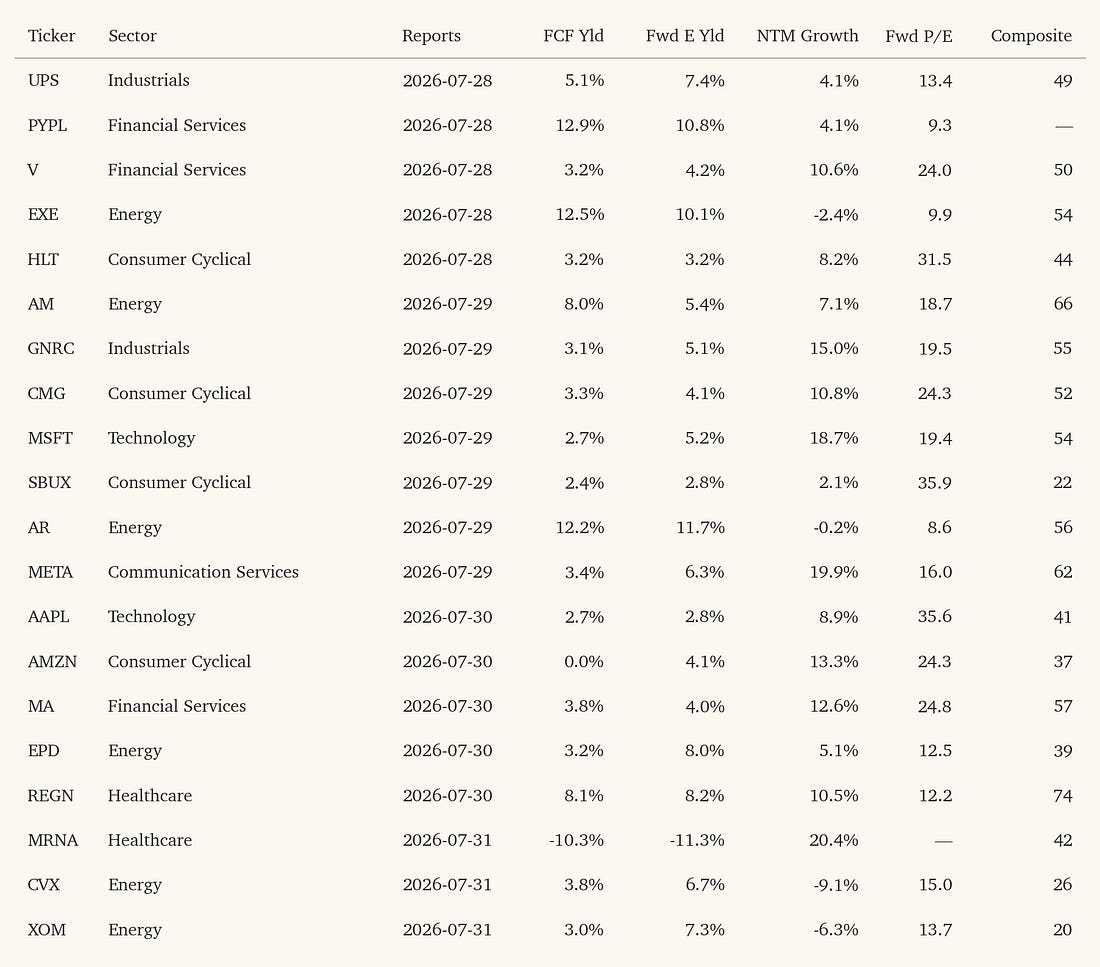
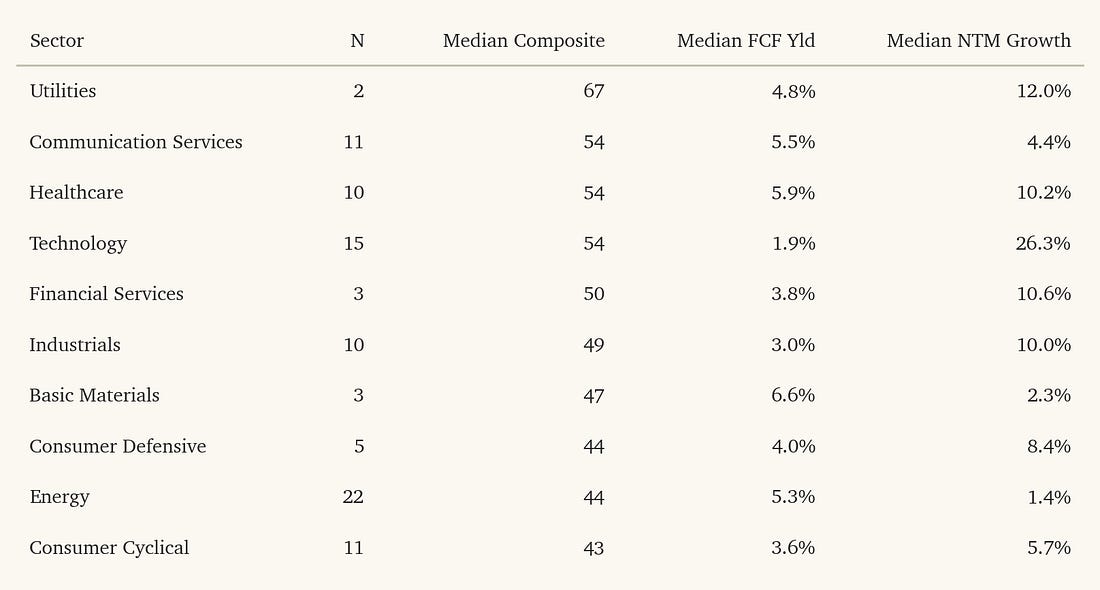
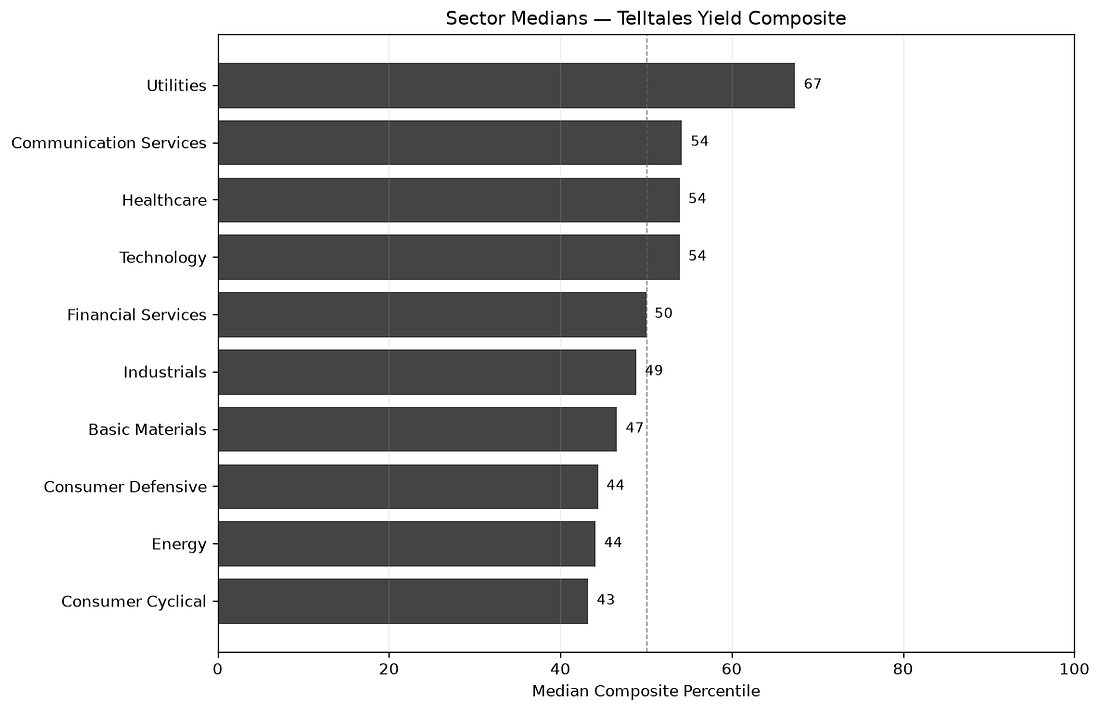
Universe of 94 cashflow-memo names, snap dates 2026-07-25 → 2026-07-26. Composite is rank-sum percentile of FCF Yield + NTM Revenue Growth (higher = better balance). Banks and finance-book names shown separately.
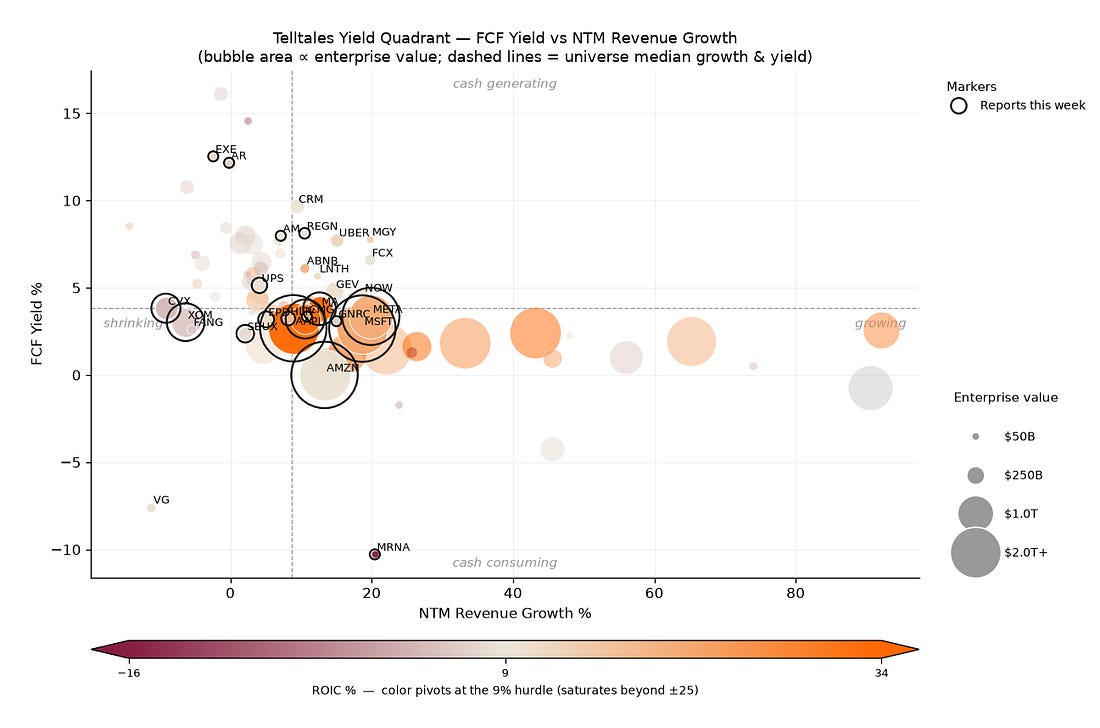
Telltales Yield — Top 10
From the Cashflow Desk — Marcus Graham
Salesforce screens as a cash machine on this table, and the balance sheet under that yield changed character in a single quarter. Per the fiscal Q1 10-Q filed in May, Salesforce raised roughly $24.7B of debt and retired a comparable amount of stock, more than doubling debt/FCF to 2.8x. The 9.7% FCF yield in the row above is a yield on a levered equity stub now, and screens ranking it against unlevered software peers are pricing different risk. I read the recap as management agreeing with the screens, which counts for something. The test on the September 2 print is whether operating cash flow grows into the new interest load, and whether the repurchase pace holds with the debt on the books.
Telltales Yield — Bottom 10
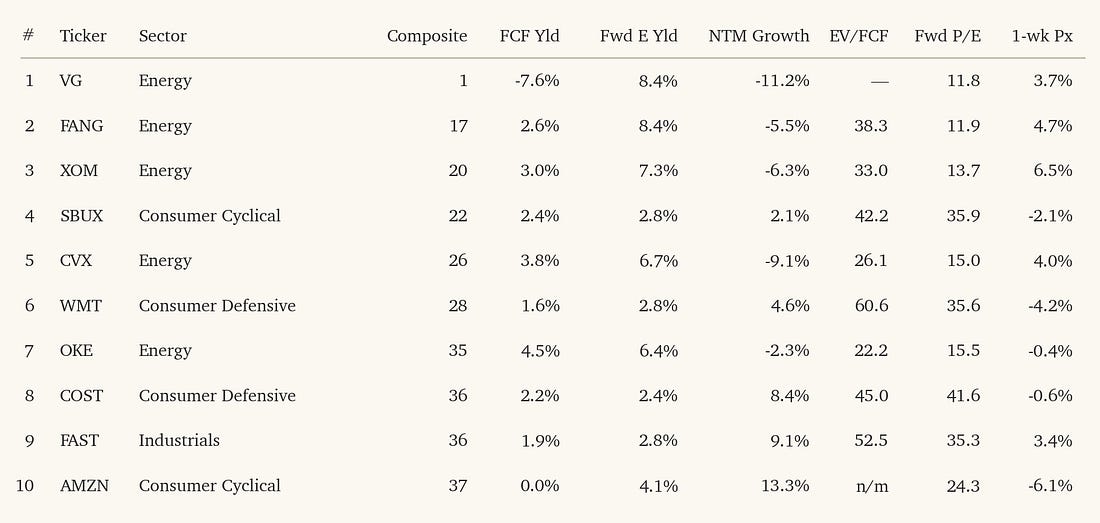
This Week’s Reporters
Sector Medians
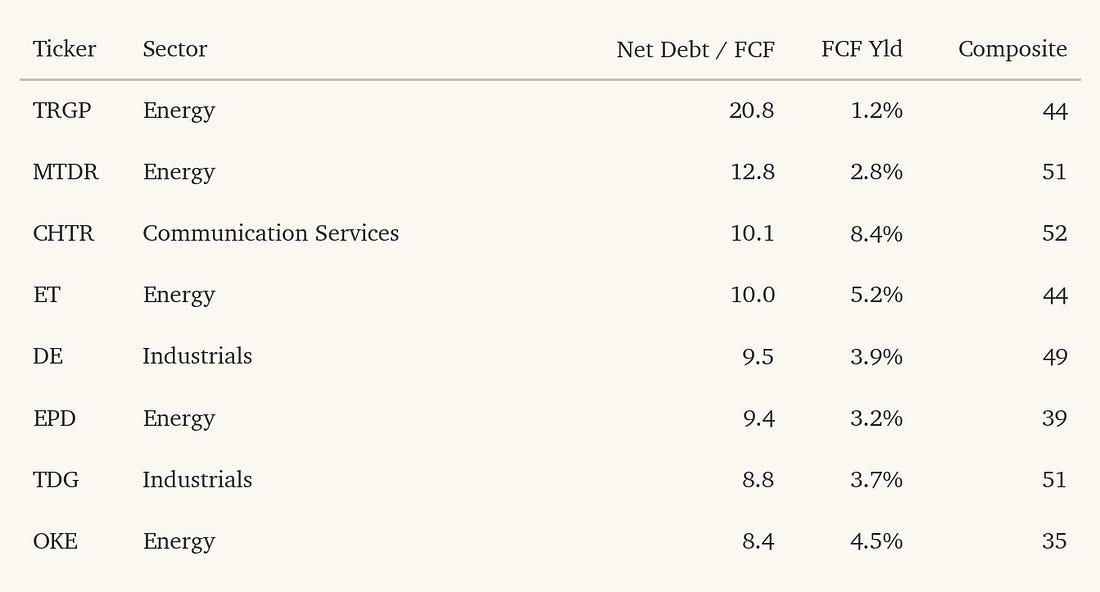
Debt / FCF Watch (highest leverage on TTM FCF)
Weekly Price Movement
Top 5 (week-over-week price) 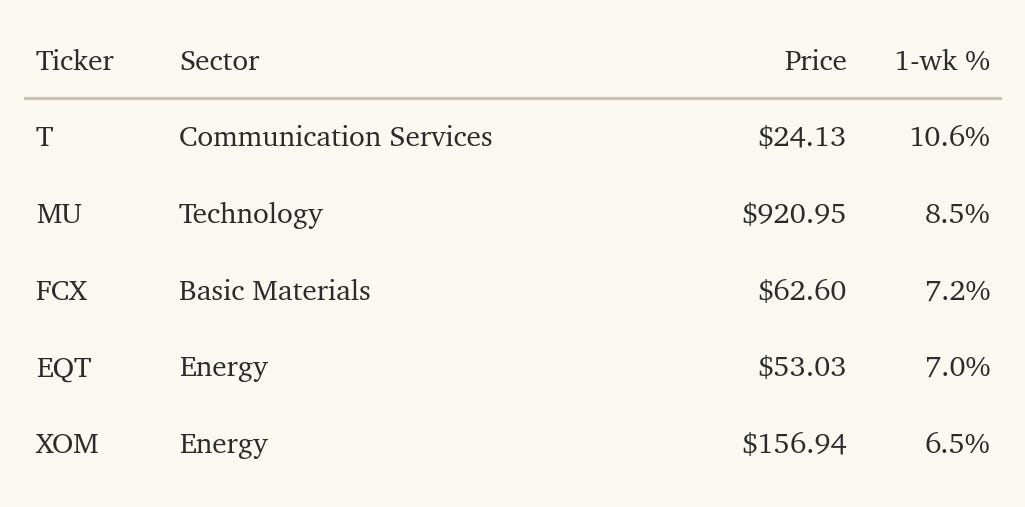
Bottom 5 (week-over-week price) 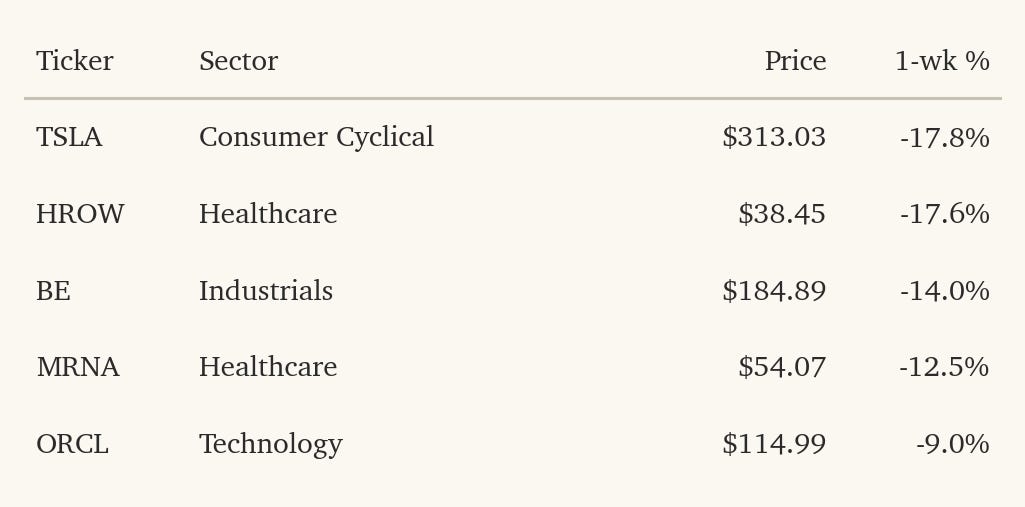
Banks (shown separately — FCF metric not meaningful)
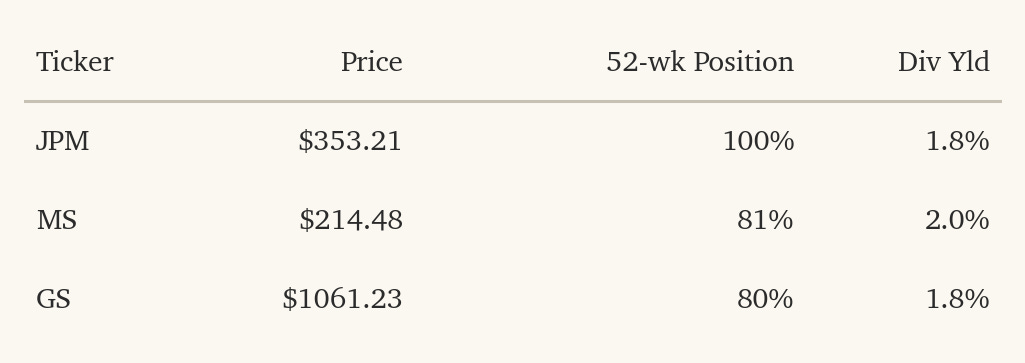
Finance-book — FCF not comparable
Customer-float / captive-finance / reserve businesses (IBKR broker float, KMX CarMax Auto Finance, PYPL customer funds, CRCL stablecoin reserves). The memo’s operating-FCF method overstates their FCF, so they are held off the ranked leaderboard pending the P&L-waterfall rebuild. 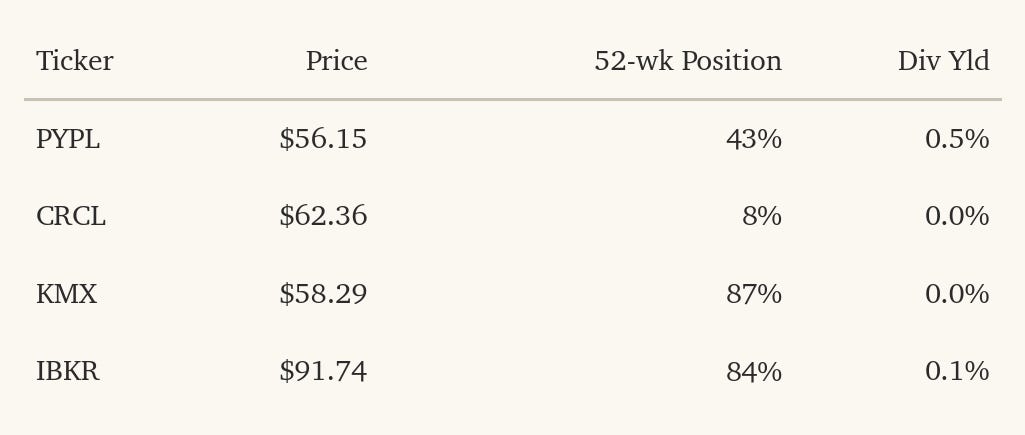
Data Gaps
90 of 92 ranked-eligible names ranked. 2 dropped for missing FCF yield or NTM revenue growth; 7 shown separately (banks + finance-book, FCF not comparable).
Source: cashflow-memo master_2026-07-26.csv. NTM growth from analyst-estimates consensus. Composite is a percentile rank, not a recommendation.
The Issue — This Week's Brief

The Cashflow Memo
Signed, Not Paid
AI capacity got contracted through 2030, and the only company collecting cash this week was selling turbines.
The Telltales Weekend Update. Ava Cabot and analyst Marcus Graham walk through what happened this week — and what’s coming next — across the 99 companies in the Cash Flow Memo. About 14 minutes. No filler.
Download the memo at telltales.us. Hunt, Jason, and Mike are back Wednesday on episode 2631.
Chapter markers
Time | Segment
0:00 | Open
0:45 | Theme — Who actually collects
4:45 | Deep dive — Page 3: AMD and Intel
8:45 | Rapid-fire — the week’s signatures
11:45 | Close + Consensus Watch
Full transcript
Opening disclaimer
Ava: The following conversation is intended for informational purposes only. You should always do your own work to determine if an investment is suitable for you.
Open
Ava: You’re listening to the Telltales Weekend Update. I’m Ava Cabot.
Marcus: And I’m Marcus Graham — the cashflow desk.
Ava: Quick note: the show is produced entirely with AI tools, and both voices you’re hearing are AI-generated. Send feedback through the Substack.
Ava: This was the week the AI build got signed, not paid. In five days: Samsung committed to a chip supply agreement with Broadcom worth more than $200 billion[^news-avgo-samsung-20260725]. Apple committed to years of US-made custom silicon with the same company[^news-avgo-apple-20260723]. AMD wrote an equity check to a customer so that customer could buy AMD’s racks[^news-amd-anthropic-20260722]. And Oracle got its credit rating cut for spending[^news-orcl-sp-20260720]. Almost none of that turns into cash this year. On Wednesday’s show, episode 2630, Hunt, Jason, and Mike walked all 20 pages of the Cash Flow Memo and came at this from the other direction — as the models commoditize, the value moves to the infrastructure[^ep-e2630]. This week the infrastructure sent out its invoices. We’re going to look at who can actually collect.
Theme — Who actually collects
Ava: Broadcom spent this week getting paid by both sides of a fight it isn’t in. Samsung signed a memorandum of understanding worth more than $200 billion — high-bandwidth memory, leading-edge foundry, advanced packaging, running through 2030[^news-avgo-samsung-20260725]. Two days earlier, Apple committed to a multiyear program with Broadcom to design and produce custom silicon and wireless connectivity for US-made chips, per Apple’s own newsroom[^news-avgo-apple-20260723]. Same week. Opposite ends of the supply chain. Marcus — who’s paying for that plumbing?
Marcus: Broadcom doesn’t have to pick a winner in the GPU war. It bills the participants. The memo has it at 52x trailing free cash flow, fiscal Q2 10-Q confirmed[^memo-avgo-evfcf-20260503], on about $36 billion of trailing-twelve free cash flow, up roughly 53% from the prior twelve months[^memo-avgo-fcf-20260503]. That multiple isn’t cheap and it isn’t pretending to be. What it’s asking is that the 2030 end of those contracts is real. The test on the next print is whether the AI semiconductor line keeps compounding once the memory allocation is locked in.
Ava: And here’s the part that doesn’t show up in the headline. When AMD launched its Helios rack this week — we’ll come back to that — SemiAnalysis found each rack needs 12 Broadcom Tomahawk switches, and that roughly 85% of the scale-up links inside it run through Broadcom retimers, 500-plus of them per rack[^news-avgo-tomahawk-20260725]. Broadcom is the only merchant supplier with silicon fast enough to do that job. Marcus, what does that do to the Broadcom case?
Marcus: It means Broadcom gets paid on an AMD share gain and on an AMD share loss. That’s a different kind of asset than a chip company. The risk isn’t demand, it’s concentration — the International Trade Commission opened an investigation this week into Samsung memory products and several customers including Broadcom, on a patent complaint from Netlist[^news-avgo-netlist-20260721]. When your position depends on being the only supplier who can do the thing, patent risk is the thing that ends it. Not the order book.
Ava: And then there’s the company that already collected. GE Vernova generated $5.1 billion of free cash flow in the second quarter alone — more than the whole of 2025, per the company’s release[^news-gev-fcf-20260722]. Orders grew 88% organically. Gas power equipment backlog plus slot reservations went from 100 gigawatts to 116, and management now expects at least 125 by year end[^news-gev-orders-20260722]. Total performance obligations are $176.3 billion as of June 30 — and almost exactly half of that is services, not equipment[^news-gev-rpo-20260722]. And per Talnexis hiring data, Vernova opened 284 new roles in the last seven days against about 2,200 open, top five hiring velocity across everything Talnexis tracks[^tlnx-gev-hiring-20260726]. That’s a backlog turning into payroll.
Marcus: Everybody else this week announced. Vernova collected. The memo has it at 21x trailing free cash flow, Q2 10-Q, filed Wednesday[^memo-gev-evfcf-20260630], on $12.4 billion of trailing-twelve free cash flow[^memo-gev-fcf-20260630]. Net debt against that is about a third of a turn[^memo-gev-debtfcf-20260630]. Broadcom’s multiple is priced off cash that’s contracted. This one is priced off cash that already cleared the bank.
Marcus: The services half of that backlog is the part I’d underline. Equipment backlog is a promise to build something. A services backlog on installed turbines is an annuity on machines already spinning, and it’s the half that doesn’t care whether the next gigawatt gets financed. What would change the take is wind — management is still carrying an EBITDA loss in that segment for the year, and Vineyard Wind sued in April to stop them exiting a supply agreement[^news-gev-wind-20260722]. Vernova is also lining up grid contracts in Venezuela, which is its own category of risk[^news-gev-venezuela-20260722].
Marcus: The gap between those two multiples is most of the week in one number. 52x is priced off a contract book that starts converting toward the end of the decade. 21x is priced off cash in the bank. I’d weight the contract-timing risk higher than the market is right now, and I’d watch the 2027 order book on both names.
Deep dive — Page 3: AMD and Intel
Ava: Two American chip companies had the best week either of them has had in years, and neither one of them got paid for it. Page 3 of the memo, same seven days, completely different reasons the cash isn’t there.
Ava: Advanced Micro Devices is putting up to $5 billion into Anthropic[^news-amd-anthropic-20260722], and Anthropic is deploying up to 2 gigawatts of AMD’s MI450 GPUs inside AMD’s Helios racks[^news-amd-mi450-20260722]. Helios entered full production this week[^news-amd-helios-production-20260724], with Microsoft named as a new customer[^news-amd-helios-20260720] and Cerebras signed as a technical partner[^news-amd-cerebras-20260723]. Intel, on the same page, printed $16.1 billion of second-quarter revenue, up 25% year over year — the strongest growth rate since 2011, and its seventh consecutive quarter beating guidance[^news-intc-revenue-20260723][^news-intc-seven-20260724]. It landed Fortinet as the first named external customer of its foundry[^news-intc-fortinet-20260721]. And it lost $11 billion in the quarter on layoff and restructuring charges[^news-intc-loss-20260723]. Marcus — which one of those is the market getting wrong?
Marcus: AMD just financed its own order book. An equity check into a customer who then buys the racks isn’t a sale, it’s a vendor loan with a purchase order stapled to it. The memo has AMD at 97x trailing free cash flow, Q1 10-Q confirmed[^memo-amd-evfcf-20260328], on $8.7 billion of trailing-twelve free cash flow — a 1% yield[^memo-amd-fcf-20260328]. That’s the price on a company whose largest new deployment is partly funded off its own balance sheet. What I’d watch is whether Helios revenue shows up in the August 4 filing or stays in the press releases[^earn-amd].
Ava: A vendor loan with a purchase order stapled to it. Noted.
Ava: There’s a counterweight, and it landed the same week. SemiAnalysis reported that AMD’s MI455X is the first data-center silicon on 2nm, ahead of everything it competes with — and in the same note, that AMD’s software gating massively regressed, with 90% parity against CUDA slipping from this summer out to October[^news-amd-semianalysis-20260725].
Marcus: That’s the whole AMD question in one sentence, and it isn’t a hardware question. AMD has been ahead on paper before. The reason the 97x multiple is a stretch isn’t the silicon, it’s that a customer can’t run the silicon until the software clears parity, and that date has now moved. Anthropic’s commitment doesn’t accelerate a compiler. I’d weight the odds of Helios revenue landing on the original schedule at about 50/50, and October is the date that settles it.
Marcus: Intel’s problem was never the revenue line. Going into this print the memo had no multiple to quote at all — trailing free cash flow was negative $2 billion at the Q1 10-Q[^memo-intc-fcf-20260328], against $13 billion of trailing capex[^memo-intc-capex-20260328]. That’s a company paying for a fab network out of an income statement that can’t carry it yet. The revenue quarter is real, and it doesn’t touch the denominator. Fortinet matters more than the revenue beat does, because external foundry volume is the only thing that eventually makes that capex line rational.
Ava: So the beat isn’t the story. The customer is.
Ava: And Intel is now looking for help carrying it. The company committed this week to 14A mass production in 2028[^news-intc-14a-20260724], and separately it’s seeking operating partners for the delayed Ohio fab — with SK Hynix exploring a role running the site rather than buying it[^news-intc-ohio-20260722].
Marcus: Both of these are the same trade with different collateral. AMD is spending equity to buy demand it can’t fully serve yet. Intel is spending capex to buy capacity nobody has ordered yet. The one with the customer is carrying 97x. The one with the capacity is carrying negative free cash flow and looking for a partner to help run the building. Neither one converts on this quarter’s numbers, and I’d revisit both on August 4 when AMD reports[^earn-amd].
Ava: Two names, one page, both spending someone else’s money to be in the same business. Neither has been paid yet. Which is the week.
Rapid-fire — the week’s signatures
Ava: Tesla asked to be valued as an industrial AI company in the same quarter its car economics went sideways. Deliveries hit 480,126 vehicles, a quarterly record[^news-tsla-deliveries-20260722]. Revenue was $28.24 billion, up about 26% and ahead of consensus[^news-tsla-revenue-20260722]. Then adjusted earnings per share came in at $0.33 against $0.51 expected, with operating profit down 57% as regulatory credits collapsed[^news-tsla-eps-20260722]. On the second-quarter call, Elon Musk said, quote, this is a massive capex year, end quote, and spent his time on robotics, silicon, and energy rather than on cars[^people-musk-capex-20260722]. Tesla also disclosed it bought an unnamed AI hardware company for $1.95 billion in stock during the quarter[^news-tsla-acquisition-20260724]. On the regulatory side the week split both ways: NHTSA denied a petition seeking a formal defect investigation into the emergency door release on about 180,000 vehicles[^news-tsla-nhtsa-20260724], while the separate probe into Full Self-Driving claims in low-visibility conditions is now at the engineering-analysis stage[^news-tsla-fsd-20260722].
Ava: Celsius beat earnings and set a 52-week low on the same day. Page 16 of the memo, and there are two reasons for that. On the print, $0.41 against $0.29 expected[^news-celh-eps-20260723]. The stock still touched $27.45[^news-celh-low-20260723]. Reason one: core Celsius brand net sales grew 6%, a sharp deceleration from prior growth[^news-celh-core-20260720]. Reason two: England published plans to restrict high-caffeine energy drink sales to under-16s, pending a Parliamentary vote[^news-celh-england-20260724]. Bernstein upgraded into the low with a $44 target[^news-celh-bernstein-20260723]. Six other brokers cut their targets and kept their Buy ratings[^news-celh-brokers-20260724]. Starbucks and Chipotle both report Wednesday off the same page[^earn-sbux][^earn-cmg].
Ava: Oracle had the week that answers the question Hunt, Jason, and Mike asked on episode 2629 — cheap, or value trap. The Pentagon awarded Oracle a 10-year software consolidation contract worth up to $7 billion[^news-orcl-pentagon-20260724]. In the same seven days, S&P cut Oracle’s credit rating over the data-center capex[^news-orcl-sp-20260720], and Oracle sued Wisconsin regulators over a $7 billion collateral demand tied to a single data center near Madison[^news-orcl-wisconsin-20260722]. Trailing-twelve free cash flow at Oracle is negative $19 billion, against $56 billion of trailing capex[^memo-orcl-fcf-20260531][^memo-orcl-capex-20260531]. Both of those sentences are true at the same time. A 10-year government contract is exactly the kind of revenue that supports a credit rating. It arrived the same week a ratings agency decided the spending in front of it mattered more.
Ava: Forward week, and it’s the heaviest of the quarter. Page 1 of the memo prints almost all at once — Microsoft and Meta Wednesday, Apple and Amazon Thursday[^earn-msft][^earn-meta][^earn-aapl][^earn-amzn]. Visa, PayPal and UPS Tuesday[^earn-v][^earn-pypl][^earn-ups]. Palantir Monday the 3rd[^earn-pltr]. And AMD Tuesday the 4th, which is when the Helios question gets its first real answer[^earn-amd].
Close + Consensus Watch
Ava: That’s the show. Wall Street’s consensus on this week’s announcements: demand is now confirmed through 2030. Confirmed demand and collected cash are separated by about four years of capex, and exactly one company in the memo shortened that gap this week. Everything else you heard was a signature. Broadcom signed contracts that convert late in the decade. AMD signed a customer it can’t fully serve until its software catches up. Intel signed one foundry customer and went looking for a partner to help run the building. Vernova banked $5.1 billion in 90 days[^news-gev-fcf-20260722]. Hiring data this week from Talnexis — talnexis.com. Download the Cash Flow Memo at telltales.us. Hunt, Jason, and Mike are back Wednesday on episode 2631. The AI build got signed this week. Watch who gets paid.
Closing disclaimer
Ava: The views expressed on this podcast are the host alone and do not constitute an offer to sell or a recommendation to purchase, or a solicitation of an offer to buy any security, nor a recommendation for any investment product or service. While certain information contained herein has been obtained from sources believed to be reliable, neither the host nor any of their employers or their affiliates have independently verified this information, and its accuracy and completeness cannot be guaranteed. Accordingly, no representation or warranty, express or implied, is made as to, and no reliance should be placed on, the fairness, accuracy, timeliness, or completeness of this information. The host and all employers and their affiliated persons assume no liability for this information and no obligation to update the information or analysis contained herein in the future, and may or may not hold positions in the securities mentioned.
Sources
Advanced Micro Devices. (2026, July 22). AMD and Anthropic announce strategic partnership to deploy up to 2 gigawatts of AMD Instinct MI450 Series GPUs [Press release]. https://ir.amd.com/news-events/press-releases/detail/1292/amd-and-anthropic-announce-strategic-partnership-to-deploy-up-to-2-gigawatts-of-amd-instinct-mi450-series-gpus
Apple Inc. (2026, July 23). Apple to increase spend with Broadcom to produce billions more U.S. chips [Press release]. https://www.apple.com/newsroom/2026/07/apple-to-increase-spend-with-broadcom-to-produce-billions-more-us-chips/
Bloomberg. (2026, July 22). GE Vernova is preparing to serve Venezuela’s grid this year. Bloomberg. https://www.bloomberg.com/news/articles/2026-07-22/ge-vernova-is-preparing-to-serve-venezuela-s-grid-this-year
Bloomberg. (2026, July 25). Samsung inks $200 billion chip supply with Broadcom. Bloomberg. https://www.bloomberg.com/news/articles/2026-07-25/samsung-inks-200-billion-chip-supply-with-broadcom
Business Insider. (2026, July 22). Elon Musk’s posts about making an espresso in FSD are being scrutinized in a Tesla investigation. Business Insider. https://www.businessinsider.com/elon-musk-post-making-an-espresso-fsd-scrutinized-by-regulators-2026-7
CNBC. (2026, July 20). AMD launches Helios, its first rack AI system to rival Nvidia, adding Microsoft as newest buyer. CNBC. https://www.cnbc.com/2026/07/20/amd-helios-microsoft-ai-nvidia.html
CNBC. (2026, July 21). Intel’s foundry lands first named customer under CEO Lip-Bu Tan, as Fortinet signs on for security chips. CNBC. https://www.cnbc.com/2026/07/21/intel-foundry-lands-fortinet-as-first-customer-for-security-chips.html
CNBC. (2026, July 22). AMD to invest up to $5 billion in Anthropic as part of computing power deal. CNBC. https://www.cnbc.com/2026/07/22/amd-anthropic-ai-chip-investment.html
CNBC. (2026, July 22). Tesla (TSLA) Q2 2026 earnings report. CNBC. https://www.cnbc.com/2026/07/22/tesla-tsla-q2-2026-earnings-report.html
CNBC. (2026, July 23). Cerebras stock gains on AMD partnership. CNBC. https://www.cnbc.com/2026/07/23/cerebras-stock-gains-on-amd-partnership.html
CNBC. (2026, July 24). Oracle signs 10-year software contract with Pentagon worth up to $7 billion. CNBC. https://www.cnbc.com/2026/07/23/oracle-wins-10-year-pentagon-software-contract-worth-up-7-billion.html
Drive Tesla Canada. (2026, July 24). Tesla AI hardware acquisition officially completed in $1.95 billion deal. Drive Tesla Canada. https://driveteslacanada.ca/news/tesla-ai-hardware-acquisition-complete/
GE Vernova. (2026, July 22). GE Vernova reports second quarter 2026 financial results and raises 2026 financial guidance [Press release]. https://www.gevernova.com/news/press-releases/ge-vernova-reports-second-quarter-2026-financial-results-raises-2026-financial
GE Vernova Inc. (2026, July 22). Form 10-Q for the quarterly period ended June 30, 2026 [Quarterly report]. U.S. Securities and Exchange Commission. https://www.sec.gov/Archives/edgar/data/1996810/000199681026000147/gev-20260630.htm
IndMoney. (2026, July 24). Intel Q2 2026 earnings: Beat, $11B loss, INTC stock reaction. IndMoney. https://www.indmoney.com/blog/us-stocks/intel-q2-earnings-results-intc-stock-reaction
Intel Corporation. (2026, July 23). Intel reports second-quarter 2026 financial results [Press release]. https://www.intc.com/news-events/press-releases/detail/1776/intel-reports-second-quarter-2026-financial-results
Investing.com. (2026, July 23). Celsius Holdings stock hits 52-week low at $27.45. Investing.com. https://www.investing.com/news/company-news/celsius-holdings-stock-hits-52week-low-at-2745-93CH-4809509
Memeburn. (2026, July 22). Oracle’s data center plans hit a problem money can’t solve. Memeburn. https://memeburn.com/oracles-data-center-plans-hit-a-problem-money-cant-solve/
Musk, E. R. (2026, July 22). Tesla Q2 2026 financial results and Q&A webcast [Earnings call]. Tesla, Inc. https://www.youtube.com/watch?v=9H5y9Uag8AA
Reuters. (2026, July 24). US agency rejects petition seeking Tesla door-release defect probe. Reuters. https://reuters.com/legal/litigation/us-auto-safety-regulator-denies-petition-seeking-tesla-door-release-defect-probe-2026-07-24
Semafor. (2026, July 22). Exclusive: Intel seeks operating partners for Ohio chip fab. Semafor. https://www.semafor.com/article/07/22/2026/intel-seeks-operating-partners-for-ohio-chip-fab
SemiAnalysis. (2026, July 25). Can AMD break the CUDA moat? AMD advancing. SemiAnalysis. https://newsletter.semianalysis.com/p/can-amd-break-the-cuda-moat-amd-advancing
Talnexis. (2026, July 26). Hiring intelligence: 7-day role velocity across 135 tracked companies. Talnexis. https://www.talnexis.com/
Teslarati. (2026, July 22). Tesla (TSLA) Q2 2026 earnings results: Miss on EPS, beat on revenue. Teslarati. https://www.teslarati.com/tesla-tsla-q2-2026-earnings-results/
The New York Times. (2026, July 23). Intel benefits from a new shift in A.I. spending. The New York Times. https://www.nytimes.com/2026/07/23/technology/intel-quarterly-results.html
The Stock Observer. (2026, July 23). Celsius (NASDAQ:CELH) sets new 1-year low – What’s next? The Stock Observer. https://www.thestockobserver.com/2026/07/23/celsius-nasdaqcelh-sets-new-1-year-low-whats-next.html
TIKR. (2026, July 24). Celsius fell to a 2026 low as England moved to restrict energy drinks and six brokers cut targets. TIKR. https://www.tikr.com/blog/celsius-fell-to-a-2026-low-as-england-moved-to-restrict-energy-drinks-and-six-brokers-cut-targets
Tom’s Hardware. (2026, July 24). Intel commits to 14A mass production in 2028 as its sales rise 25% year-over-year. Tom’s Hardware. https://www.tomshardware.com/pc-components/cpus/intel-commits-to-14a-mass-production-in-2028-as-its-sales-rise-25-percent-year-over-year
Trefis. (2026, July 20). History has an opinion on this CELH price level. Trefis. https://www.trefis.com/stock/celh/articles-v3/607934/history-has-an-opinion-on-this-celh-price-level/2026-07-20
Utility Dive. (2026, July 23). GE Vernova gas turbine backlog climbs to 116 GW. Utility Dive. https://www.utilitydive.com/news/ge-vernova-gas-turbine-backlog-climbs-to-116-gw/826039/
Wisconsin Public Radio. (2026, July 20). Oracle’s credit rating cut amid data center legal battle with Wisconsin regulators. WPR. https://www.wpr.org/news/oracles-credit-rating-cut-data-center-legal-battle-wisconsin-regulators
Yahoo Finance. (2026, July 21). Is Broadcom (AVGO) still undervalued as Netlist patent claims test sentiment? Yahoo Finance. https://finance.yahoo.com/markets/stocks/articles/broadcom-avgo-still-undervalued-netlist-061112166.html
Yahoo Finance. (2026, July 24). AMD stock gains overnight: Analysts laud chipmaker’s server leadership after strong Helios, customer updates. Yahoo Finance. https://finance.yahoo.com/markets/stocks/articles/amd-stock-gains-overnight-analysts-laud-chipmakers-server-leadership-after-strong-helios-customer-updates-053622107.html
Internal data
Internal data is provided on a best efforts basis.


