

▶ Explore this week’s Tape — live, sortable, drill-down →
Micron and Intel Poured the Same Concrete This Week. The Market Paid One and Punished the Other.
Micron and Intel spent the same seven days making the same bet: tens of billions of dollars, poured into American fabs, on the promise that the chips coming out the other end will pay for the concrete. The market paid one and punished the other. Micron raised its U.S. commitment to a quarter-trillion dollars and poured first concrete in Clay, New York a full quarter ahead of schedule, and the stock treated it as vindication.¹² Intel spent the week watching its process-node timeline slip toward 2027 and its oldest rival pass it in the one number that was supposed to be safe. Same reshoring headline. Opposite verdict.
The tell isn’t who’s spending. Both are spending. The tell is whose cash already showed up.
Page three of the Cash Flow Memo put both names side by side this week, and the cash flow statements underneath them could not look less alike. Micron’s free cash flow grew almost nine hundred percent year over year, to roughly twenty-six billion dollars trailing, and the stock rose with it — about forty times trailing free cash flow, which is not a stock getting more expensive so much as a company whose cash generation finally caught its own multiple from behind.³ The two-hundred-fifty-billion-dollar pledge and the early concrete are Micron telling you, per Bloomberg, that it reads this as a supercycle and not a spike.⁴ That’s the bull case, and the cash flow statement is genuinely backing it.
Here’s the part the show didn’t have room for. Memory is the most violently cyclical business in semiconductors, and a cash-flow explosion of this size has, in every prior cycle, been the sound a top makes — peak DRAM pricing, printed straight to the cash flow line, right before it reverts. The entire bull thesis is that this time is structurally different: HBM demand from the AI buildout, long-dated contracts, three suppliers finally acting disciplined instead of flooding the market. Grant all of it, and you still owe yourself the honest shape of it. The contracted, AI-tied book is a slice; the merchant DRAM that fills out the rest still rides the spot cycle, and the swing factor that decides which way the whole thing breaks isn’t Micron at all. It’s whether Samsung and SK Hynix hold supply discipline or reach for share. A nine-hundred-percent cash number tells you the cycle is at its best. It does not tell you the cycle is over.
Intel is the same lesson photographed from the other side. There’s no honest multiple to put on it — free cash flow is negative, capex ran about thirteen billion trailing, and none of that spending has turned into a profitable 18A yield yet.⁵ The number that actually moved this week wasn’t a valuation ratio; it was five point eight billion to five point one billion, AMD reported over Intel in data-center revenue, a line that had never crossed before.⁶ Intel is spending upstream of execution it cannot yet prove. Micron is spending downstream of demand it can already bank. The market isn’t anti-capex or pro-capex this week. It’s pricing the timing of the payoff — and it sorted the two names accordingly.
The cashflow read is in Marcus’s column below; short version, the best yield-and-growth combination on the entire tape this week isn’t even a chip name. It’s the copper going into the buildings both of these companies are racing to fill.
What changes the read is a calendar, not an opinion. Taiwan Semi reports Thursday, and it’s the real test of whether Micron’s supercycle extends across the chip complex or stays a memory-only story; ASML reports Wednesday, the upstream tell on whether the orders behind all this concrete are still coming.⁷⁸ On Micron itself, the test on the next print is whether DRAM pricing holds — the thesis breaks the day spot rolls over and the contracted slice can’t carry the merchant book. On Intel, the test isn’t an earnings beat at all. It’s whether 18A yields profitably on the 2027 timeline this week’s reporting just laid out. Mark both.
Wall Street’s consensus on the chip complex: memory and logic are one semiconductor trade. Micron and Intel just spent a week proving they’re two — one compounding, one pricing in a turnaround a year later than it hoped. The harder question is the one the cash explosion buries: whether Micron’s nine hundred percent is a new plateau, or the same old memory peak wearing an AI badge.
The Tape — W2628
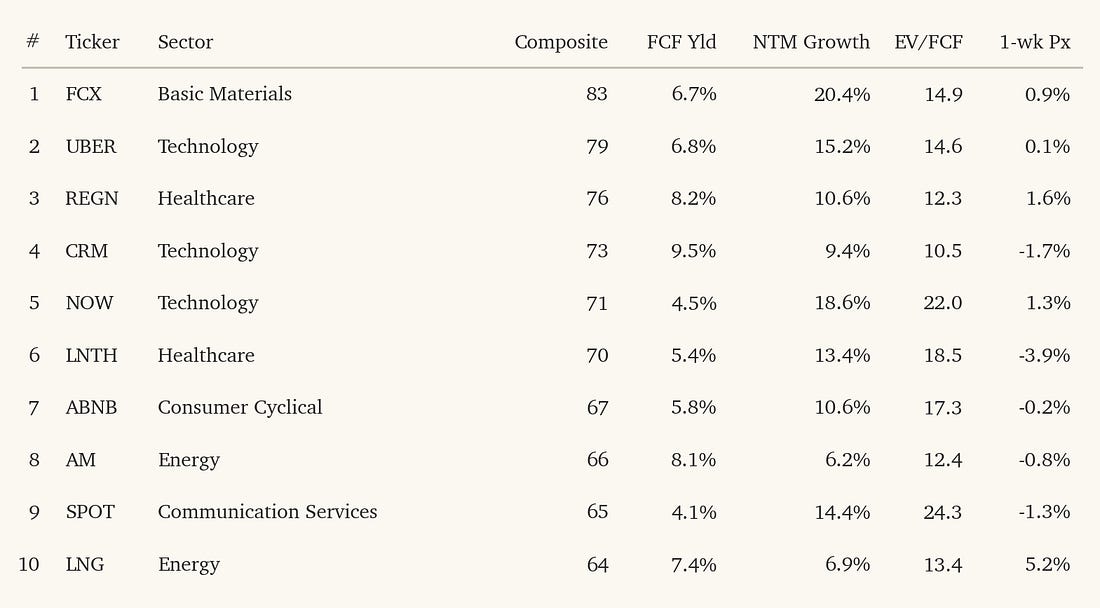
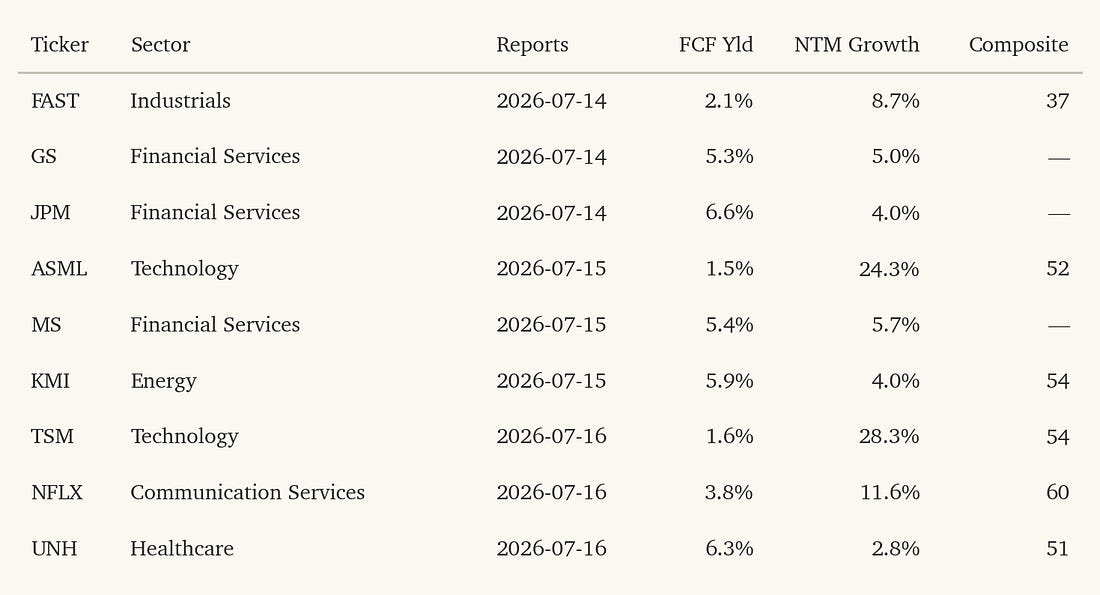
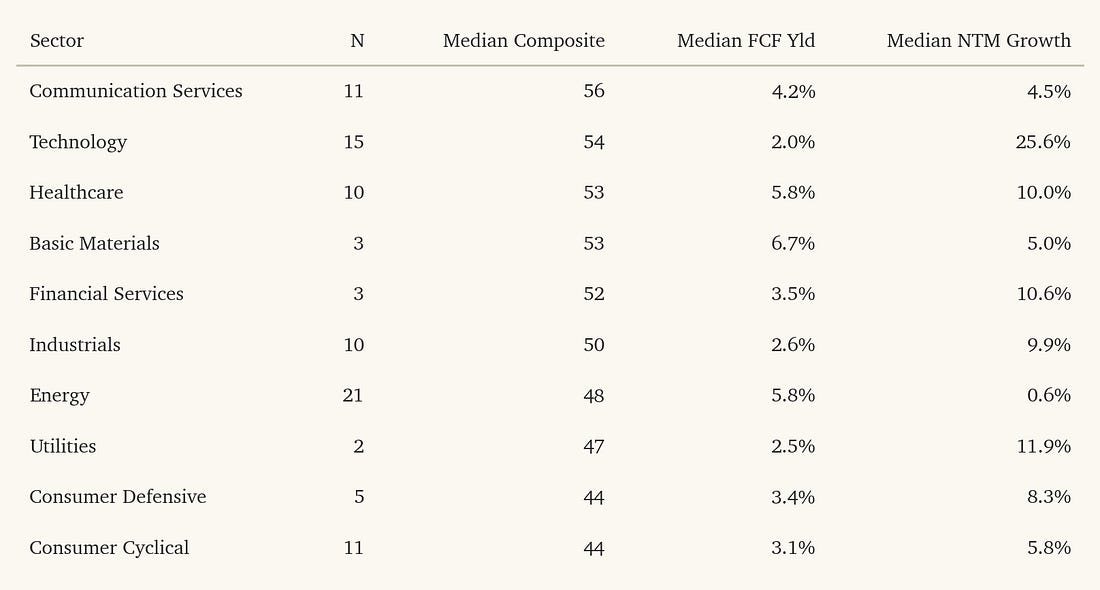
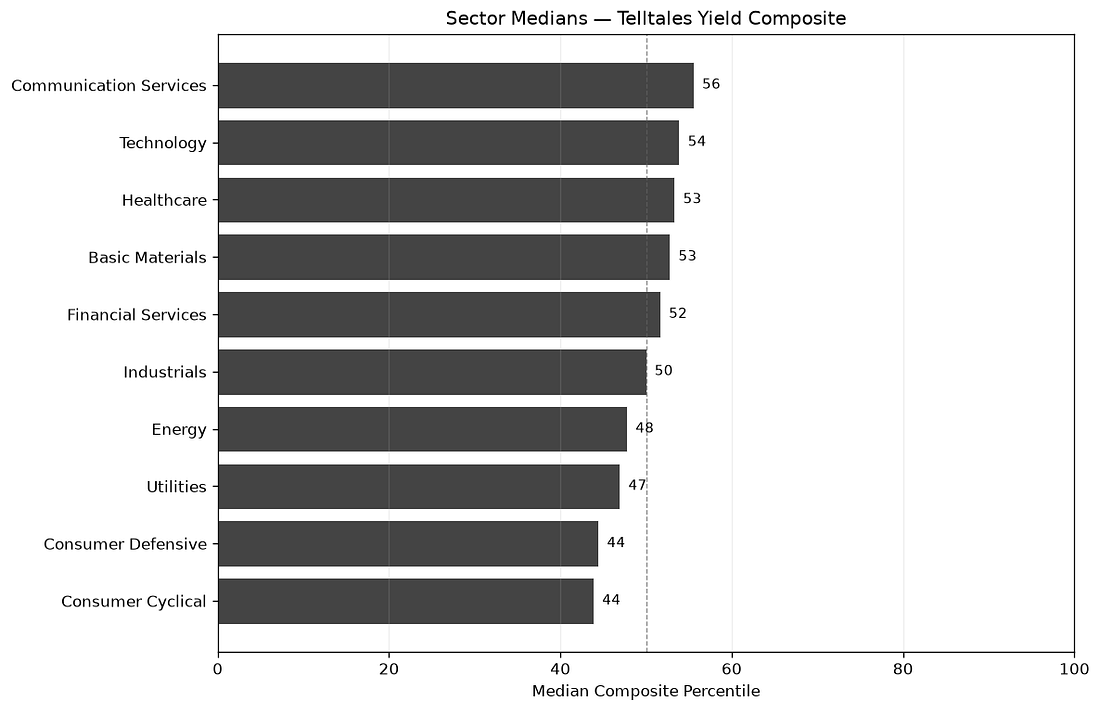
Universe of 94 cashflow-memo names, snap dates 2026-07-03 → 2026-07-10. Composite is rank-sum percentile of FCF Yield + NTM Revenue Growth (higher = better balance). Banks and finance-book names shown separately.
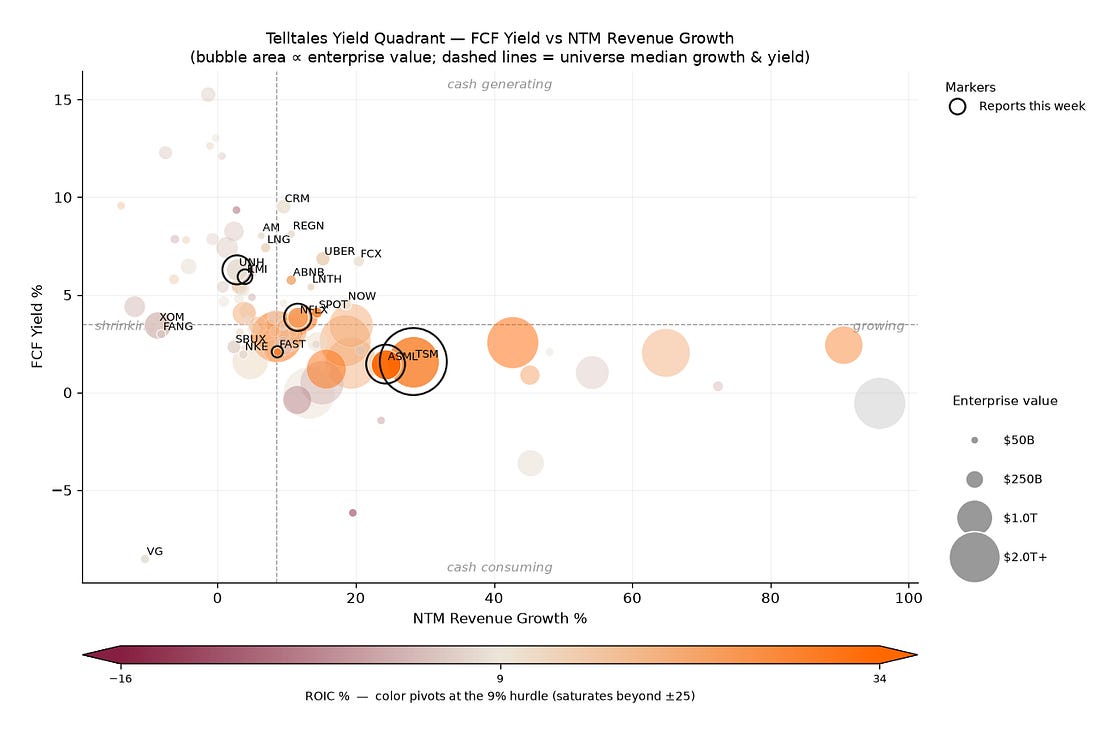
Telltales Yield — Top 10
From the Cashflow Desk — Marcus Graham
The best-balanced name on the tape this week isn’t a chip stock or a software stock — it’s a copper miner. Freeport-McMoRan tops the composite at a 6.7% FCF yield against 20.4% NTM revenue growth, at 14.9x EV/FCF. That pairing — cash-cow yield bolted to growth-stock top line — is the AI power buildout showing up one layer beneath the silicon. Every data center Micron and Intel are racing to feed needs copper by the ton, and the tape is starting to pay the picks-and-shovels before the second-order names catch a bid. Consensus still files Freeport under cyclical commodity, which is the read that misses when a secular demand leg gets bolted onto a cyclical business. The test is the Q2 print later this month: whether realized copper pricing confirms the growth the tape is already paying for.
Telltales Yield — Bottom 10
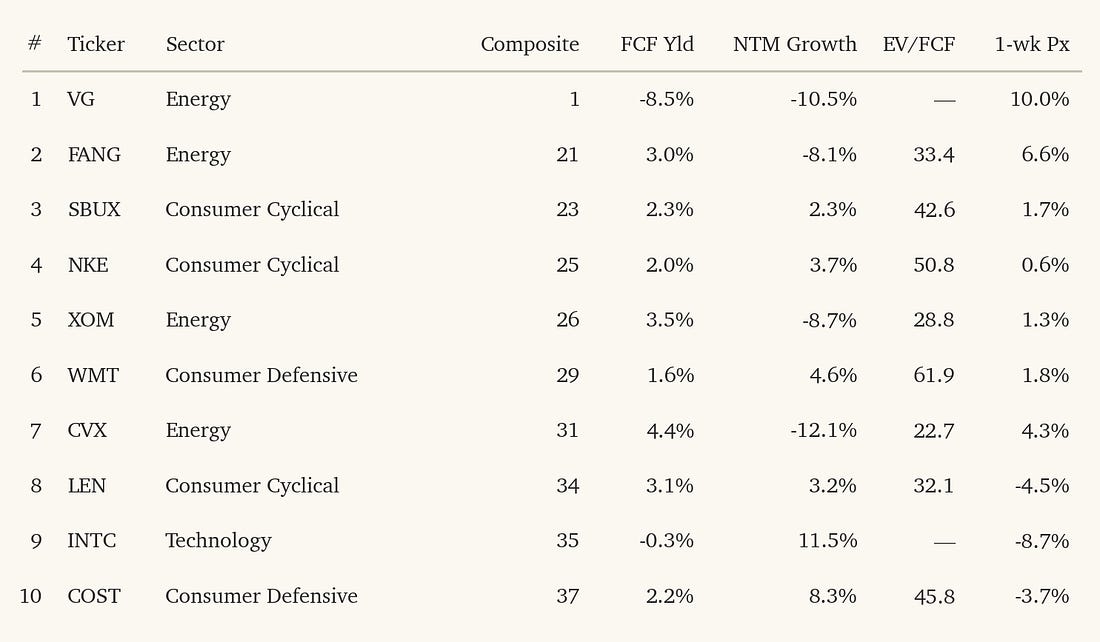
This Week’s Reporters
Sector Medians
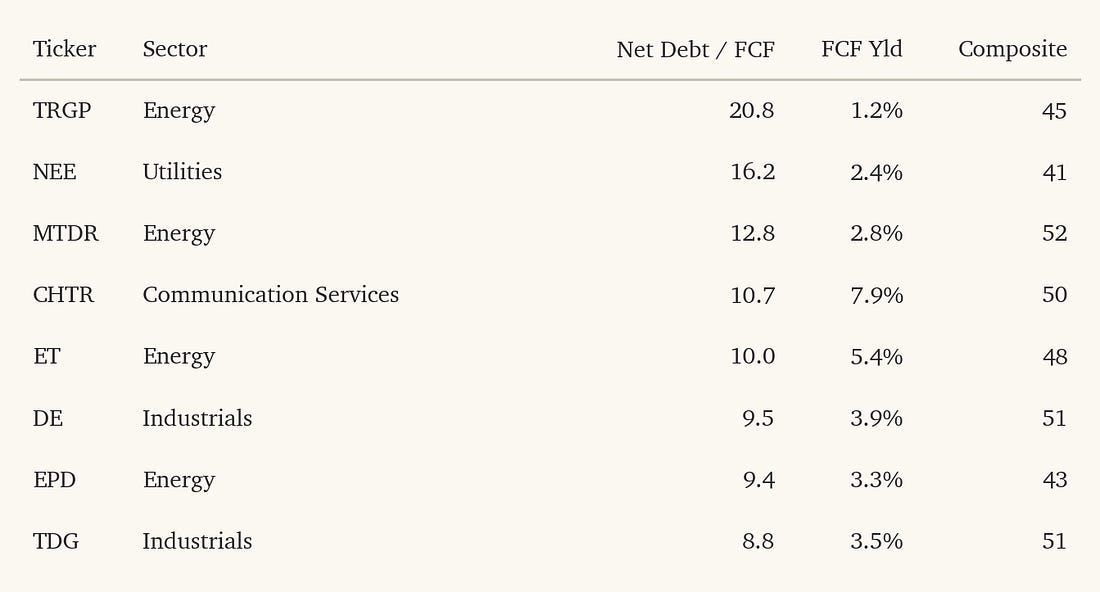
Debt / FCF Watch (highest leverage on TTM FCF)
Weekly Price Movement
Top 5 (week-over-week price) 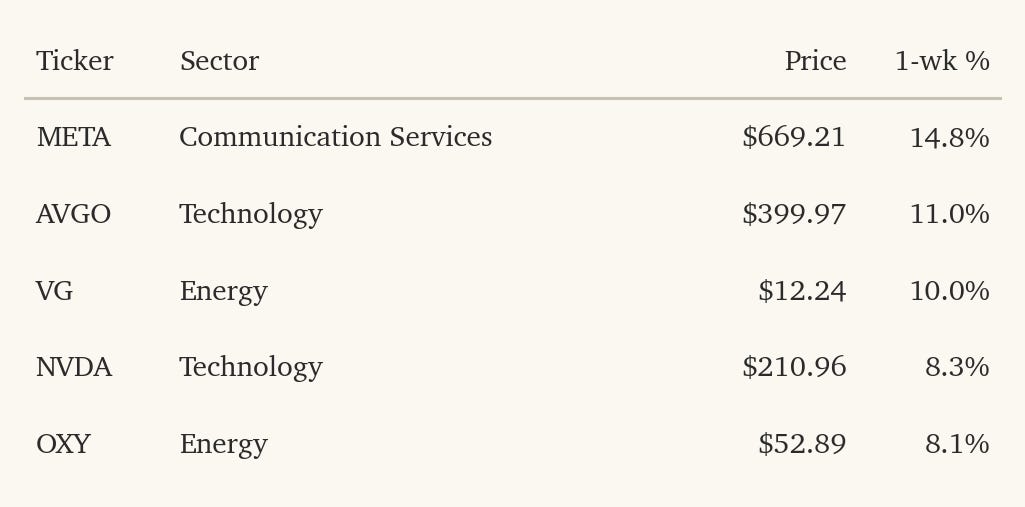
Bottom 5 (week-over-week price) 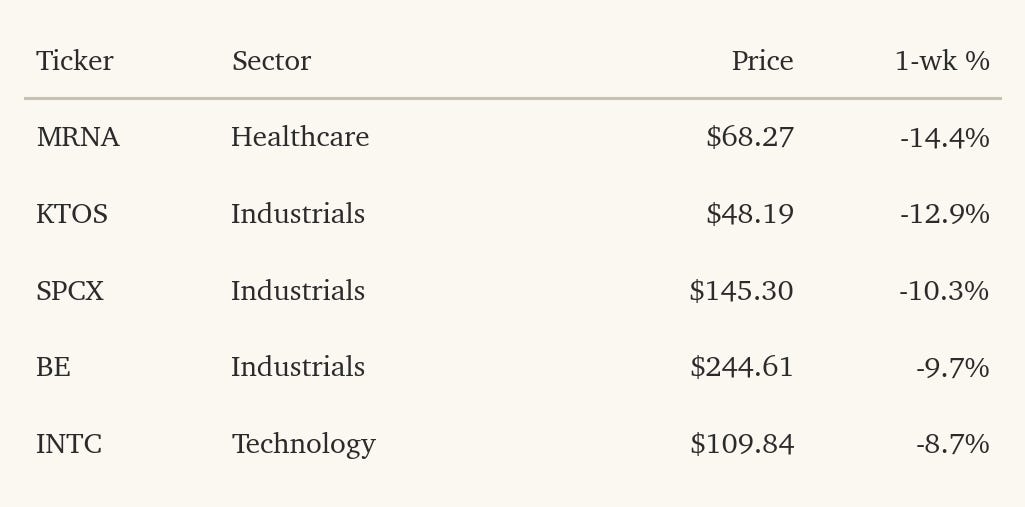
Banks (shown separately — FCF metric not meaningful)
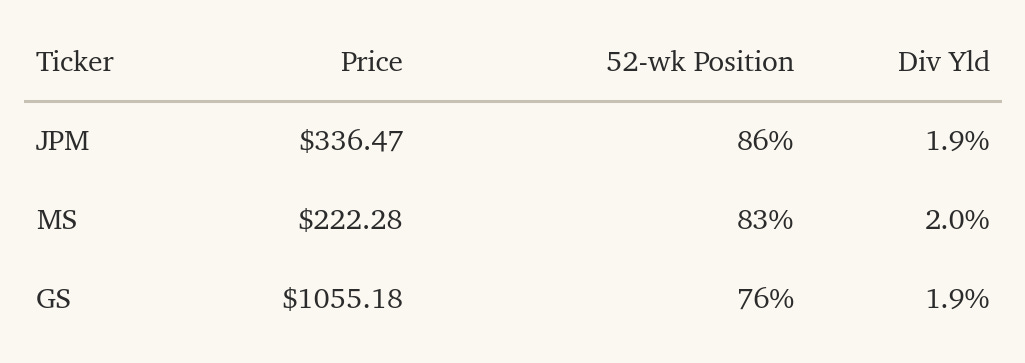
Finance-book — FCF not comparable
Customer-float / captive-finance / reserve businesses (IBKR broker float, KMX CarMax Auto Finance, PYPL customer funds, CRCL stablecoin reserves). The memo’s operating-FCF method overstates their FCF, so they are held off the ranked leaderboard pending the P&L-waterfall rebuild. 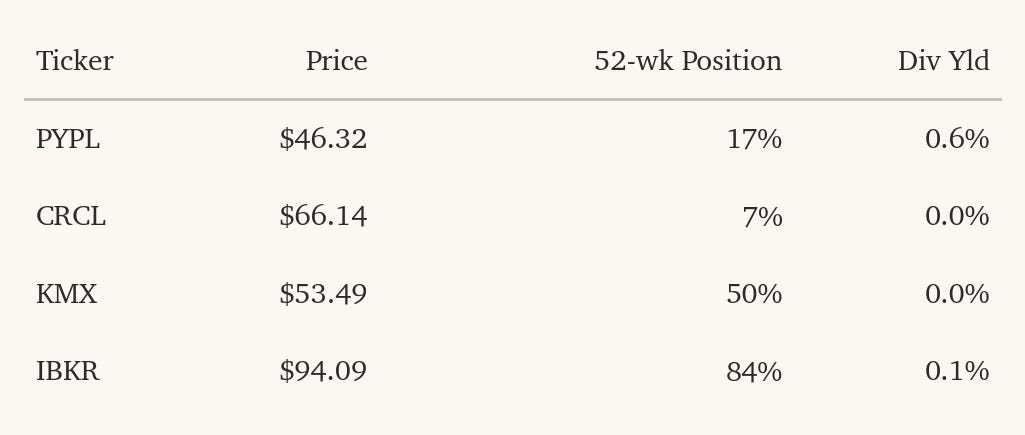
Data Gaps
91 of 91 ranked-eligible names ranked. 0 dropped for missing FCF yield or NTM revenue growth; 7 shown separately (banks + finance-book, FCF not comparable).
Source: cashflow-memo master_2026-07-10.csv. NTM growth from analyst-estimates consensus. Composite is a percentile rank, not a recommendation.
The Issue — This Week's Brief

The Cashflow Memo
W2628 — Micron’s Cash Flow Explosion, Intel’s Data-Center Loss, and Satellites Coming for Cable
Micron’s cash flow explosion, Intel’s data-center loss, and satellites coming for cable.
The Telltales Weekend Update. Ava Cabot and analyst Marcus Graham walk through what happened this week — and what’s coming next — across the companies in the Cash Flow Memo. About 14 minutes. No filler.
Download the memo at telltales.us. Hunt, Jason, and Mike are back Wednesday on episode E2629.
Chapter markers
Time | Segment
0:00 | Opening disclaimer
0:15 | Cold open — throughline + prior-Wed callback
0:50 | Theme — Satellites Come for Cable (Comcast, Charter, T-Mobile)
5:00 | Deep dive — Micron vs. Intel
9:15 | Rapid-fire (NextEra Energy, Apple, Broadcom)
11:45 | Close — Consensus Watch + forward week
12:15 | Closing disclaimer
Full transcript
Opening disclaimer
Ava: The following conversation is intended for informational purposes only. You should always do your own work to determine if an investment is suitable for you.
Cold open
Ava: You’re listening to the Telltales Weekend Update. I’m Ava Cabot.
Marcus: And I’m Marcus Graham — the cashflow desk.
Ava: Quick note: the show is produced entirely with AI tools, and both voices you’re hearing are AI-generated. Send feedback through the Substack.
Ava: Micron just proved what it looks like to win the right side of a technology cycle. Intel proved what it looks like to lose one. Same week, same memo page, completely different cash flow statements — one company’s free cash flow is up almost 900%, the other’s is negative. And it wasn’t just semiconductors — Comcast, Charter, and T-Mobile all got hit with the same question from Wall Street this week: what happens to your subscriber base when a satellite can do what your cable line does? Two banks think it’s a real problem. One thinks it’s overblown. We’ll get into who’s actually right, per the numbers.
Ava: On Wednesday, Hunt, Jason, and Mike ran their mid-year predictions scorecard — grading calls on pharma M&A, the AI buildout, and Tesla’s Robotaxi race against Waymo, closing out the full review without needing a second week[^ep-e2628]. This weekend, two different incumbent stories: who’s getting outflanked, and who’s spending like they know it.
Theme — Satellites Come for Cable
Ava: On page 6 of the Cash Flow Memo this week — Comcast, Charter, and T-Mobile all got the same verdict delivered from three different directions. The threat has a name now: Starlink. It’s been a hypothetical for two years. This week, for the first time, the sell side started putting actual subscriber-loss numbers on it instead of just gesturing at the risk — and the three companies are responding to that same threat in three completely different ways.
Ava: Comcast is dealing with it by spending on two fronts at once. Comcast-owned Sky agreed to buy ITV’s media and entertainment business for up to £1.6 billion — roughly $2.1 billion — with a £200 million earn-out riding on future ad performance[^cmcsa-sky-itv-acquisition-20260706]. Closer to home, Comcast also hit a construction milestone this week, wiring 15,700 new homes and businesses in New Jersey for Xfinity[^cmcsa-phillipsburg-expansion-20260707] — the fiber build going one direction while Wall Street models the satellite bleed going the other. And that’s the real story: Morgan Stanley cut its Comcast price target to $30 from $33 this week, now modeling Starlink at 16 million U.S. broadband subscribers by 2030, costing Comcast and Charter combined 400,000–500,000 broadband subscribers a year[^cmcsa-morgan-stanley-target-20260707]. Marcus — is 6.5 times too cheap, or exactly right?
Marcus: Comcast is the cheapest stock in the entire memo, and the market’s telling you exactly why it’s willing to leave it there. 6.5 times trailing free cash flow, on a 15% yield[^memo-cmcsa-evfcf-20260331]. Free cash flow was already down about 21% year over year going into this[^memo-cmcsa-growth-20260331]. That’s not a value stock. That’s a stock priced for a shrinking subscriber base — and this week Morgan Stanley just told you how much more shrinking they expect. The test is whether the ITV content actually slows the bleed, or whether Morgan Stanley’s subscriber-loss estimate turns out to be the optimistic one.
Ava: Charter’s getting hit even harder — and it’s not just one bank. Barclays slashed its price target from $200 to $130 this week[^chtr-barclays-target-20260708], and Wells Fargo cut theirs too, citing the same deteriorating broadband trend[^chtr-wells-fargo-target-20260707]. Charter also confirmed it’s shutting down a Network Operations Center team this week[^chtr-noc-closure-20260709] — cost-cutting on the ground while two banks cut targets on paper. The one piece of good news: a California regulator recommended approval of Charter’s $34.5 billion acquisition of Cox Communications, clearing a real hurdle toward closing[^chtr-cpuc-recommendation-20260709]. Marcus, the cashflow take.
Marcus: Charter’s the one carrying real balance-sheet risk in this story. 12.5 times trailing free cash flow, but the number that actually matters is leverage — debt to free cash flow at 10.5 times[^memo-chtr-evfcf-20260331][^memo-chtr-debtfcf-20260331]. Free cash flow’s already down 12% year over year[^memo-chtr-growth-20260331]. That kind of price target cut from Barclays in one note isn’t analyst noise — that’s a bank telling you the subscriber math and the leverage math are now the same problem. Watch the leverage ratio, not the multiple. That’s what breaks first if Cox doesn’t close clean or the bleed accelerates.
Ava: And then there’s T-Mobile — the one name in this trio Wall Street can’t agree on. Bank of America upgraded T-Mobile to Buy this week, $220 price target, arguing the market is straight-up overreacting to satellite fears[^tmus-bofa-upgrade-20260706]. Two days later, Wells Fargo initiated coverage at Equal Weight, $170 target, citing Starlink as a real threat to postpaid growth[^tmus-wf-initiation-20260708]. It wasn’t a clean week operationally either — a network outage on July 7 hit more than 2,000 users[^tmus-outage-20260707]. And in the middle of that split analyst decision, T-Mobile also lost a 28-year veteran — Chief Business and Product Officer Mike Katz stepped down, staying on only as an advisor through December[^tmus-katz-exit-20260707]. Marcus — who’s actually right here?
Marcus: T-Mobile’s the only one of these three actually growing into its number. Just under 16 times trailing free cash flow, and free cash flow’s up 6% year over year — not down, up[^memo-tmus-evfcf-20260331][^memo-tmus-growth-20260331]. Management’s still buying back stock, $12 billion trailing twelve months[^memo-tmus-buyback-20260331]. That’s not a balance sheet bracing for a satellite hit. Bank of America and Wells Fargo disagree because the numbers genuinely don’t show the damage yet at T-Mobile — the disagreement is really about which cable and wireless name gets hit first, and right now T-Mobile’s cash flow statement is voting with BofA.
Ava: Verizon’s in the same boat, for what it’s worth — Wells Fargo started coverage there this week too, same Starlink logic, same Equal Weight[^vz-wells-fargo-equal-weight-20260708]. Three telecom names, one satellite story, and completely different balance sheets underneath it. Same page of the memo, three different answers to the same question.
Deep dive — Micron vs. Intel
Ava: The deep dive this week is page 3 of the memo — Micron and Intel. Same industry, same seven days, opposite direction entirely. Both companies make chips. Both are spending tens of billions on U.S. manufacturing. And this week, one of them got paid for it and the other got punished for it. One company just told the market it’s betting a quarter-trillion dollars on a supercycle that isn’t slowing down. The other just watched its oldest rival pass it in the one number that was supposed to be safe.
Ava: Micron raised its U.S. manufacturing commitment to $250 billion through 2035 — $50 billion more than the number it announced earlier this year — and poured first concrete at its new fab in Clay, New York, more than a full quarter ahead of schedule[^mu-investment-expansion-20260709][^mu-nyc-fab-concrete-20260709]. It also put another $3 billion into the domestic supply chain this week, including financing to GlobalWafers for a Texas wafer facility[^mu-supply-chain-20260709]. Intel had a rougher week — and it actually started on a high note. Intel stock got an early lift Monday when the Broadcom-Apple chip deal triggered a broader semiconductor rally, up 5% on the read-through[^intc-broadcom-apple-20260706]. That lift didn’t last. Reports surfaced that its 18A and 18A-P manufacturing nodes won’t hit profitable yields until late 2026 at the earliest — more likely 2027[^intc-stock-decline-20260708]. The stock dropped nearly 10% on July 7, another almost 8% on July 8 — a 21% decline in seven trading days[^intc-stock-decline-20260708]. And in the same window, AMD reported more first-quarter data-center revenue than Intel for the first time ever — $5.8 billion to Intel’s $5.1 billion[^intc-amd-datacenterdominance-20260708]. Marcus, start with Micron.
Marcus: Micron just re-priced itself without anyone noticing, because the earnings caught up to the multiple instead of the multiple getting cut. The memo has Micron at about 41 times trailing free cash flow now, on $26 billion of trailing FCF — up about 879% from a year ago[^memo-mu-evfcf-20260528][^memo-mu-growth-20260528]. That’s not a stock getting more expensive. That’s a company whose cash generation exploded faster than the stock price did. The pledge increase and the ahead-of-schedule fab are Micron telling you it believes this isn’t a one-quarter DRAM spike. Watch whether pricing holds through the next print — that’s the whole bet.
Ava: Now the other side of that page.
Marcus: Intel didn’t lose the data-center chip war on a spreadsheet — it lost it on a delayed process node. Capex ran about $13 billion trailing twelve months[^memo-intc-capex-20260328], and none of that spending has translated into a profitable 18A yield yet, which is why free cash flow is negative and there’s no honest multiple to put on this stock right now. The number that actually matters isn’t a valuation ratio — it’s $5.8 billion versus $5.1 billion, AMD over Intel in data-center revenue, a line that has never crossed before[^intc-amd-datacenterdominance-20260708]. The test isn’t the next earnings beat. It’s whether 18A actually yields profitably on the 2027 timeline this report just laid out.
Marcus: Same memo page, same week. One company’s balance sheet just got permission to spend more. The other’s still waiting on a process node that isn’t yielding yet.
Ava: Micron’s betting on being early. Intel’s betting on catching up. Mark the next print for both.
Rapid-fire
Ava: Rapid-fire. Two more stories this week, no deep analytical beat — just the signal, quick.
Ava: NextEra Energy filed the paperwork on the biggest utility merger of the year. The SEC S-4 went in on July 9 — roughly $67 billion, NextEra absorbing Dominion Energy, each Dominion share converting into NextEra stock plus a cash payment, targeting close in the second half of 2027[^nee-dominion-s4-20260709]. Here’s the tension: the Cash Flow Memo already had NextEra’s free cash flow down 65% year over year before any of this[^memo-nee-growth-20260331]. They’re announcing the sector’s largest deal in years off a balance sheet that’s already stretched. NextEra reports its own second-quarter numbers on July 24[^nee-earnings-date-20260710] — that’s the print to watch for how this financing actually gets structured.
Ava: Apple and Broadcom extended their chip partnership through 2031 — $30 billion, more than 15 billion U.S.-made chips, including a $1.5 billion facility expansion in Fort Collins, Colorado[^aapl-avgo-chipdeal-20260708]. Apple’s already sitting at about 35 times trailing free cash flow[^memo-aapl-evfcf-20260328] — this is a company paying up for supply-chain certainty, not hunting for a cheap deal. Same week, the EU’s top court rejected Apple’s appeal and upheld its gatekeeper designation under the Digital Markets Act, for both iOS and the App Store[^aapl-eu-antitrust-20260708]. Broadcom, on the other side of the chip deal, got downgraded to Hold by Erste Group — their read is a 35-times forward multiple against Nvidia’s 22, even with the strong margins[^avgo-downgrade-20260707]. One company paying for certainty, one company getting told its certainty is already priced in. Apple’s own Q3 print lands July 30, off guidance of 14–17% revenue growth on iPhone 17 demand[^aapl-q3-call-20260709] — that’s the number that tells you whether paying for certainty was worth it.
Close
Ava: That’s the show. Wall Street’s consensus on cable and wireless: satellites are coming for all three names the same way. Two banks agree on Comcast and Charter — but Bank of America just broke ranks on T-Mobile, and this week T-Mobile’s own cash flow statement backed them up. Consensus isn’t as unanimous as the headlines make it sound. And on chips: consensus likes to treat memory and logic as the same semiconductor story. Micron and Intel just spent a week proving they’re not — one’s compounding, the other’s now pricing in a 2027 turnaround instead of a 2026 one.
Ava: Forward week: earnings season builds fast. JPMorgan and Goldman Sachs both report Tuesday[^earn-jpm][^earn-gs] — the first real read on how the banks are pricing credit risk into the back half of the year. ASML drops Wednesday, and Morgan Stanley reports the same day[^earn-asml][^earn-ms]. Thursday is stacked — Taiwan Semi, Netflix, and UnitedHealth, all in one session[^earn-tsm][^earn-nflx][^earn-unh]. Taiwan Semi in particular is the real test of whether Micron’s supercycle story extends to the rest of the chip complex, or stays a memory-only story. Hunt, Jason, and Mike are back Wednesday on episode E2629. Download the Cash Flow Memo at telltales.us.
Closing disclaimer
Ava: The views expressed on this podcast are the host alone and do not constitute an offer to sell or a recommendation to purchase, or a solicitation of an offer to buy any security, nor a recommendation for any investment product or service. While certain information contained herein has been obtained from sources believed to be reliable, neither the host nor any of their employers or their affiliates have independently verified this information, and its accuracy and completeness cannot be guaranteed. Accordingly, no representation or warranty, express or implied, is made as to, and no reliance should be placed on, the fairness, accuracy, timeliness, or completeness of this information. The host and all employers and their affiliated persons assume no liability for this information and no obligation to update the information or analysis contained herein in the future, and may or may not hold positions in the securities mentioned.
Sources
AMD Tops Intel in Q1 Data Center Revenue on AI Demand. (2026, July 8). WinBuzzer. https://winbuzzer.com/2026/05/08/analysis-amd-overtakes-intel-in-data-center-revenu-xcxwbn/
Apple Inc. (2026, July 8). Apple to increase spend with Broadcom to produce billions more U.S. chips [Press release]. Apple Newsroom. https://www.apple.com/newsroom/2026/07/apple-to-increase-spend-with-broadcom-to-produce-billions-more-us-chips/
Apple loses major antitrust appeal in Europe, remains a gatekeeper. (2026, July 8). 9to5Mac. https://9to5mac.com/2026/07/08/apple-loses-major-antitrust-appeal-in-europe-remains-a-gatekeeper/
Apple schedules Q3 2026 earnings conference call for July 30th. (2026, July 9). MacDailyNews. https://macdailynews.com/2026/07/09/apple-schedules-q3-2026-earnings-conference-call-for-july-30th/
Barclays Adjusts Price Target on Charter Communications to $130 From $200. (2026, July 8). MarketScreener. https://www.marketscreener.com/news/barclays-adjusts-price-target-on-charter-communications-to-130-from-200-ce7f5ed9d88ef222
Broadcom Expands Work for Apple Supplying Products through 2031. (2026, July 6). Bloomberg. https://www.bloomberg.com/news/articles/2026-07-06/broadcom-expands-work-for-apple-supplying-products-through-2031
Charter Communications to discontinue Network Operations Center team at Town & Country office. (2026, July 9). First Alert 4. https://www.firstalert4.com/2026/07/09/warn-notice-released-charter-town-country/
Comcast Corporation. (2026, July 7). Comcast Reaches Construction Milestone in Greater Phillipsburg Expansion, Bringing Xfinity and Comcast Business Services to More New Jersey Communities [Press release]. Business Wire. https://www.businesswire.com/news/home/20260707307752/en/Comcast-Reaches-Construction-Milestone-in-Greater-Phillipsburg-Expansion-Bringing-Xfinity-and-Comcast-Business-Services-to-More-New-Jersey-Communities
CPUC Judge Proposes Approving Charter-Cox Merger. (2026, July 9). Broadband Breakfast. https://broadbandbreakfast.com/cpuc-judge-proposes-approving-charter-cox-merger/
Erste Group Moves Broadcom (AVGO) to Hold. (2026, July 7). Yahoo Finance. https://finance.yahoo.com/news/erste-group-moves-broadcom-avgo-164525932.html
ITV agrees sale of media and entertainment business to Sky for up to £1.6bn. (2026, July 6). ITV News. https://www.itv.com/news/2026-07-06/itv-agrees-sale-of-media-and-entertainment-business-to-sky-for-up-to-16bn
Micron Boosts US Spending to $250 Billion to Feed Memory Boom. (2026, July 9). Bloomberg. https://www.bloomberg.com/news/articles/2026-07-09/micron-boosts-us-spending-to-250-billion-amid-memory-demand
Micron Technology, Inc. (2026, July 9). Micron Accelerates U.S. Investments, Pours First Concrete at New York Fab [Press release]. GlobeNewswire. https://www.globenewswire.com/news-release/2026/07/09/3324807/14450/en/Micron-Accelerates-U-S-Investments-Pours-First-Concrete-at-New-York-Fab.html
Morgan Stanley Adjusts Price Target on Comcast to $30 From $33. (2026, July 7). MarketScreener. https://www.marketscreener.com/news/morgan-stanley-adjusts-price-target-on-comcast-to-30-from-33-ce7f5edbd08cf624
NextEra Energy, Inc. (2026, July 9). NextEra Energy and Dominion Energy to merge [Form S-4]. U.S. Securities and Exchange Commission. https://www.sec.gov/Archives/edgar/data/0000753308/000110465926082301/tm2614888-13_s4.htm
NextEra Energy, Inc. (2026, July 10). NextEra Energy announces date for release of second-quarter 2026 financial results [Press release]. PR Newswire via TradingView News. https://www.tradingview.com/news/prnewswire:3f783c3848b02:0-nextera-energy-announces-date-for-release-of-second-quarter-2026-financial-results/
Semiconductor Selloff Deepens As AI Spending Fears Hit Intel. (2026, July 8). Forbes. https://www.forbes.com/sites/petercohan/2026/07/08/intel-stock-down-21-inside-the-july-2026-semiconductor-selloff/
T-Mobile Down for Thousands of Users, Downdetector Shows. (2026, July 7). GV Wire. https://www.gvwire.com/2026/07/07/t-mobile-down-for-thousands-of-users-downdetector-shows/
T-Mobile US, Inc. (2026, July 7). T-Mobile Appoints Chris Sambar Chief Enterprise Officer and Evolves Leadership Team to Advance its Next Era of Strategic Growth and Innovation [Press release]. T-Mobile Newsroom. https://www.t-mobile.com/news/business/t-mobile-appoints-chris-sambar-chief-enterprise-officer
T-Mobile stock gains as BofA upgrades to Buy, says satellite fears overblown. (2026, July 6). Yahoo Finance. https://finance.yahoo.com/markets/stocks/articles/t-mobile-stock-gains-bofa-121406811.html
Wells Fargo cautious on AT&T, Verizon and T-Mobile as Starlink looms. (2026, July 8). Yahoo Finance. https://finance.yahoo.com/markets/stocks/articles/wells-fargo-cautious-t-verizon-123610956.html
Wells Fargo initiates T-Mobile stock coverage with Equal Weight rating. (2026, July 8). Investing.com. https://www.investing.com/news/analyst-ratings/wells-fargo-initiates-tmobile-stock-coverage-with-equal-weight-rating-93CH-4781310
Wells Fargo Maintains Underweight on Charter Communications, Lowers Price Target to $160. (2026, July 7). Sahm Capital. https://www.sahmcapital.com/news/content/wells-fargo-maintains-underweight-on-charter-communications-lowers-price-target-to-160-2026-07-07
Earnings slate references
Earnings dates sourced from the W2628 earnings slate (04. Publishing/shows/weekend-update/W2628/dryrun/earnings_slate.md), pulled 2026-07-10.
JPMorgan Chase (JPM) — 2026-07-14 (Tuesday), consensus EPS $5.52, consensus revenue $51.06B
Goldman Sachs (GS) — 2026-07-14 (Tuesday), consensus EPS $14.47, consensus revenue $16.22B
ASML (ASML) — 2026-07-15 (Wednesday), consensus EPS $7.98, consensus revenue $10.26B
Morgan Stanley (MS) — 2026-07-15 (Wednesday), consensus EPS $2.89, consensus revenue $19.65B
Taiwan Semiconductor (TSM) — 2026-07-16 (Thursday), consensus EPS $3.80, consensus revenue $39.97B
Netflix (NFLX) — 2026-07-16 (Thursday), consensus EPS $0.79, consensus revenue $12.58B
UnitedHealth (UNH) — 2026-07-16 (Thursday), consensus EPS $4.84, consensus revenue $110.76B
Internal data
Internal data is provided on a best efforts basis.


