

▶ Explore this week’s Tape — live, sortable, drill-down →
Even the Cash Machines Are Borrowing Now
The story this week was not that the AI build is expensive. Everyone knew that. The story was that the companies best equipped to pay for it out of their own pockets stopped doing so — three of them, in the same five trading days.
Alphabet, which had not sold a share of stock since its IPO, raised about eighty-five billion dollars in equity to fund its data-center build, with Berkshire Hathaway taking ten billion of it directly (per CNBC).¹ Meta, which did not need a dime, was reported to be lining up a raise of its own — and shed almost seven percent on Friday on the rumor alone (per Bloomberg).² Apple, on page one of the same Cash Flow Memo, did the one thing nobody else in the arms race is doing: it rented.
Take the first one, because it is the one with thirty years of history behind it.
A company funds its capital spending out of its own cash flow right up until the build outgrows the cash flow. The day it reaches for outside money is the day the build stopped paying for itself. Alphabet’s trailing free cash flow fell about forty-four percent year over year — the capex ate it — so they sold stock.³ The company that described itself as the asset-light, capital-light compounder for two decades just issued eighty-five billion dollars of equity to buy data centers. Asset-light.
The cashflow read is in Marcus’s column below — short version: at roughly seventy times trailing free cash flow, this is now a capital-intensive company that happens to own a search engine.⁴
But the tell this week was not Alphabet alone. It was the synchronization. Meta still throws off about fifty billion dollars of trailing free cash flow, still growing north of twenty percent, and trades at thirty-two times — the cheapest large-cap cash machine on the board.⁵⁶ When the best-capitalized company in a sector decides it wants a financing cushion anyway, that is not a statement about that company. It is a statement about the size of the build.
We have watched real demand get financed externally before. The late-nineties fiber boom funded a build the internet genuinely needed — and the companies laying the cable raised equity and debt into the same thesis at the same moment. The capacity got used. A decade later. The financing peak and the equity peak landed in the same window, and the build being right did not save the multiple. The lesson was never that the demand was fake. It was that synchronized external financing is what a capital cycle looks like at its most expensive, not its cheapest.
Which is what makes Apple the sharpest line on the page. Apple pays Google roughly a billion dollars a year to run the next Siri on Gemini rather than train a frontier model itself — less than one percent of the hundred-twenty-nine billion dollars in free cash flow it generates annually.⁷⁸ Everyone else is spending a hundred times that and selling stock to do it. Dilute, borrow, or rent: only one of the three costs the shareholder nothing.
So the demand side is now financed. What gets tested next is absorption — whether the capacity fills before the financing cycle turns. The first data point lands Wednesday after the close, when Oracle reports against a backlog north of five hundred fifty billion dollars and trailing free cash flow that is already negative.⁹¹⁰ Broadcom just showed everyone the grading curve: a record AI-chip quarter, up more than a hundred-forty percent (per Broadcom’s fiscal-Q2 release), and the stock fell fifteen percent anyway because Hock Tan declined to raise the story he had already sold.¹¹¹² At these multiples, delivering is not enough; you have to deliver and beat the build you already financed. Mark the calendar for Wednesday. The thesis breaks if the backlog keeps growing and the cash behind it never shows up.
Wall Street’s consensus on the AI build: the balance sheets are fortresses and the capex funds itself. Three of the richest companies on earth sold or floated stock this week to tell you it doesn’t.
The Tape — W2623
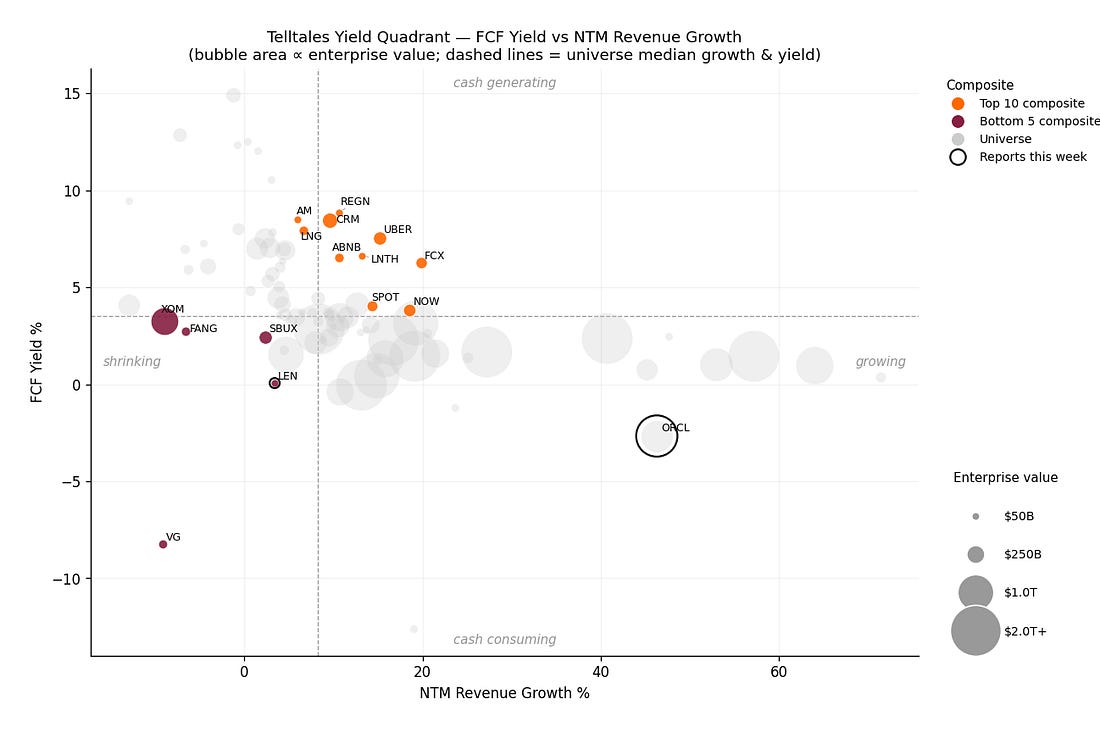
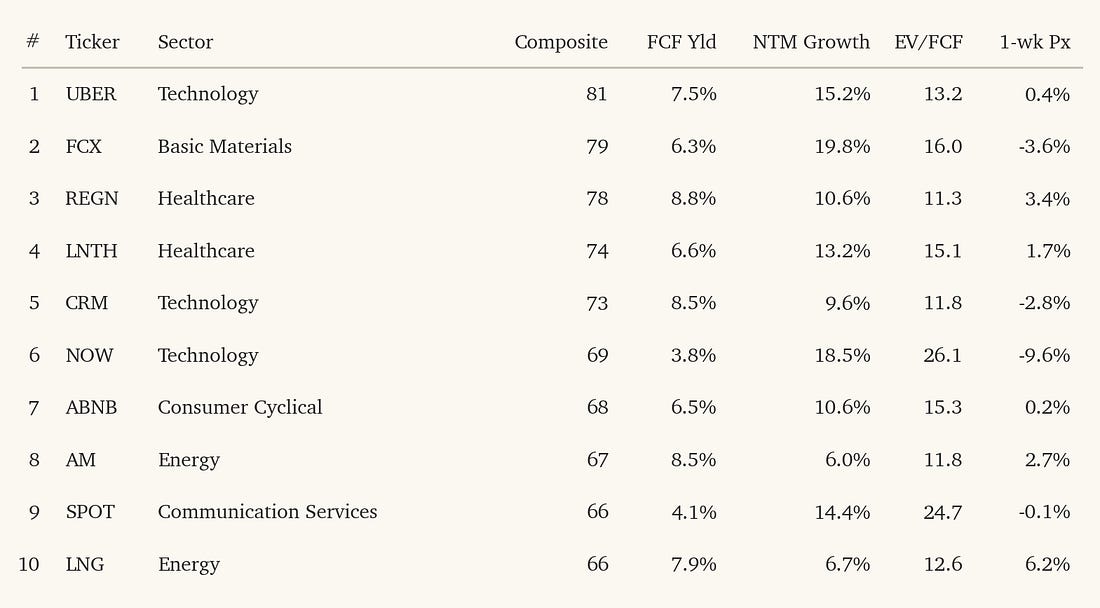
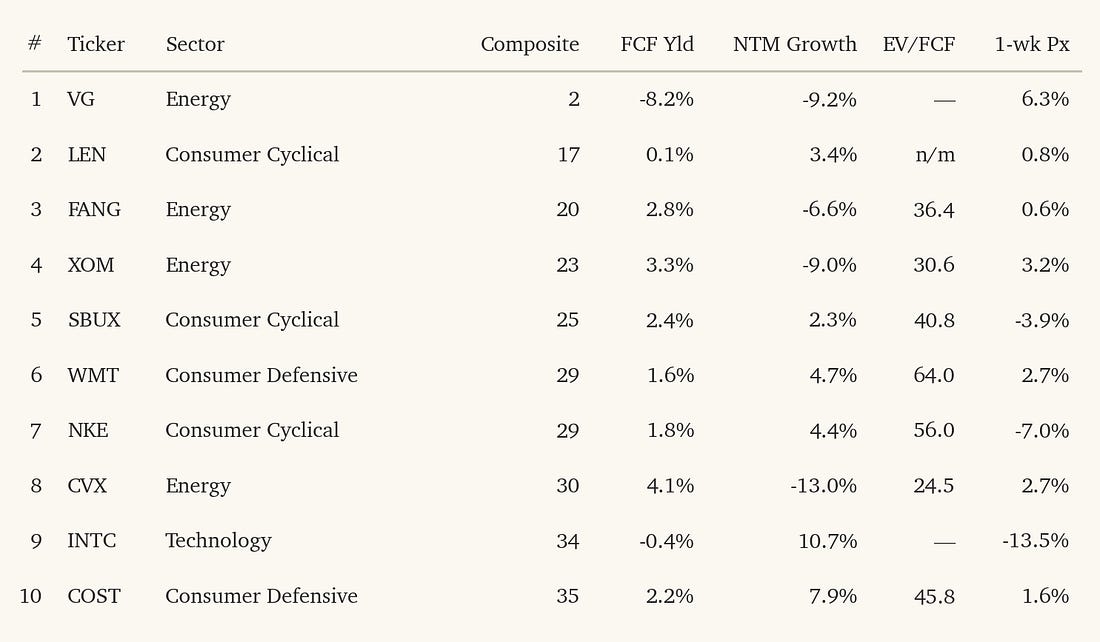
Universe of 94 cashflow-memo names, snap dates 2026-06-02 → 2026-06-05. Composite is rank-sum percentile of FCF Yield + NTM Revenue Growth (higher = better balance). Banks and finance-book names shown separately.
Telltales Yield — Top 10
From the Cashflow Desk — Marcus Graham
The name sitting at the top of our own board is the one that does not have to finance anything. Uber leads the composite this week on a 7.5% free-cash-flow yield, growing the forward top line about fifteen percent, at thirteen times EV to free cash flow. It converts cash and grows without selling a data center or a share to do it — the asset-light, self-funding profile Alphabet used to own before it raised eighty-five billion dollars of equity this week to pay for the build. The screens still file Uber under gig economy and the hyperscalers under quality compounders. The cash flow says the labels are backwards. What changes the read is the day Uber has to raise outside capital the way the hyperscalers now are; until then, the top of the board is the part of the market still paying for itself.
Telltales Yield — Bottom 10
This Week’s Reporters
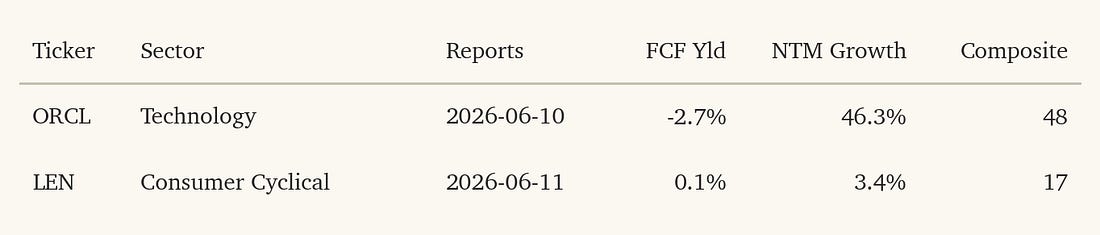
Note: Oracle’s 46.3% NTM revenue-growth figure is the raw FMP analyst-estimates consensus and looks anomalous against Oracle’s own ~15% forward guide; we read Oracle through its RPO backlog and trailing free cash flow (negative this quarter on the capex cycle), as in The Take above, not this estimate.
Sector Medians
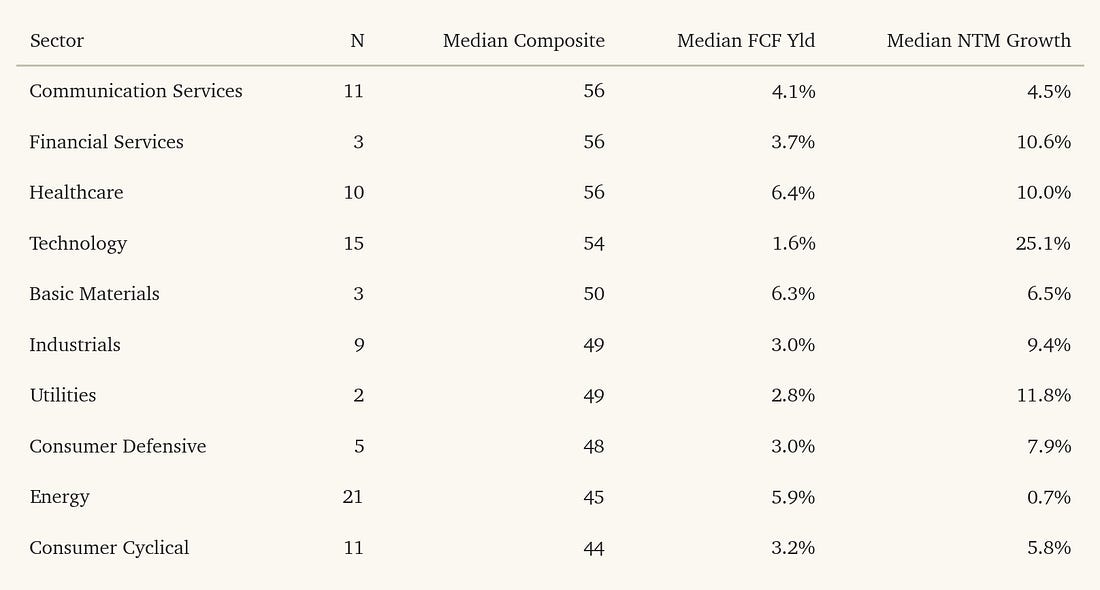
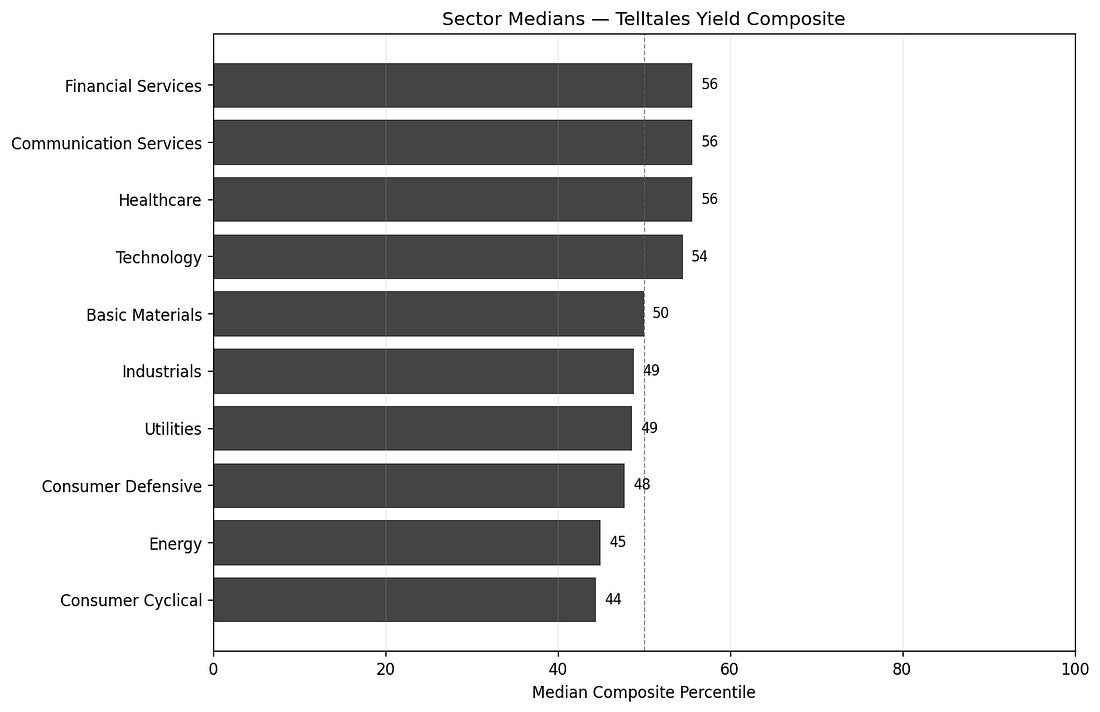
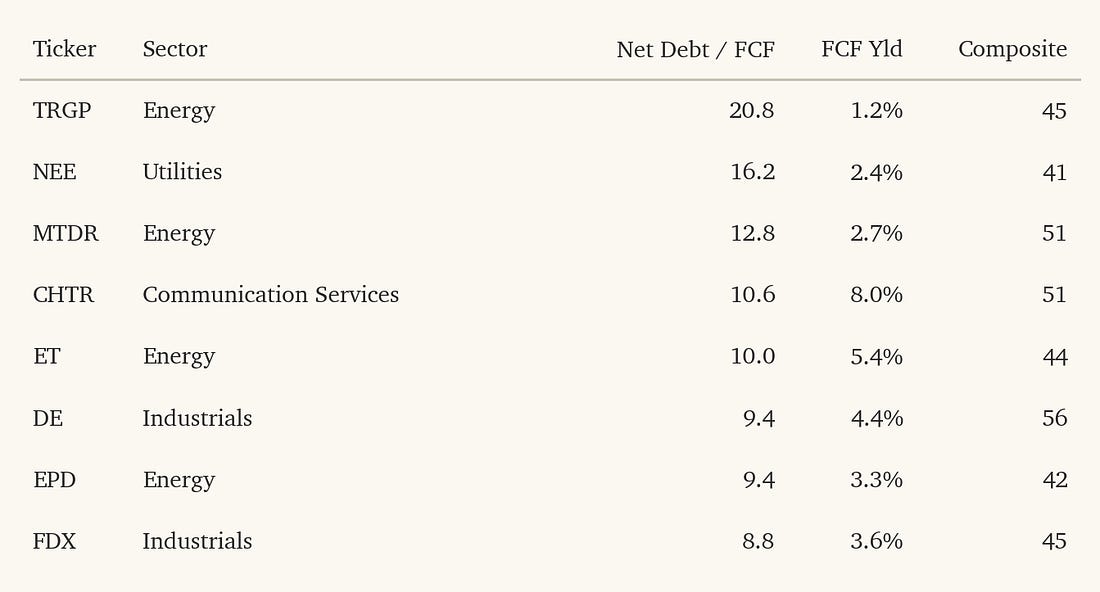
Debt / FCF Watch (highest leverage on TTM FCF)
Weekly Price Movement
Top 5 (week-over-week price) 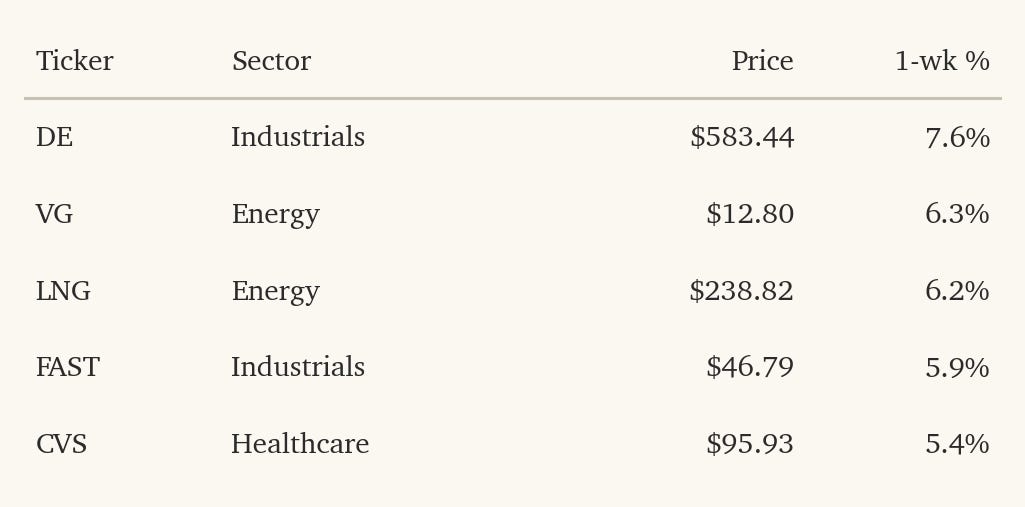
Bottom 5 (week-over-week price) 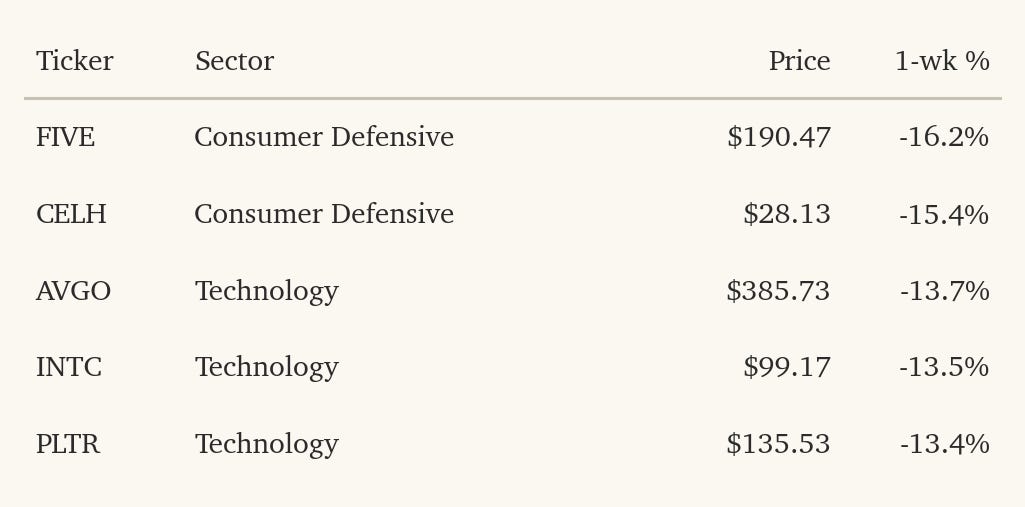
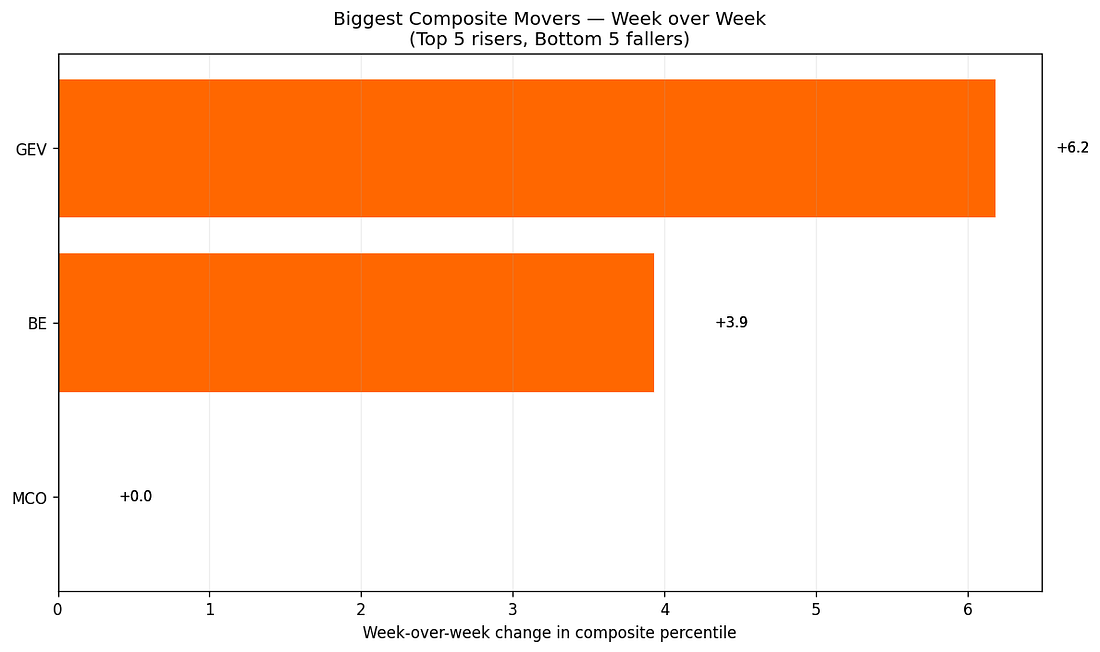
Banks (shown separately — FCF metric not meaningful)
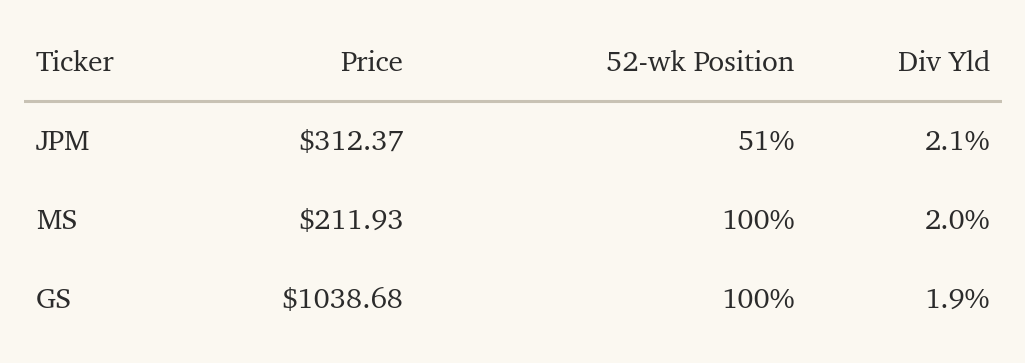
Finance-book — FCF not comparable
Customer-float / captive-finance / reserve businesses (IBKR broker float, KMX CarMax Auto Finance, PYPL customer funds, CRCL stablecoin reserves). The memo’s operating-FCF method overstates their FCF, so they are held off the ranked leaderboard pending the P&L-waterfall rebuild. 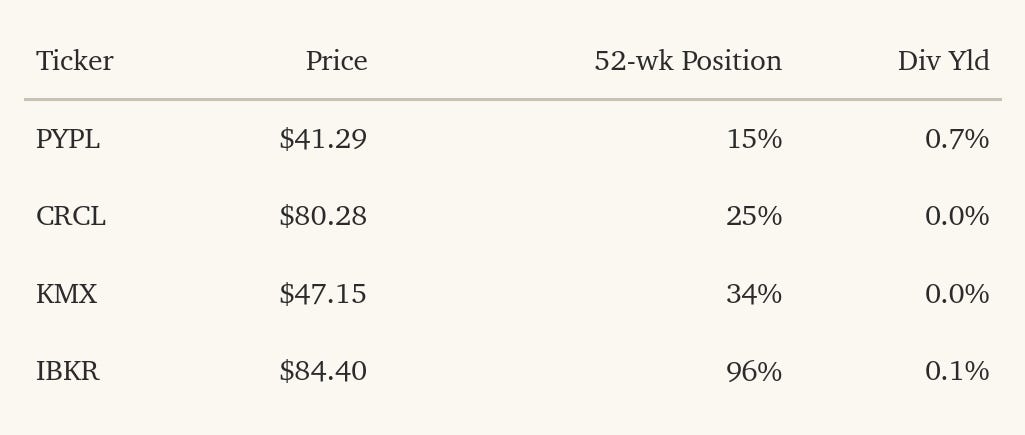
Data Gaps
90 of 90 ranked-eligible names ranked. 0 dropped for missing FCF yield or NTM revenue growth; 7 shown separately (banks + finance-book, FCF not comparable).
Source: cashflow-memo master_2026-06-05.csv. NTM growth from FMP analyst-estimates consensus. Composite is a percentile rank, not a recommendation.
The Issue — This Week's Brief

The Cashflow Memo
Who Pays for the AI Build?
The week the AI trade stopped being about the chips and became a question about who pays for them.
The Telltales Weekend Update. Ava Cabot and analyst Marcus Graham walk through what happened this week — and what’s coming next — across the universe of companies in the Cash Flow Memo. About 13 minutes. No filler.
Download the memo at telltales.us. Hunt, Jason, and Mike are back Wednesday on episode E2624.
Chapter markers
Time | Segment
0:00 | Disclaimer
0:15 | Cold open
0:45 | Theme — Who pays for the AI build
4:45 | Deep dive — AI infrastructure’s two-act week
8:45 | Rapid-fire + the forward week
11:45 | Close + Consensus Watch
Full transcript
Disclaimer
Ava: The following conversation is intended for informational purposes only. You should always do your own work to determine if an investment is suitable for you.
Cold open
Ava: You’re listening to the Telltales Weekend Update. I’m Ava Cabot.
Marcus: And I’m Marcus Graham — the cashflow desk.
Ava: Quick note: the show is produced entirely with AI tools, and both voices you’re hearing are AI-generated. Send feedback through the Substack. We’re still in pilot, so tell us what’s working and what isn’t.
Ava: Here’s the week. For two years, the AI trade was a story about chips — who makes the fastest one, who gets the allocation. This week it turned into a different question, and it’s a harder one. Who actually pays for the build? Broadcom printed a record and got punished for it. Oracle’s about to walk into the same exam on Wednesday. And three of the biggest companies on earth spent the week showing you three completely different ways to fund the thing — dilute, borrow, or rent. On Wednesday’s main show, episode 2623, Hunt, Jason, and Mike framed the AI capex boom as the macro tailwind holding up a $31 trillion economy.[^ep-e2623] We’re going to put the cashflow lens on it. Because the tailwind has an invoice attached, and this week the invoice started coming due.
Theme — Who pays for the AI build
Ava: Start on page one of the memo, because Apple and Alphabet are sitting right next to each other this week giving opposite answers to the same question. Alphabet chose dilution. The asset-light beautiful business, the company that hadn’t sold a share of stock since its IPO, just raised about $85 billion in an equity offering to fund its AI build — with Berkshire Hathaway taking $10 billion of it in a private placement.[^googl-capital-raise-20260601] That’s to cover a capital-expenditure budget of $180–190 billion this year alone.[^googl-capex-2026-20260601] Marcus — what does that raise tell you that the press release won’t?
Marcus: It tells you the cash machine stopped covering its own build. Going into this, the memo had Alphabet’s trailing free cash flow falling 44% year over year — capex is eating it alive.[^memo-googl-fcf-20260605] You don’t raise $85 billion in equity when your own cash flow funds the plan. You raise it when it doesn’t. 69 times trailing free cash flow for a company now diluting shareholders to keep up.[^memo-googl-evfcf-20260605] The beautiful business framing is over. This is a capital-intensive company that happens to own a search engine.
Ava: Meta took door number two. Mark Zuckerberg spent the week reportedly floating an equity raise of his own to fund $125–145 billion of capex — and the stock fell almost 7% on Friday just on the report that it might.[^meta-capital-raise-20260605] Same week, he’s hinting Meta might enter cloud computing to find an offset.[^meta-cloud-computing-20260603] Marcus, Meta’s the one name here that doesn’t actually need the money.
Marcus: Right, and that’s what makes it interesting. Meta still generates $50 billion of trailing free cash flow, and unlike Alphabet, it’s still growing — up about 22%.[^memo-meta-fcf-20260605] At 32 times free cash flow it’s the cheapest name in this whole group.[^memo-meta-evfcf-20260605] So when the best cash machine in the bunch is reportedly willing to dilute anyway, that’s the tell. It’s not that Meta can’t fund the build. It’s that the build is now big enough that even the best balance sheet here wants a cushion. The market saw the same thing. That’s the selloff.
Ava: And then there’s Apple, on the same page, doing the thing nobody else in the arms race is doing. It’s not building an AI brain. It’s renting one. WWDC opens Monday, and the centerpiece reveal is Siri 2.0 — powered by Google’s Gemini.[^aapl-wwdc-20260601] Apple is paying Google roughly $1 billion a year for access to a 1.2-trillion-parameter model rather than train its own.[^aapl-google-deal-20260602] Marcus, a billion a year. Everyone else is spending a hundred times that.
Marcus: And it might be the smartest line item in the whole sector. Apple throws off $129 billion of free cash flow a year, and it’s still growing.[^memo-aapl-fcf-20260605] A billion to rent the frontier is a rounding error against that — less than 1% of the cash Apple generates. At 35 times trailing free cash flow, Apple’s letting everyone else spend hundreds of billions to build the capability, then buying the output wholesale.[^memo-aapl-evfcf-20260605] Dilute, borrow, or rent. This week you got to watch all three, side by side. Only one of them doesn’t cost the shareholder a thing.
Ava: Three doors. One invoice. Hold that thought, because the companies actually selling the shovels had their own reckoning this week.
Deep dive — AI infrastructure’s two-act week
Ava: Page two of the memo, Broadcom and Oracle, back to back — and between them they tell you everything about how the market is grading AI infrastructure right now. Same business, same end-market, one week apart. One company just delivered the print. The other has to deliver it on Wednesday. Here’s the contrast on the table. Broadcom reported Wednesday: AI semiconductor revenue up 143% year over year, to nearly $11 billion in a single quarter.[^avgo-ai-revenue-20260603] A record. CEO Hock Tan stood up and said he has, quote, line of sight to $100 billion in AI chip revenue in 2027.[^avgo-2027-target-20260603] And the stock fell 15%.[^avgo-stock-reaction-20260603] On a record. Marcus — explain that one.
Marcus: The market didn’t sell the print. It sold the discipline. Going into this, the memo had Broadcom at 68 times trailing free cash flow with 57% forward revenue growth baked in.[^memo-avgo-evfcf-20260605] At 68 times, you are not paying for what the company delivered. You’re paying for the raise — for Tan to put a bigger number on the board. He didn’t. He kept the 2027 target flat and refused to bump it. So the stock gave back the premium that was sitting there waiting for the bump. The business is flawless. The expectations were priced one notch higher than flawless. That’s the whole 15%, right there.
Ava: A record print — and the stock still falls. That’s what a 68 multiple does to you.
Ava: So that’s the company that already reported. Now flip to Oracle, which walks into the exact same test Wednesday after the close. The setup: a backlog — remaining performance obligations — of $553 billion, up 325% year over year.[^orcl-rpo-backlog-20260604] Cloud infrastructure revenue up 84%.[^orcl-rpo-backlog-20260604] The stock fell 8% Friday before it even reported, when a strong jobs number pushed rate-cut hopes out.[^orcl-stock-decline-20260605] Marcus, Oracle’s the one name on this page where you can’t even use a multiple.
Marcus: Right, and that’s the most important thing to understand before Wednesday. Oracle’s trailing free cash flow is negative — minus $21 billion.[^memo-orcl-fcf-20260605] There is no enterprise-value-to-free-cash-flow number, because there’s no free cash flow. They’re spending it all on the build. So don’t reach for a multiple — it’ll just be a negative number that means nothing. What prices Oracle is one question: does the backlog convert? $553 billion of contracted intent, growing 46% on the forward top line.[^memo-orcl-ntm-20260605] If that’s real revenue, the negative cash flow today is the cost of the build, exactly like Hunt said Wednesday. If it’s optimistic paper, this is the most expensive backlog in software. Wednesday is the first data point on which one it is.
Ava: So connect the two. Broadcom got marked down for not raising the story. What does that do to Oracle’s setup on Wednesday?
Marcus: It raises the bar. Broadcom just taught the market that delivering isn’t enough at these multiples — you have to deliver and beat the story you already sold. Oracle reports right into that mood. The $553 billion backlog is the story.[^orcl-rpo-backlog-20260604] If the cash behind it doesn’t start showing up Wednesday, Oracle gets the Broadcom treatment — except Oracle doesn’t have positive free cash flow to cushion the fall. Same exam, one week later, harder grader.
Ava: And the one name standing behind both of them — selling the silicon into that whole build — had its own week. Marcus, Nvidia.
Marcus: Nvidia is the supply that proves the demand both of these companies are selling. At the Taipei keynote this week, Jensen Huang said it flat: quote, Vera Rubin is in full production.[^tp-jensen-production-20260601] That’s the next-generation architecture confirmed off the roadmap and into the fab. And he made the claim that, if it holds, is the entire moat: quote, Today, Nvidia’s token cost is the lowest in the world.[^tp-jensen-tokencost-20260601] His framing — not by a little, by orders of magnitude. Against 41 times trailing free cash flow, that pricing-power claim is the whole argument.[^memo-nvda-evfcf-20260605] And here’s the tell the market usually waits for the print to see — per Talnexis hiring data, Nvidia’s AI engineering roles have been accelerating for weeks, and its customer-deployment postings just spiked.[^tlnx-nvda-hiring-20260605] That’s not a chip-research pattern. That’s staffing to go deploy an installed base. Demand you can see in the job board before you see it in the revenue.
Ava: So the scoreboard for the week. Broadcom delivered and still got marked down. Oracle has to prove the backlog is real. And Nvidia is hiring like the demand is already in the building. Imagine that.
Rapid-fire + the forward week
Ava: Three quick ones, and then the forward week. First, Celsius. The energy-drink story just picked up a regulator. Texas Attorney General Ken Paxton opened a formal investigation into Celsius and Alani Nu over alleged deceptive marketing to minors[^celh-txag-20260605] — and that’s a fresh overhang on top of margin pressure the company’s already flagged as it digests the Alani Nu and Rockstar acquisitions.[^celh-margin-pressure-20260604] The stock’s been telling you about the margin worry. Now there’s a legal one too.
Ava: Second, Five Below, and this one’s just a clean beat. Comparable sales up almost 23%. Adjusted earnings beat the Street by more than 30%. And management raised the full-year guide.[^five-q1-eps-20260603] In a week when half of retail is talking about a cautious consumer, Five Below printed the quarter the rest of the sector wishes it had.
Ava: Third, Vertex. A pipeline name doing pipeline things. The FDA accepted Vertex’s application for povetacicept in IgA nephropathy — a kidney disease — with a decision date set for November 30.[^vrtx-povetacicept-20260601] That stacks on top of the cystic-fibrosis franchise and the new non-opioid painkiller. Vertex isn’t a one-drug company anymore, and the back half of this year is a string of catalysts.
Ava: And the forward week. Oracle is the marquee print — Wednesday after the close, and you just heard why it matters. Lennar reports Thursday, and watch the gross margin: it collapsed to about 15% last quarter on the heaviest incentives since 2010, and the question is whether that was the floor.[^len-earnings-20260528] Then, looking out: CarMax reports the following Wednesday, June 17;[^earn-kmx] FedEx reports June 23, its first quarter as a pure-play express network after spinning off its freight business and pulling out about $4 billion in cash.[^fdx-q4-earnings-20260602] And keep an eye on Lantheus — there’s a reported $7 billion takeover interest and an FDA decision both landing this month.[^lnth-pdufa-20260605] Cheapest name in our biotech set, two binary events, one window.
Close + Consensus Watch
Ava: That’s the show. Wall Street’s consensus on the AI-infrastructure week: Broadcom stumbled, Oracle’s the safe re-rate, and the hyperscalers can fund this forever. I’d put all three on the watch list, because all three are about to be tested. Here’s the throughline to take into Monday: this was the week the AI trade stopped being about the chips and became a question about who pays for them. Dilute, borrow, or rent on the demand side. Deliver the backlog or don’t on the supply side. The capex is real, the tailwind is real — and now, finally, so is the bill. One more thing: the hiring data we cited this week is from Talnexis — talnexis.com. You can pull up the Cash Flow Memo yourself at telltales.us. And Hunt, Jason, and Mike are back Wednesday on episode 2624, continuing the healthcare-and-deficit thread. We’ll see you next Saturday.
Disclaimer
Ava: The views expressed on this podcast are the host alone and do not constitute an offer to sell or a recommendation to purchase, or a solicitation of an offer to buy any security, nor a recommendation for any investment product or service. While certain information contained herein has been obtained from sources believed to be reliable, neither the host nor any of their employers or their affiliates have independently verified this information, and its accuracy and completeness cannot be guaranteed. Accordingly, no representation or warranty, express or implied, is made as to, and no reliance should be placed on, the fairness, accuracy, timeliness, or completeness of this information. The host and all employers and their affiliated persons assume no liability for this information and no obligation to update the information or analysis contained herein in the future, and may or may not hold positions in the securities mentioned.
Sources
Bloomberg. (2026, June 5). Meta shares fall up to 7% on report of potential stock sale for AI funding. https://www.bloomberg.com/news/articles/2026-06-05/meta-considers-raising-billions-in-share-sale-ft-reports
BusinessWire. (2026, June 1). Vertex announces U.S. FDA acceptance of Biologics License Application for accelerated approval of povetacicept in IgA nephropathy [Press release]. https://www.businesswire.com/news/home/20260601424914/en/Vertex-Announces-US-FDA-Acceptance-of-Biologics-License-Application-for-Accelerated-Approval-of-Povetacicept-in-IgA-Nephropathy
CNBC. (2026, June 1). Alphabet plans to raise $80 billion from stock sales to fund AI build-out. https://www.cnbc.com/2026/06/01/alphabet-to-raise-80-billion-from-stock-sales-to-fund-ai-buildout.html
FedEx Investor Relations. (2026, June 2). FedEx board of directors approves spin-off of FedEx Freight [Press release]. https://investors.fedex.com/news-and-events/investor-news/investor-news-details/2026/FedEx-Board-of-Directors-Approves-Spin-off-of-FedEx-Freight/default.aspx
FinancialContent. (2026, June 5). Why Oracle (ORCL) shares are sliding today. https://markets.financialcontent.com/stocks/article/stockstory-2026-6-5-why-oracle-orcl-shares-are-sliding-today
FX Leaders. (2026, June 4). Oracle (ORCL) stock analysis: $553B backlog, AI revenue surge, and a $700B bet on cloud infrastructure. https://www.fxleaders.com/news/2026/06/04/oracle-orcl-stock-analysis-553b-backlog-ai-revenue-surge-and-a-700b-bet-on-cloud-infrastructure/
GlobeNewswire. (2026, May 7). Lantheus reports first quarter 2026 financial results and provides business update [Press release]. https://www.globenewswire.com/news-release/2026/05/07/3289785/0/en/Lantheus-Reports-First-Quarter-2026-Financial-Results-and-Provides-Business-Update.html
HeyGoTrade. (2026, June 3). Broadcom (AVGO) after the earnings drop: Buy the dip or stay cautious? https://www.heygotrade.com/en/blog/broadcom-avgo-stock-2026/
Huang, J. (2026, June 1). NVIDIA GTC Taipei 2026 keynote [Keynote address]. NVIDIA. YouTube. https://www.youtube.com/watch?v=wSp6AiNIrsY
Lennar Corporation. (2026, May 28). Lennar Corporation to broadcast its second quarter 2026 earnings call on June 12, 2026 [Press release]. https://newsroom.lennar.com/2026-05-28-Lennar-Corporation-to-Broadcast-Its-Second-Quarter-2026-Earnings-Call-on-June-12,-2026
Money Morning. (2026, June 5). Alphabet just sold $84.75 billion in stock. Here’s why that might be the smartest move of 2026. https://moneymorning.com/2026/06/05/alphabet-googl-84-billion-equity-raise-ai-infrastructure-2026
Office of the Texas Attorney General. (2026). Attorney General Ken Paxton announces investigation of Celsius Energy Drink Company to protect Texas. https://www.texasattorneygeneral.gov/news/releases/attorney-general-ken-paxton-announces-investigation-celsius-energy-drink-company-protect-texas
QuiverQuant. (2026, June 4). Celsius Holdings (CELH) slides as investors digest conference materials highlighting margin pressure and integration execution risk. https://www.quiverquant.com/news/Celsius+Holdings+(CELH)+slides+as+investors+digest+conference+materials+highlighting+margin+pressure+and+integration+execution+risk
Stock Titan. (2026, June 3). Broadcom Q2 2026 revenue up 48%, guides to $29.4B. https://www.stocktitan.net/news/AVGO/broadcom-inc-announces-second-quarter-fiscal-year-2026-financial-if4yrbje8hq6.html
Tech Insider. (2026, June 3). Broadcom AI revenue surges: Custom chip strategy 2026. https://tech-insider.org/broadcom-ai-revenue-custom-chips-2026/
The Motley Fool. (2026, June 1). Apple’s WWDC is June 8. Here’s the 1 announcement that could move the stock. https://www.fool.com/investing/2026/06/01/apples-wwdc-is-june-8-heres-the-1-announcement-tha/
The Motley Fool. (2026, June 2). Apple’s biggest AI test arrives June 8. Here’s what’s really at stake at WWDC. https://www.fool.com/investing/2026/06/02/apple-biggest-ai-test-june-8-whats-stake-wwdc/
The Motley Fool. (2026, June 3). Meta Platforms just hinted at a new business unit that could generate billions. https://www.fool.com/investing/2026/06/03/meta-platforms-just-hinted-at-a-new-business-unit/
Yahoo Finance. (2026, June 3). Five Below (FIVE) Q1 earnings and revenues surpass estimates. https://finance.yahoo.com/markets/stocks/articles/five-below-five-q1-earnings-211002302.html
Hiring intelligence
Hiring-velocity claims for Nvidia are sourced from Talnexis, a hiring-intelligence platform that tracks public job-board postings across tracked tech companies, refreshed daily. Source: Talnexis (https://www.talnexis.com/). Signals cited: HIRING_VELOCITY on AI/ML (12→14→20, three-week trend) and CATEGORY_SPIKE on Solution Engineering (4→14, 3.5x in 7 days), both detected 2026-06-05. See 04. Publishing/shows/weekend-update/W2623/dryrun/talnexis_signals.md.
Forward earnings (FMP)
CarMax (KMX) earnings date — 2026-06-17 (Wednesday) before market open, consensus EPS $0.94, revenue $7.39B. Source: FMP /stable/earnings?symbol=KMX, pulled 2026-06-05. See 04. Publishing/shows/weekend-update/W2623/dryrun/earnings_slate.md.
Internal data
Internal data is provided on a best efforts basis.
Tracked-people quotes
Jensen Huang quotes are drawn verbatim (with keynote timestamps) from the Telltales tracked-people signal corpus:
Vera Rubin is in full production. — Jensen Huang @ 00:40:39
Today, Nvidia’s token cost is the lowest in the world. Not by 10%, by X factors, orders of magnitude. — Jensen Huang @ 00:48:44
Source: NVIDIA GTC Taipei 2026 keynote, 2026-06-01 (https://www.youtube.com/watch?v=wSp6AiNIrsY). Memo: 01. Raw/secondary/people/Jensen Huang/2026-06-01 - NVIDIA - NVIDIA-GTC-Taipei-2026-Keynote-Full-Replay - signal.md.


