

The Trillion-Dollar Bet That the Cycle Is Dead
The market just handed a memory company a trillion-dollar valuation at roughly a hundred times trailing free cash flow, on a yield under one percent.¹² Strip the letters AI off that sentence and it is a bet that the most violently cyclical business in technology has quietly stopped being cyclical.
On Wednesday’s main show, Hunt, Jason, and Mike spent an hour on the opposite problem — how you get to a two-trillion-dollar valuation on a company with almost no free cash flow at all. That was the SpaceX S-1.³ This week the market answered the mirror image for Micron. It looked at the cash that actually exists, and it priced that cash as if it can never fall again.
Here is the part the screens are not showing you. As recently as fiscal 2023, Micron lost almost six billion dollars in a single year — and its gross margin went negative, which is the polite way of saying it sold memory for less than it cost to make.⁴ That was not 1998. That was two years ago. The cycle before it: fourteen billion in net income in 2018, gone to a fraction of that by 2020.⁵ Boom, glut, collapse, repeat. The most reliable pattern in semiconductors, and Micron has run it twice in the last eight years.
The mechanism is not mysterious. High memory prices pull in capacity. Capacity becomes supply. Supply kills the price. A hundred times trailing free cash flow is the market betting that mechanism has been switched off — that high-bandwidth memory, the stuff that feeds the AI accelerators, is different enough to outrun the cycle for years instead of quarters. The bull case is real, and worth stating fairly: Micron’s entire 2026 HBM output is already sold out,⁶ management says it can fill only half to two-thirds of what its largest customers are asking for,⁷ and trailing free cash flow has grown more than fivefold off the 2023 trough.⁸ The stock rose nineteen percent the day it crossed a trillion, and nearly ninety percent in a month.⁹¹⁰ None of that is fake. The only question is whether it is permanent.
Now put Broadcom next to it, because it reports Wednesday and the contrast is the whole point.¹¹ Broadcom is guiding AI-chip revenue up a hundred and forty percent, to roughly eleven billion dollars in a single quarter¹² — and it goes into that print at about seventy times trailing free cash flow, on more than thirty billion dollars of cash it has already banked.¹³¹⁴ The cashflow read is in Marcus’s column below; short version, one of these names is a bet on a shortage and the other is a bet on a standard. Micron needs the cycle to stay broken. Broadcom gets paid whether the buyer is Google, Meta, or Anthropic, and it needs nothing about memory pricing to be true. Page one of the Cash Flow Memo has both names. The market is paying the fatter multiple for the one carrying all the cycle risk.
What changes the read is not a hiring chart or a single beat. It is the first crack in sold out. Broadcom’s print on Wednesday, June third, is the near-term referee — if a hundred-and-forty-percent AI guide actually holds, the standard is winning and the shortage trade has competition. The Micron test runs longer: watch HBM contract pricing into 2026 and the first time a competitor qualifies into the big accelerator sockets. The thesis breaks the day sold out quietly becomes renegotiated. That is always how a memory cycle turns. Not with a warning. With a renegotiation.
For a long-cycle owner the discipline is simple and unpopular. You are not paid to decide whether AI memory demand is real this year. It is. You are paid to ask what Micron earns across the whole cycle, trough included, and whether a trillion-dollar tag survives the year the glut comes back. In 2023 the answer to that question was a six-billion-dollar loss. The market has decided that year was the last of its kind. The market has decided that before.
Wall Street’s consensus on Micron’s trillion-dollar tag: AI broke the memory cycle. The memory cycle has broken that consensus before — twice since 2018, and the second time the gross margin went negative.
The Tape — W2622
Universe of 94 cashflow-memo names, snap dates 2026-05-26 → 2026-05-30. Composite is rank-sum percentile of FCF Yield + NTM Revenue Growth (higher = better balance). Financials shown separately.
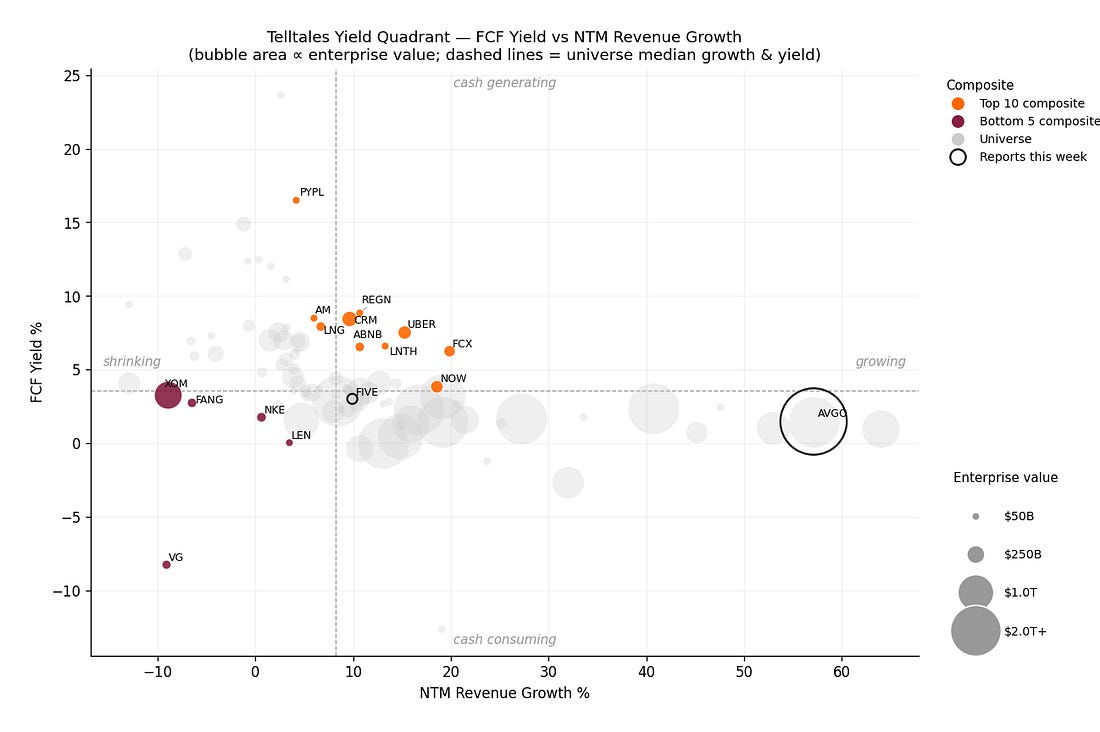
Telltales Yield — Top 10
# | Ticker | Sector | Composite | FCF Yld | NTM Growth | EV/FCF | 1-wk Px
1 | UBER | Technology | 80 | 7.5% | 15.2% | 13.2 | -2.0%
2 | FCX | Basic Materials | 78 | 6.3% | 19.8% | 16.0 | 6.0%
3 | REGN | Healthcare | 77 | 8.8% | 10.6% | 11.3 | -3.8%
4 | LNTH | Healthcare | 73 | 6.6% | 13.2% | 15.1 | -3.6%
5 | CRM | Technology | 72 | 8.5% | 9.6% | 11.8 | 6.1%
6 | NOW | Technology | 68 | 3.8% | 18.5% | 26.1 | 21.8%
7 | ABNB | Consumer Cyclical | 67 | 6.5% | 10.6% | 15.3 | 0.7%
8 | PYPL | Financial Services | 67 | 16.5% | 4.1% | 6.1 | 1.2%
9 | AM | Energy | 67 | 8.5% | 6.0% | 11.8 | -5.5%
10 | LNG | Energy | 66 | 7.9% | 6.7% | 12.6 | -6.6%
From the Cashflow Desk — Marcus Graham
Micron’s trillion-dollar tag and Broadcom’s get talked about as the same AI trade. They are not. Micron sits at 102x trailing FCF — a multiple that only pays off if the memory cycle is dead, in a business that lost $5.8B two fiscal years ago when the last glut hit. Broadcom goes into Wednesday’s print near 68x and needs nothing about memory pricing to cooperate; it gets paid on the custom-silicon standard whether the buyer is Google, Meta, or Anthropic. One name is a bet on a shortage. The other is a bet on a standard, and the standard is the cheaper multiple. The test is Wednesday, June 3: if Broadcom’s AI guide holds, the cycle-proof story suddenly has a cheaper rival. We re-anchor Micron when the next HBM contract-pricing print lands.
Telltales Yield — Bottom 10
# | Ticker | Sector | Composite | FCF Yld | NTM Growth | EV/FCF | 1-wk Px
1 | VG | Energy | 2 | -8.2% | -9.2% | — | -12.9%
2 | LEN | Consumer Cyclical | 18 | 0.1% | 3.4% | 1589.4 | 1.0%
3 | NKE | Consumer Cyclical | 19 | 1.8% | 0.6% | 56.0 | 3.5%
4 | FANG | Energy | 20 | 2.8% | -6.6% | 36.4 | -4.6%
5 | XOM | Energy | 22 | 3.3% | -9.0% | 30.6 | -6.2%
6 | SBUX | Consumer Cyclical | 25 | 2.4% | 2.3% | 40.8 | -3.8%
7 | CVX | Energy | 29 | 4.1% | -13.0% | 24.5 | -4.7%
8 | WMT | Consumer Defensive | 29 | 1.6% | 4.7% | 64.0 | -3.8%
9 | INTC | Technology | 35 | -0.4% | 10.7% | — | -4.3%
10 | COST | Consumer Defensive | 36 | 2.2% | 7.9% | 45.8 | -7.0%
This Week’s Reporters
Ticker | Sector | Reports | FCF Yld | NTM Growth | Composite
AVGO | Technology | 2026-06-03 | 1.5% | 57.1% | 58
FIVE | Consumer Defensive | 2026-06-03 | 3.0% | 9.9% | 48
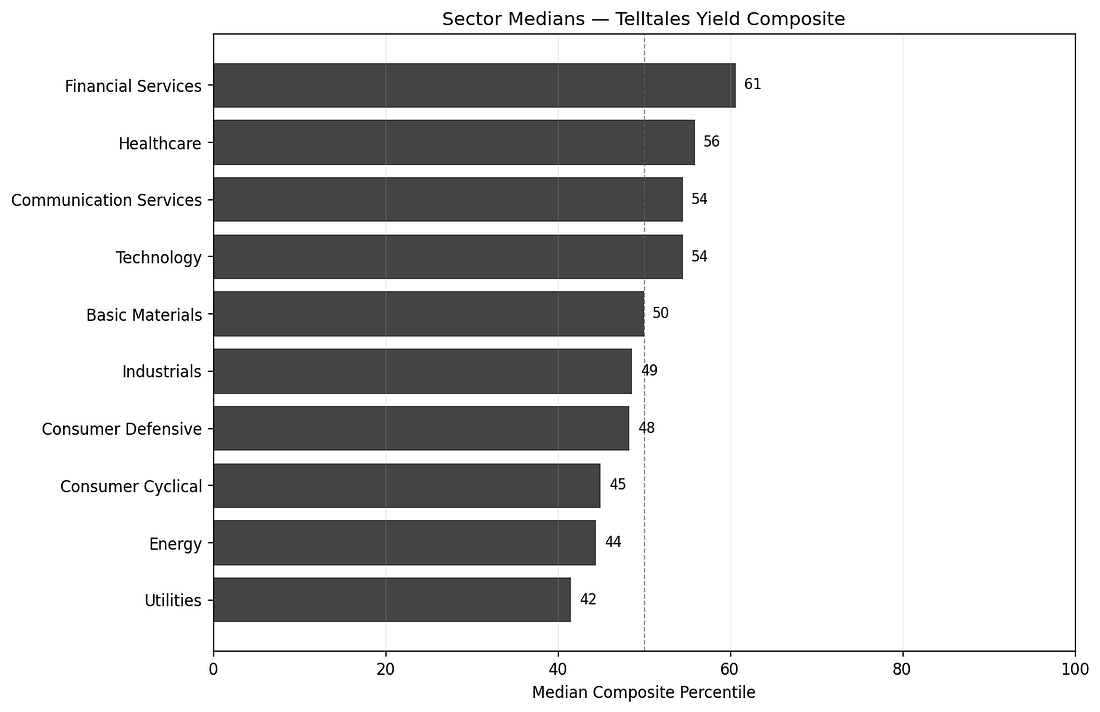
Sector Medians
Sector | N | Median Composite | Median FCF Yld | Median NTM Growth
Financial Services | 4 | 61 | 3.8% | 11.6%
Healthcare | 10 | 56 | 6.4% | 10.0%
Technology | 15 | 54 | 1.6% | 25.1%
Communication Services | 11 | 54 | 4.1% | 4.5%
Basic Materials | 3 | 50 | 6.3% | 6.5%
Industrials | 8 | 49 | 3.3% | 9.0%
Consumer Defensive | 5 | 48 | 3.0% | 7.9%
Consumer Cyclical | 12 | 45 | 3.3% | 4.8%
Energy | 21 | 44 | 5.9% | 0.7%
Utilities | 1 | 42 | 2.4% | 9.5%
Debt / FCF Watch (highest leverage on TTM FCF)
Ticker | Sector | Net Debt / FCF | FCF Yld | Composite
TRGP | Energy | 20.8 | 1.2% | 44
NEE | Utilities | 16.2 | 2.4% | 42
MTDR | Energy | 12.8 | 2.7% | 51
CHTR | Communication Services | 10.6 | 8.0% | 50
ET | Energy | 10.0 | 5.4% | 44
DE | Industrials | 9.4 | 4.4% | 56
EPD | Energy | 9.4 | 3.3% | 43
FDX | Industrials | 8.8 | 3.6% | 46
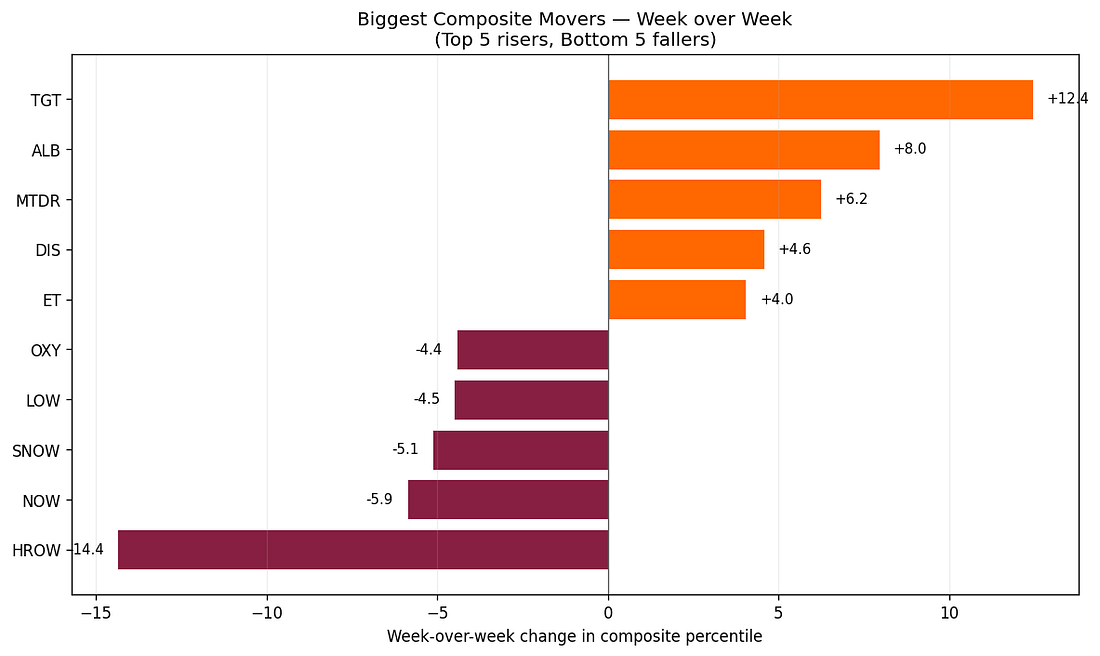
Weekly Price Movement
Top 5 (week-over-week price) | Ticker | Sector | Price | 1-wk % | |——–|——–|——:|——-:| | SNOW | Technology | $255.55 | 48.4% | | MU | Technology | $971.00 | 29.3% | | NOW | Technology | $124.37 | 21.8% | | ORCL | Technology | $225.78 | 17.5% | | PLTR | Technology | $156.54 | 14.4% |
Bottom 5 (week-over-week price) | Ticker | Sector | Price | 1-wk % | |——–|——–|——:|——-:| | VG | Energy | $12.04 | -12.9% | | OKE | Energy | $83.94 | -10.7% | | KMI | Energy | $31.08 | -8.0% | | TRGP | Energy | $255.07 | -7.8% | | CF | Basic Materials | $112.35 | -7.7% |
Financials (shown separately — FCF metric not meaningful)
Ticker | Price | 52-wk Position | Div Yld
JPM | $299.31 | 51% | 2.1%
MS | $208.00 | 100% | 2.0%
GS | $1025.56 | 100% | 1.9%
IBKR | $86.97 | 96% | 0.1%
Data Gaps
90 of 90 non-Financial names ranked. 0 dropped for missing FCF yield or NTM revenue growth.
Source: cashflow-memo master_2026-05-30.csv. NTM growth from FMP analyst-estimates consensus. Composite is a percentile rank, not a recommendation.
▶ Explore the interactive Tape →
The Cashflow Memo

Five Prices, One Question
The week the market argued what AI revenue is worth, and gave five different answers.
The Telltales Weekend Update. Ava Cabot and analyst Marcus Graham walk through what happened this week — and what’s coming next — across the companies in the Cash Flow Memo. About 14 minutes. No filler.
Download the memo at telltales.us. Hunt, Jason, and Mike are back Wednesday on episode 2623.
Chapter markers
Time | Segment
0:00 | Disclaimer
0:15 | Cold open
0:45 | Theme — What is AI worth? (Snowflake, Salesforce, Palantir)
4:45 | Deep dive — Micron & Broadcom
8:45 | Rapid-fire — Lilly, Kratos, and the forward week
11:45 | Close & Consensus Watch
12:45 | Disclaimer
Full transcript
Disclaimer
Ava: The following conversation is intended for informational purposes only. You should always do your own work to determine if an investment is suitable for you.
Cold open
Ava: You’re listening to the Telltales Weekend Update. I’m Ava Cabot.
Marcus: And I’m Marcus Graham — the cashflow desk.
Ava: Quick note: the show is produced entirely with AI tools, and both voices you’re hearing are AI-generated. Send feedback through the Substack. On Wednesday’s main show, Hunt, Jason, and Mike spent an hour on one question — how do you get to a $2 trillion valuation on a company with almost no free cash flow? That was the SpaceX S-1.[^ep-e2622] This week the market asked the opposite question, and asked it five times. Not how you justify a valuation with no cash — but what the AI cash flow that actually exists is worth. And across five names, it came back with five completely different answers. That’s the show.
Theme — What is AI worth?
Ava: On page 2 of the memo this week, the whole enterprise-software book tells one story — and then contradicts itself. This is the cleanest version of the only fight that mattered all week: AI revenue is real, it’s growing, and the market cannot agree what it’s worth. Watch it price three layers of the same stack three completely different ways.
Ava: Start with the data layer. Snowflake had the best trading day in its history this week — up 36% in a single session[^news-snow-surge] — on a Q1 beat[^news-snow-q1] and a $6 billion, five-year commitment from AWS.[^news-snow-aws] Now the application layer. Salesforce beat the same week, and told you Agentforce is already a $1.2 billion business growing more than 200%[^news-crm-arr] — and the stock is down 33% on the year.[^news-crm-stock] Same enterprise-AI dollar. One name up a third in a session, the other down a third on the year. Marcus — one of those prices is wrong.
Marcus: The market is buying the picks-and-shovels and pricing the application like it’s already roadkill. Going into this print the memo had Salesforce at 12 times trailing free cash flow on an 8% free-cash yield, Q4 10-K confirmed[^memo-crm-evfcf][^memo-crm-yield] — we re-anchor when the Q1 10-Q files. 12 times, on a company that’s still growing and already running a real AI-agent business. That’s the price of a melting ice cube. Snowflake went into its own print at 45 times[^memo-snow-evfcf], and the market just paid up for more. The whole spread is one bet — agents eat the workflow vendor and feed the data platform — and you’re paying the fattest multiple for the side that might lose.
Ava: A melting ice cube growing 200%. Sure. And here’s the tell the stock price is ignoring — per Talnexis hiring data, Salesforce’s AI and machine-learning job postings jumped more than five-fold in a single week.[^tlnx-crm-aiml] Companies that believe they’re being disrupted don’t staff the disruption. And then there’s the third layer — over on page 5, with the chips and the defense names.
Ava: Palantir is being priced as something you simply can’t avoid buying. The stock jumped 9% this week[^news-pltr-surge] — not on earnings, on procurement. The Pentagon made its Maven system a formal program of record[^news-pltr-maven], and the Army folded 75 separate contracts into a single $10 billion enterprise agreement.[^news-pltr-army] When the buyer standardizes on you, you stop being a vendor. You become infrastructure. Marcus — what does infrastructure cost?
Marcus: It’s the most expensive name in the entire memo, and it’s expensive on purpose. 130 times trailing free cash flow[^memo-pltr-evfcf] — but a program of record isn’t a contract, it’s a multi-year funding line, and free cash flow already grew almost 200% over the last year.[^memo-pltr-fcf] That multiple isn’t pricing today’s cash. It’s pricing a decade of government AI spend compounding. The test is whether commercial growth holds up next to the government book. If it stalls, 130 times is a long way down.
Ava: So: rewarded, buried, and untouchable. Three layers, three verdicts, one week.
Deep dive — Micron & Broadcom
Ava: Here’s the same fight, one layer down, in its purest form. Micron and Broadcom are the two ways to own the silicon underneath the entire AI build — the memory, and the custom chips. Same supercycle. The market just priced them like they live in different decades.
Ava: Micron crossed $1 trillion in market value this week for the first time ever[^news-mu-trillion] — up 19% the day it happened, 88% in a month[^news-mu-momentum] — because its entire 2026 high-bandwidth-memory output is already sold out[^news-mu-hbm], and management says it can fill maybe half to two-thirds of what its biggest customers are asking for.[^news-mu-demand] Broadcom reports Wednesday[^earn-avgo], guiding AI-chip revenue up 140% year-over-year — to almost $11 billion in a single quarter.[^news-avgo-ai] Two anchors of the same build. Marcus — which one is mispriced?
Marcus: The surprising one is Micron, because a memory company is not supposed to trade like this. Memory is the most violently cyclical business in technology — boom, glut, collapse, repeat. And the memo has it at 102 times trailing free cash flow[^memo-mu-evfcf] at a yield under 1%.[^memo-mu-yield] On paper, that’s absurd. Except free cash flow grew more than fivefold off the last trough[^memo-mu-fcf], and the bull thesis is that this time the cycle doesn’t come back — that AI memory demand outruns supply for years, not quarters. 102 times is the market betting the cycle is dead. If memory is still cyclical, this is the top.
Marcus: Broadcom is the opposite trade — same supercycle, half the multiple. Going into Wednesday the memo has it at 68 times trailing free cash flow[^memo-avgo-evfcf], on $32 billion of cash it’s already banked[^memo-avgo-fcf] — not a memory company’s hope, actual trailing cash. And Broadcom doesn’t need the cycle to break. It designs the custom chips and the networking that wire a million accelerators into one machine[^news-avgo-network], and it gets paid whether the buyer is Google, Meta, or Anthropic.[^news-avgo-anthropic] Micron is a bet on a shortage. Broadcom is a bet on a standard.
Marcus: So here’s what the comparison actually says. One supercycle, and the market trusts one of these names with twice the multiple of the other. Wednesday’s print is the first real referee — if Broadcom’s AI guide holds, the safer way to own this build is the custom-silicon standard, and Micron’s trillion-dollar tag is the one carrying all the cycle risk.
Ava: Two ways to own the same boom, priced like a coin flip. Wednesday we find out which side the house is on.
Rapid-fire — Lilly, Kratos, and the forward week
Ava: Away from the AI-pricing fight, two catalysts moved real money this week — and a few names report before you’re back here next Saturday.
Ava: Eli Lilly had the kind of week that resets a franchise — twice. Phase 3 data on retatrutide, its triple-hormone obesity drug, came in at 28% average weight loss over 80 weeks[^news-lly-reta] — that’s bariatric-surgery territory, from an injection. And separately, the one-time gene-editing therapy it picked up in the Verve deal cut bad cholesterol by up to 62% with a single infusion.[^news-lly-verve] Two franchises, two different decades of revenue, one week. Lilly presents the full data at the diabetes meeting in New Orleans, June 5-8[^news-lly-ada] — and that’s a clean segue, because Wednesday’s main show is the healthcare deep dive Hunt, Jason, and Mike have been promising.
Ava: Kratos jumped almost 14% in a day[^news-ktos-surge] on a report the Trump administration may take direct financial stakes in U.S. drone manufacturers — the government as an equity investor in its own supply chain. Same week, Kratos and GE Aerospace won a joint Air Force contract to develop the engine for collaborative combat aircraft.[^news-ktos-ge] It’s the Palantir thread again: the Pentagon isn’t just buying defense technology, it’s trying to own the means of producing it.
Ava: A few more before Monday. Meta started charging for the thing it always gave away — paid Instagram, Facebook, and WhatsApp tiers went live this week at $3-4 a month.[^news-meta-subs] The company that built an empire on free is now testing whether its users will pay for it. In energy, Hunt made the oil call on Wednesday, so I’ll leave the Strait of Hormuz to him — the company news this week was a handoff at the top of Occidental, where Vicki Hollub steps down and Richard Jackson takes over June 1.[^news-oxy-ceo] And the forward calendar: Broadcom and Five Below both report Wednesday[^earn-five] — Five Below the cleaner tariff read, sourcing well over half its goods from China[^news-five-china] — with Oracle the Wednesday after.[^earn-orcl]
Close & Consensus Watch
Ava: That’s the Weekend Update. Five names, five different prices on the same idea — that AI revenue is real, and growing. Snowflake priced for acceleration. Salesforce priced for death. Palantir priced as a utility. Micron priced like the cycle is finally over. Broadcom priced like the only grown-up in the room. They cannot all be right. Wall Street’s consensus on enterprise AI this week: Snowflake’s the winner, Salesforce is roadkill. Same quarter, both beat — and one of those calls is wrong. Broadcom’s print Wednesday is the first real referee. Hiring data this week from Talnexis — talnexis.com. All of it runs off the Cash Flow Memo, the universe we track every week. Grab it at telltales.us. Hunt, Jason, and Mike are back Wednesday on episode 2623 — the healthcare deep dive they’ve been teasing for two weeks. We’ll see you Saturday.
Disclaimer
Ava: The views expressed on this podcast are the host alone and do not constitute an offer to sell or a recommendation to purchase, or a solicitation of an offer to buy any security, nor a recommendation for any investment product or service. While certain information contained herein has been obtained from sources believed to be reliable, neither the host nor any of their employers or their affiliates have independently verified this information, and its accuracy and completeness cannot be guaranteed. Accordingly, no representation or warranty, express or implied, is made as to, and no reliance should be placed on, the fairness, accuracy, timeliness, or completeness of this information. The host and all employers and their affiliated persons assume no liability for this information and no obligation to update the information or analysis contained herein in the future, and may or may not hold positions in the securities mentioned.
Sources
A single dose of Lilly’s PCSK9 base editor VERVE-102 reduced PCSK9 by up to 88% and LDL-C by up to 62% with durable effects. (2026, May 27). PR Newswire. https://www.prnewswire.com/news-releases/a-single-dose-of-lillys-pcsk9-base-editor-verve-102-reduced-pcsk9-by-up-to-88-and-ldl-c-by-up-to-62-with-durable-effects-supporting-its-potential-as-a-one-time-treatment-for-hypercholesterolemia-302780172.html (Peer-reviewed: New England Journal of Medicine, https://www.nejm.org/doi/full/10.1056/NEJMoa2601283)
Broadcom (AVGO) set for strong Q2 earnings driven by AI growth. (2026, May 29). GuruFocus. https://www.gurufocus.com/news/8891842/broadcom-avgo-set-for-strong-q2-earnings-driven-by-ai-growth
CRM drops 33% in 2026 despite earnings beat as AI fears overshadow $1.2B Agentforce growth. (2026, May 28). FX Leaders. https://www.fxleaders.com/news/2026/05/28/crm-drops-33-in-2026-despite-earnings-beat-as-ai-fears-overshadow-1-2b-agentforce-growth/
The custom AI ASIC state of play (May 2026): Broadcom deals, Google TPUs, Meta MTIA & beyond. (2026, May). Tom’s Hardware. https://www.tomshardware.com/tech-industry/semiconductors/custom-ai-asics-examined-from-broadcom-to-mtia
Debt financing deal for Anthropic PBC involves Broadcom and Alphabet. (2026, May 28). GuruFocus. https://www.gurufocus.com/news/8890022/debt-financing-deal-for-anthropic-pbc-involves-broadcom-and-alphabet
Does Five Below’s tariff response strategy strengthen its value brand or signal margin strain? (2025, December 25). Sahm Capital. https://www.sahmcapital.com/news/content/does-five-below-fives-tariff-response-strategy-strengthen-its-value-brand-or-signal-margin-strain-2025-12-25
Eli Lilly (LLY) showcases new findings at ADA’s 86th Scientific Sessions. (2026, May 28). GuruFocus. https://www.gurufocus.com/news/8889220/eli-lilly-lly-showcases-new-findings-at-adas-86th-scientific-sessions
Kratos contract wins deepen role in hypersonics propulsion and space systems. (2026, May 29). Yahoo Finance. https://finance.yahoo.com/news/kratos-contract-wins-deepen-role-120929437.html
Lilly’s triple agonist, retatrutide, delivered powerful weight loss in pivotal Phase 3 obesity trial. (2026, May 21). PR Newswire. https://www.prnewswire.com/news-releases/lillys-triple-agonist-retatrutide-delivered-powerful-weight-loss-in-pivotal-phase-3-obesity-trial-302778859.html
Meta officially launches Instagram, Facebook, and WhatsApp subscriptions, with more to come — including AI plans. (2026, May 27). TechCrunch. https://techcrunch.com/2026/05/27/meta-officially-launches-instagram-facebook-and-whatsapp-subscriptions-with-more-to-come-including-ai-plans/
Micron hits $1 trillion market cap for the first time as stock surges 19%. (2026, May 26). CNBC. https://www.cnbc.com/2026/05/26/micron-stock-trillion-market-cap.html
Micron technology: AI-powered semiconductor demand and the capital expenditure question (management can fulfill 50% to two-thirds of customer demand). (2026, May). MarketMinute / FinancialContent. https://markets.financialcontent.com/stocks/article/marketminute-2026-3-20-micron-technology-guidance-miss-ai-powered-semiconductor-demand-and-the-capital-expenditure-crisis
Micron’s entire 2026 HBM output sold out. (2026, May). HeyGoTrade. https://www.heygotrade.com/en/blog/mu-stock-analysis/
MU stock outlook May 30 2026: Micron at $1 trillion — AI demand & next-week preview (shares +88% over the past month). (2026, May 30). FX Leaders. https://www.fxleaders.com/news/2026/05/30/mu-stock-outlook-may-30-2026-micron-at-1-trillion-ai-demand-next-week-preview/
Occidental Petroleum. (2026, May 5). Occidental announces CEO succession [Press release]. https://www.oxy.com/news/news-releases/occidental-announces-ceo-succession/
Snowflake. (2026, May 27). Snowflake expands AWS collaboration with $6B commitment to accelerate enterprise agentic AI adoption [Press release]. https://www.snowflake.com/en/news/press-releases/snowflake-expands-aws-collaboration-with-6b-commitment-to-accelerate-enterprise-agentic-ai-adoption/
Snowflake Q1 fiscal 2027 earnings beat, $6 billion AWS deal (product revenue $1.33B, up 34% YoY; EPS $0.39 vs. $0.32 consensus). (2026, May 27). Yahoo Finance. https://finance.yahoo.com/markets/stocks/articles/snowflake-q1-fiscal-2027-earnings-120043255.html
Snowflake surges 36% for best day ever on AI frenzy, fueling software rally. (2026, May 28). CNBC. https://www.cnbc.com/2026/05/28/snowflake-snow-software-stock-rally.html
Talnexis. (2026, May 24). Salesforce — AI/ML hiring category spike (28 roles in 7 days vs. 5 prior, 5.6x) [Hiring intelligence]. https://www.talnexis.com/
United States Army. (2025, July 31). U.S. Army awards enterprise service agreement to enhance military readiness and drive operational efficiency (75 contracts consolidated; $10B cap over up to 10 years) [Press release]. https://www.army.mil/article/287506/u_s_army_awards_enterprise_service_agreement_to_enhance_military_readiness-and-drive-operational-efficiency
Why Kratos Defense stock popped today (up 13.8% on May 28 following WSJ report the Trump administration may invest directly in U.S. drone manufacturers). (2026, May 28). The Motley Fool. https://www.fool.com/investing/2026/05/28/why-kratos-defense-stock-popped-today/
Why Palantir stock is soaring today (up ~9% on potential U.S. drone-manufacturer funding and software-sector momentum). (2026, May 28). The Motley Fool. https://www.fool.com/investing/2026/05/28/why-palantir-stock-is-soaring-today/
Why Palantir’s new program of record with the Pentagon could be a game changer (Maven Smart System designated a formal program of record, March 2026). (2026, March 31). The Motley Fool. https://www.fool.com/investing/2026/03/31/why-palantir-s-new-program-of-record-with-the-penta/
Internal data
Internal data is provided on a best efforts basis.
Forward earnings (FMP)
AVGO — Broadcom, 2026-06-03 (Wednesday). Consensus EPS $2.40, revenue ~$22.12B. FMP
/stable/earnings?symbol=AVGO, pulled 2026-05-30.FIVE — Five Below, 2026-06-03 (Wednesday). Consensus EPS $1.76, revenue ~$1.23B. FMP
/stable/earnings?symbol=FIVE, pulled 2026-05-30.ORCL — Oracle, 2026-06-10 (Wednesday). Consensus EPS $1.96, revenue ~$19.10B. FMP
/stable/earnings?symbol=ORCL, pulled 2026-05-30.


